Aligning Outcomes, Activities & Assessments

PDF of Video Slide Deck
Finks Resources

The first half of the video points primarily to the traditional cognitive alignment that we should strive for in our instructional design and curriculum development. If you are engaged in competency-based education that is part of a skills-based program, introductory to intermediate courses, instruction that is designed to prepare students for a credentialing exam, or other forms of standardized testing and evaluation then the cognitive alignment which we outline is the minimum alignment you should apply.

Alignment

If you are working at a higher level or are able to incorporate authentic learning opportunities through project-based learning and are using an outcome-based design then you will have the opportunity to expand your scope of alignment and incorporate more aspects of the affective and the psychomotor domains and better address the whole learner. If you are not familiar with the difference between competency-based education vs outcome-based education or need confirmation of how I am using these two concepts please refer to the post Why I Don’t Use Checklists, Progress Bars & Other Activity Monitors to explore these ideas further.

To explore alignment at a higher or more wholistic level you need to first change your focus:

When you create a significant learning environment (CSLE) in which you give your learners choice, ownership, and voice through authentic learning opportunities (COVA). The CSLE+COVA framework shifts the focus from the curriculum, skills, and abilities to the authentic learning opportunity which ideally should be a real-world project that will have a significant impact on the learner and their learning community. The skills and abilities may still need to be developed or supported but the learner takes on the responsibility to become more of a self-directed learner who acquires or learns those skills and abilities in a just-in-time fashion as they work toward solving the challenge of the authentic learning opportunity. The instructor takes on more of the role of coach, guide, and facilitator and helps shift the learner from assessment of and for learning to assessment as learning

Alignment is one piece of the learning environment and we must warn against the notion of looking for a quick fix or simple application of a tool to help you find this alignment. This is part of a well-thought-out and planned instructional design or curriculum development process.

Additional resources to consider:

Collecting dots vs connecting dots
Assessment OF/FOR/AS Learning
Feedforward Vs. Feedback
We Need More Autodidacts
How to Change the World One Learner at a Time
3210 Curriculum Resources
COVA eBook
Dwayne’s Recommended Reading

Dwayne’s DIY Video Setup – Part 6: To Script or Not To Script…

To Script or Not To Script…
The more instructional videos that I make the more I have learned to rely on scripts to ensure that I am conveying an effective message. I now use a script for the following:

  • 2-3 minute or less introduction, promotion, bridge video,
  • 4-10 minute overview, contextual, foundational, tips, video
  • 10-18 minute informational, TED Talk style of video

To estimate the time of my script I will often refer to the Voice Over Script Word Counter at thevoicerealm.com

Even in my long-form discussions I still work on an outline with my collaborator so there is some form of guide or script. When I create a Tips or Tutorial video and I use a tool like screencast-o-matic to insert my talking head into the video on the bottom corner of the screen, I will use the slide deck, website, article, document, or other resources I am explaining as the script. I also plan out what the key points will and what parts of the resources I will highlight.

The only time I don’t script is when I create the 2-8 minute feedforward videos I create for my students when I am giving them educative or formative assessment. But even in this context, I have a format that I follow so while I am conversational in my feedforward I still have a specific structure or a very loose script.

While I have spent most of my emphasis on why I script I cannot ignore why scripting, narrating, or as I like to say telling a good story can be powerful and transformational. I have been exploring these ideas for several years and the following posts have the potential to take you down quite the rabbit trail. Don’t worry it is a worthwhile journey:

Teleprompter
Since I use a script for most videos I also use a teleprompter. Finding the right teleprompter has been a bit of a journey. When first started to formalize my video creation process I used my whole living room as my studio and I used a DIY teleprompter and either a full-sized Android tablet to project my scripts.

This worked great but, the space needed, the setup (20-30) and take downtime (15-20) and the need for an assistant to run the camera and teleprompter limited my options. As the need to create more videos increased I shifted to more of a permanent setup in my small office space.

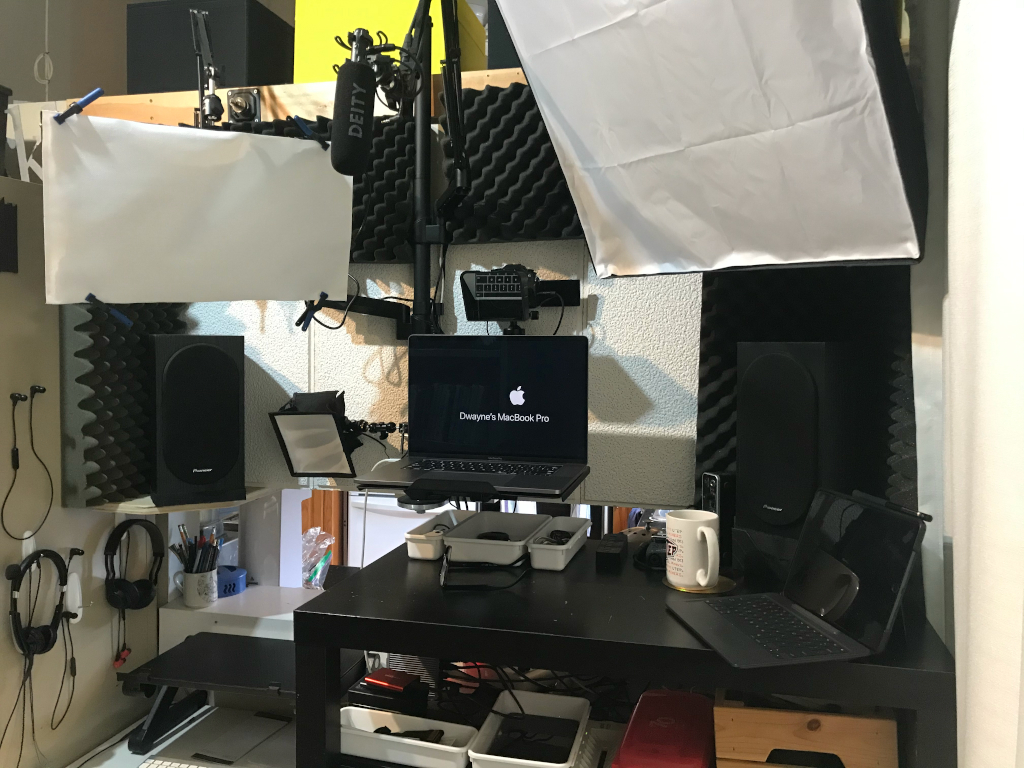
LR Studio Setup

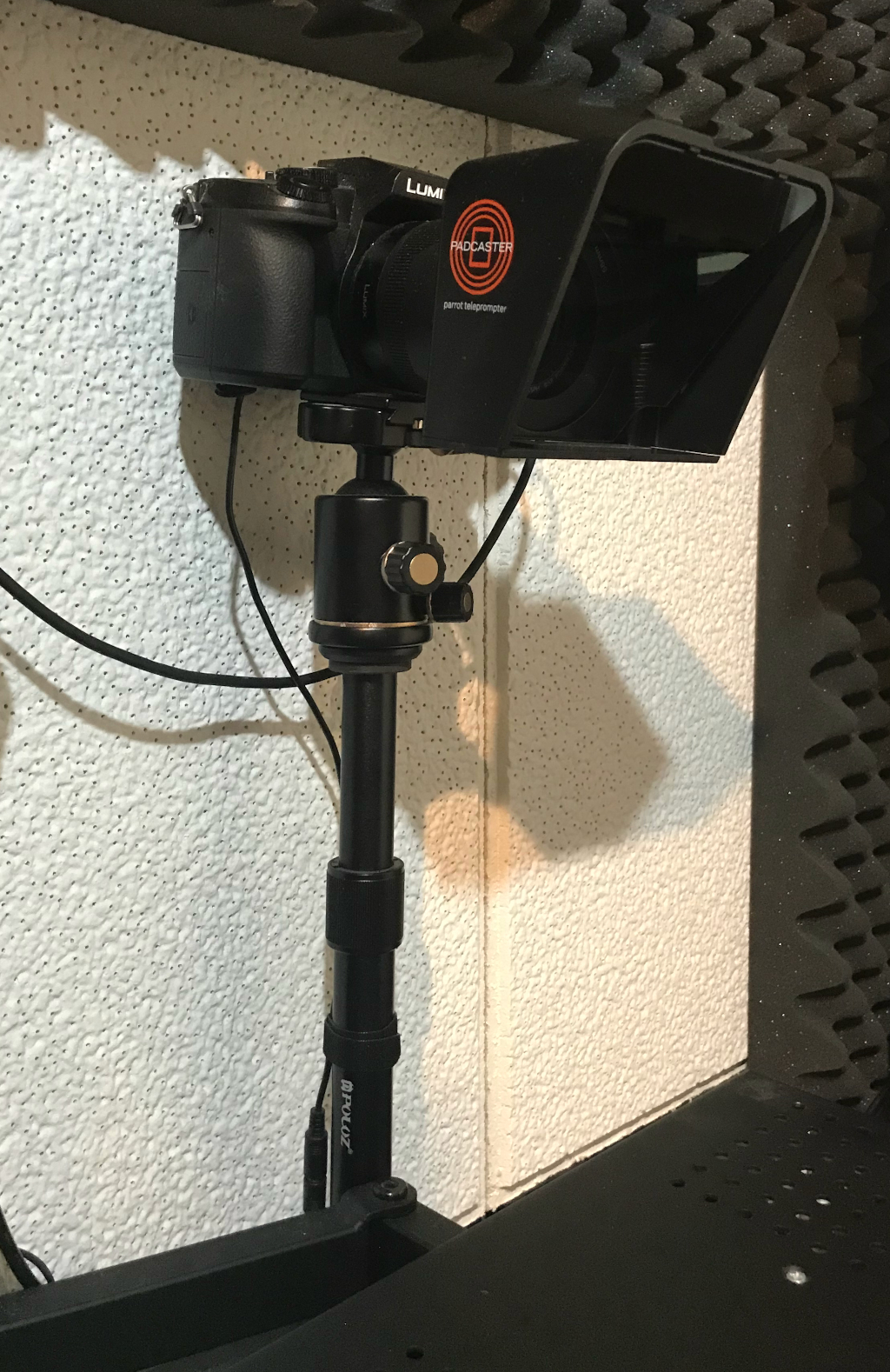
I experimented with a web-based teleprompter CuePrompter. Even after positioning the script directly below my camera I still found that it looked like I was reading because my eyes were not directly focused on the lens of the camera. After researching several lens mounted options I have been using the Parrot Teleprompter from Padcaster.

Parrot Teleprompter

At $100 US or $175 CDN it is a reasonably priced solution that is very simple to set up. You just screw on a mounting bracket to your lens and the teleprompter slides into place. You slide the iPhone into the bottom shelf and you are ready to go in less than a minute.

The plastic teleprompter that mounts on your DSLR lens is great but when you combine it with a voice-activated app that will track your voice and scroll your text as you talk you are at a whole other level of productivity. the SmartPrompt Pro app that I am currently using enables me to stop and start and control the teleprompter as I go through my narration

Because my camera is so close I can reach out and simply scroll the teleprompter script back to the section I want to re-shoot and restart the teleprompter. This lens-mounted teleprompter is one of the last pieces to my video production setup that I wish I would have explored sooner. This is one of many pieces to the video production puzzle that I have been working on over the past few years. While have finally gotten to the point where I can be up and running in just a few minutes there are still many areas of improvement that I am continuing to explore.

Please refer to my DIY Video setup posts for more details on the audio and lighting considerations.

Also, remember that my office setup is very compressed so the limited space that I have to work in is a very important consideration. If you have more space you will have many more options. If you are like many people dealing with the COVID pandemic of 2020/2021 you may be working from home so your space or lack of space will also be a consideration.

Regardless of your situation, I trust these ideas that I have shared will help you become more efficient and effective at creating videos for your instructional setting.

Recommendations:
Voice Over Script Word Counter at thevoicerealm.com
Parrot Teleprompter from Padcaster
SmartPrompt Pro

Dwayne’s DIY Video Setup series:
Dwayne’s DIY Video Setup – Part 5 Audio & Lighting Update
Dwayne’s DIY Video Setup – Part 4 Audio
Dwayne’s DIY Video Setup – Part 3 LED Lighting Update
Dwayne’s DIY Video Setup – Part 2 Lighting & Background
Dwayne’s DIY Video Setup – Part 1 Teleprompter & Tripod
Dwayne’s DIY Video Creation Toolbox
My Video & Media Tools

Progress Depends on Unreasonable People

The reasonable [person] adapts [themself] to the world; the unreasonable one persists in trying to adapt the world to [themself]. Therefore, all progress depends on the unreasonable [person].

This updated quote is based on Geoge Bernard Shaw’s (1903) Maxims for Revolutionists which was an appendix to his play Man and Superman: A Comedy and a Philosophy. The following is the original quote.

The reasonable man adapts himself to the world; the unreasonable one persists in trying to adapt the world to himself. Therefore, all progress depends on the unreasonable man (Shaw, 1903).

I am currently working with a new group of graduate students who are building their literature reviews to support their innovation plans and as result, like my students, I have to walk the talk and go back to the primary source whenever possible. It has been many years since I last read through Shaw’s Maxims for Revolutionists so when I reviewed the above quote on Reason also I reviewed the entire work. I have always been was struck by the satirical or contrarian bent of most of Shaw’s writing and his maxims are some of the best examples of his desire for progress or change.

Shaw is the unreasonable man that he writes about and he was striving to adapt the world to himself. While some may not agree with the man or his philosophy there is no denying some of his ideas are impactful and as challenging today as they were over 100 years ago.

This is not the first time I have considered Shaw’s maxim – The Power of Being An Unreasonable Learner

Reference
Shaw, G. B. (2002). Maxims for revolutionists: Reason (1903). Man and Superman: A Comedy and a Philosophy. Indy publishing Co., New York

Revealing the Hidden Competing Commitment that Resists Change

We need to consider that most people are not intentionally or logically resisting change, they simply have been conditioned by our educational system to accepting the way their world is and unconsciously have a hidden competing commitment that prevents them from even seeing the opportunities that are being presented. The following is an excerpt from the soon to be published book on the Learner’s Mindset (Harapnuik & Thibodeaux, 2021)  that explains why people will have a hidden commitment that hinders their growth and progress:

…Garnder Campbell also laments that when he points to an opportunity that new media, technology, or other emerging resources offer, too many educators fail to see the potential in these opportunities, and he shares the following exchange to highlight the missed opportunities:

Gardner: I say well I have a bag of gold. Would you like a bag of gold?
People: Where do you find time for bags of gold…oh no another currency to master gold… is that sustainable?
Garnder: Like no you spend it.
People: Well, what would you spend it on?
Gardner: What would you like to spend it on?
People: I don’t have time for your philosophical questions Gardner.
Gardner: It’s a bag of gold what part of that do you not understand?

This resistance to change or more specifically resistance to recognizing an opportunity should not be attributed to these educators’ lack of commitment to change or doing what is best for their students. Harvard researchers Kegan and Lahey (2001) suggest that most people are not opposed to change they are just unwittingly holding a hidden competing commitment that prevents them from seeing the need for change. These commitments are often grounded in beliefs or mindsets that have been held very closely and many will be routed in their childhood experience.

Since most people in the west have spent 13 years in K-12 education and assuming 7 hours a day for 180 days a year we have spent 16,380 hours in a school-based on the information transfer model, we should not be surprised by our deep routed fixed mindset thinking and our aversion to seeing the world from any other perspective. When you factor in another 4 years for an undergraduate degree, most teachers have spent 21,420 hours in a passive educational environment of information transfer, main lecture points, rubrics, individual competition, and standardized testing. Considering the thousands of hours most teachers have spent in this environment, we should not be surprised by their deeply rooted hidden commitment to maintaining this status quo. Shifting from the fixed mindset to the growth mindset, to the innovator’s mindset, or ultimately a learner’s mindset may seem straightforward but as Kegan and Lahey (2001) have found this type of change challenges the very psychological foundations upon which people function.

Kegan and Lahey (2001) suggest that you deal with or mitigate the limits of the hidden commitment to the status quo in the following steps:

  • Diagnose the competing commitment
  • Identify the big assumption
  • Testing and replacing the big assumption

It is possible to diagnose the competing commitment and identify the dominant assumption simultaneously by getting teachers to step back far enough to see how an authentic learning opportunity can create the context for the standards, curriculum, and assessment they are required to use. This change in focus is the first step, but it will be difficult because it is asking people to look at things from a different perspective while their hidden commitment to maintaining the system of education that they know is preventing them from seeing the opportunity. Replacing the big assumption happens when you equip teachers to create a significant environment where they can give their learners choice, ownership, and voice through authentic learning opportunities. This will start them down the path of embracing or adopting a learner’s mindset.

Moving to or adopting a learner’s mindset requires that one change their thinking about learning, their approach to helping learners learn how to learn, and changing the learning environment. One of the most significant challenges to adopting and living the learner’s mindset is that these three changes in our behavior need to happen cumulatively and in close proximity.

This change in mindset is not easy and there are several systemic, psychological, and practical challenges that must be overcome. Consider the following resources as you explore how to reinvigorate your learner’s mindset:

References

Campbell, G. (2010, May 3). No digital facelifts: Thinking the unthinkable about open educational experiences. [Video] Retrieved from https://youtu.be/lelmXaSibrc

Harapnuik, D. K., & Thibodeaux, T. N. (2021). Learner’s Mindset. Book in progress.

Kegan, R., & Lahey, L. L. (2001). The real reason people won’t change. HBR’s 10 Must Reads on Change, 77.