Links to Authentic Learning posts:
Archives For Learning
In this Learner’s Mindset Discussion. Dr. Thibodeaux and I discuss the 5 biggest ePortfolio mistakes I have made over the years. Another way to look at these mistakes is from the context of what are the 5 things I wish I did sooner? If I were to start from scratch with what I know now what would I do?
- Switched to WordPress Sooner
- Stop playing the name game (i.e. website, blog, digital portfolio, ePortfolio, etc.)
- Create a domain of my own
- Post sooner and smaller
- Digital dump drawer
Bonus Mistake – 5b. or 6. Effective navigation structure
The following is a short summary of the highlights from the discussion:
1. Switched to WordPress Sooner
I started teaching fully online in 1995 and I started my first ePortfolio or started keeping a weblog what we refer to as a Blog at the same time. Unfortunately, I don’t have a fully functional record going back to 1995 because I kept on chasing the next best platform. I had learned HTML (hypertext markup language) and quickly realized that this wasn’t an efficient way to post quickly and often so I started using an early content management system what are commonly called CMS back in the late 90s. Unfortunately, many of these systems like XOOPS, Hyperwave, and Mambo no longer exist and many of the CMSs like Joomla and Drupal that are still around today are not the best tool for an ePortfolio. I have lost over a decade of my posts because of this. I have many archived versions of my earlier sites exported to HTML but these archives are just too difficult to use. In early 2000 I also started posting for the institutions that I was working for and when I left those institutions all may work remained and in most cases is no longer available. From 2006-2009 I posted almost daily and while I do have an archive it isn’t easily accessible online. In 2009 I finally stopped shopping around and realized that WordPress was going to be around for the long haul can I committed to this platform.
2. Stop playing the name game
My ePortfolio is the same as my blog or as my website, or my net presence. Regardless of what you call it…this is my space on the internet that I fully control where I can share my voice, insights, ideas, and resources with others… or not. This issue also contributed to my search for the ideal platform. I know I wasn’t just blogging so I actually stayed away the early WP because it really just focused on 90% of what I wanted to do. It wasn’t long before WP matured to the point it did everything the early CMS did and much more. But I still waited for too many years to move to it and also to create my own domain.
3. Create a domain of my own.
I own many many domains which I have parked and don’t use and in 2009 I finally registered my own name and have been using this as my only website, ePortfolio, blog, or whatever you want to call it. I wasted so much time, money, and resources moving from platform to platform or trying to copy the work when I was working with a number of different educational institutions. If you are using your school or institution’s platform for your website, blog, ePortfolio, etc. you never really own it and it will stay with the institution when you leave. Once again I have lost so much of my work over the years because I made this mistake.
4. Post sooner and smaller.
Seth Godin posts almost daily and sometimes it is just a matter of 2-3 sentences. Some of these best or most memorable and useful posts have been 2-3 sentences. It has taken me WAY too long to realize that my posts don’t have to have every detail or that they need to be perfect. It is much better to get your ideas out and in the process, you start to make those meaningful connections as you reflect on your experiences. You can always go back and edit what you have written or add a Part B or follow-up post.
5. Digital dump drawer
If you want your ideas to be useful to others you just can dump all your digital content into your site and treat it like people treat a dump drawer–you know that drawer or shelf or cabinet that you just dump things into and that you can never find again. Rather than just dump assignments, essays, or other digital content into your digital container you need to create a context for this information and connect it to that context. This is an integral part of making that meaningful connection.
Bonus
5b. or 6. Effective navigation structure
Just because you know what rabbit trail to take to your information doesn’t mean others will. Building an effective navigation structure, using tags and categories, and having a functional search engine will help others find your information…so will sending your audience an accurate URL. Having a fully functional search engine will also help you and your users to find things that haven’t been titled or categorized well. When you have several hundred or thousand posts/pages on your site a search engine is a necessity not only for your user but for yourself.
Links to some of the people, sites, or tools I mentioned in LMD and this post
Seth Godin’s Blog
https://seths.blog
WP – CMS Market Share
https://w3techs.com/technologies/overview/content_management/all
WordPress history
https://codex.wordpress.org/History
Mambo history
https://en.wikipedia.org/wiki/Mambo_(software)
Joomla History
https://cms2cms.com/blog/hyper-speed-joomla-history/
Evolution of the CMS
https://cms2cms.com/blog/evolution-cms-platform-caveman-homo-sapiens/
Drupal History
https://www.drupal.org/about/history
History of blogging
https://blog.hubspot.com/marketing/history-of-blogging
History of EduBlog
http://historyofeducationsociety.blogspot.com/
https://en.wikipedia.org/wiki/Edublog
Updated February 2026

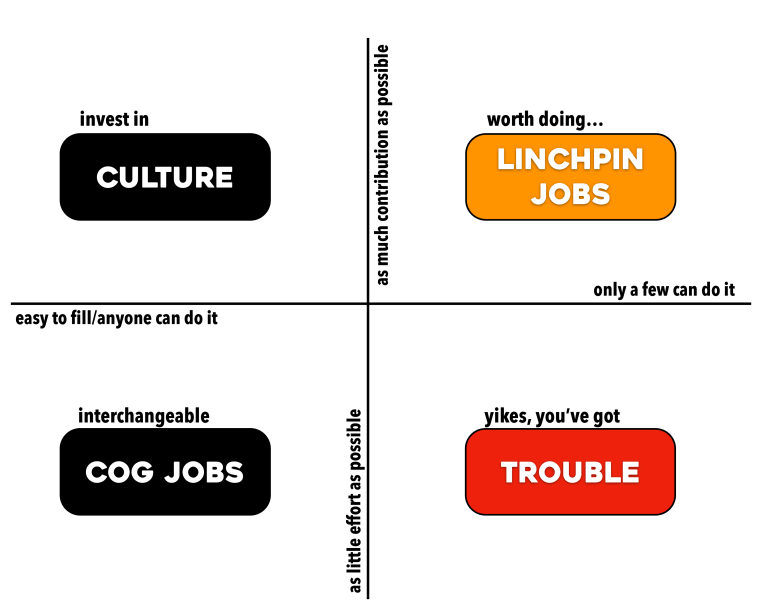
Source: https://seths.blog/2018/12/where-are-the-linchpin-jobs/
Seth Godin (2018) is pointing to the bad deal that industry has offered the worker:
Here’s a job. We’ll pay you as little as we can get away with while still being able to fill the job. We’ll make sure it’s easy to find people for this job, because we don’t want you to have much in the way of power or influence. We’ll use software to read the resumes, and we’ll do it in huge batches.
In return, you’ll work as little as you can get away with. That’s the only sane way to respond to the role of being a cog. If the system is going to squeeze you, no need to volunteer.
Godin warns us that the most cog-like jobs are will eventually be done by machines and that cog-like work doesn’t create nearly as much value as truly human work. He is looking to his community and to employers to take the risk and move from compliance and cog based jobs to jobs that require the employee to use their unique talents and abilities to contribute in ways that only they can.
If this is going to work I think educators also have make a shift in the way that we prepare our learners to become contributing members of society rather then just compliant cogs. We need to move away from the information transfer model of education that uses the industrial age and standards testing approach which simply asks students to regurgitate information and fall into compliance. In contrast we need to embrace the learner and create significant learning environments that give the learner choice, ownership and voice through authentic leaning opportunities if we really want to empower our learners to do the work that only a few humans can really do and to contribute to a better humanity and society.
Are we preparing our students to be compliant cogs or creative contributors?
References:
Godin, S. (2018, December 6). Where are the Linchpin jobs? [Blog] Retrieved from: https://seths.blog/2018/12/where-are-the-linchpin-jobs/

Source: https://www.edsurge.com/news/2018-12-03-8-great-ways-to-enhance-retention-infographic
There was a time that I would simply repost this infographic, point to the source, and quiet those voices in my head screaming “this is not about learning this is just about information retrieval and retention”. But this is a different time.
Ebbinghaus’ classic forgetting curve shows how quickly we forget information and unless we utilize one of the many tips or tricks to repeat our exposure to information we are hoping to retain then we will indeed forget the information. In several places in the infographic the authors incorrectly equate the notion of information transfer to learning in statements like:
First conceived in by the 19th-century psychologist Hermann Ebbeinghaus, the forgetting curve models the exponential rate at which humans forget the information we’ve learned.
Students forget the most right after they have learned something, with the rate of forgetting declining as time goes on.
In other places the authors more accurately convey that what is happening is information transfer and not learning:
How can teachers equip their students to retain more of the information they are given?
The more students are asked to recall information, the more they strengthen their memory.
What makes these types of infograhpics so frustrating and perhaps even dangerous is that they often embed elements of truth within the misinformation. The five factors that affect our ability to retain information: relevance, difficulty, context, stress, and sleep are accurate but the first three also hold the key to a more accurate way in which we actually learn. Before I go any further, I need to clarify that I am using the constructivist definition of learning which can be summarized as the learner coming to know by making meaningful connections rather than the behaviorist or information transfer definition of learning which can be summarized as the process of acquiring new knowledge, skills or behaviors. If you hold to the information transfer understanding of learning then you need to continually repeat the information input, test the retrieval, use visual or other mnemonic tricks, and use a host of other methods detailed in the infographic to improve the information retention and retrieval.
Or, you can simply use authentic learning opportunities to provide the relevance and context for the learner to take ownership of what they are learning and make those meaningful connections that will not be forgotten. When a learner is exposed to new information or values within the context of working on real-world problems they will be able to develop useful skills and modify existing understanding which ultimately leads to the making of meaningful connections. When you add the significance that comes from a solving and ultimately owning a real challenging problem, the learner will not only retain what they have learned they will have a foundation to make additional meaningful connections and apply their understanding to new situations. This is learning.
We have a choice.
Continue to give students information and then equip them to use a wide assortment of information retention methods or tricks to effectively regurgitate the information.
OR
Create a significant learning environment in which we give our learners choice, ownership, and voice through authentic learning opportunities and help them to learn how to learn.
This leads me to the final question that we need to ask. Are you preparing your learner for the test or for life?

A few weeks ago I had the opportunity to spend some time with my boys and their friends at a biking industry party at a local bike shop that sponsors my boys and other professional racers. I took advantage of this time to ask a racer who my older son raced with earlier in the year in the Enduro World Series (EWS) races in Chile, Columbia and Whistler… what was the biggest lesson he learned this year on the EWS circuit? He stated that he the noticed that fastest racers didn’t always take the fastest line down the mountain—they seemed to take the most fun line or the line that allowed them to flow down the mountain. Instead of hitting the hardest and fastest lines they seamed to be having the most fun and were simply flowing down the course. He also stated that it took him the full season to finally accept this and it wasn’t until this last race that he stopped trying to go the fastest and simply went out to have some fun and enjoy the day. When you race for 6-7 hours each day its is foolish to try and run at 100%. You not only destroy your bike you destroy your body. He argued that when he stopped looking for the fastest line and simply went out to find the most efficient or most fun way to come down the mountain he ended up being much faster at the end of the day and posted his best results. It wasn’t until he started looking at the bigger picture and started asking different questions that enabled him to look at his racing different that finally led to his best results. His major regret was that he didn’t come to this realization and start asking a different questions until his final race of the season. He also wished that he would have learned this lesson many years earlier.
Asking enough of the right questions isn’t only a challenge in professional EWS racing it is a challenge in our educational system and more specifically in our learning environments. In the words of Ken Robinson, our educational systems are all too often focused on finding the right answer, which is usually at the back of book, and that we shouldn’t look at. Robinson is using humor to lesson the devastating foolishness of our practice and to spur us onto to acknowledging that we have a serious problem. If we just go along with the status quo and accept that our systems of education are primarily focused on conditioning students to find the right answers for the exam then we are missing the fact that our students are not learning because learning is not about finding the right answers it is about asking questions. Learning is the process of making meaningful connections and we can’t make those connections without asking questions— lots of questions from different perspectives. If we only focus on finding the right answers Clayton Christensen argues we will trap ourselves into marginal thinking because someone can’t be taught until they are ready to learn. Asking questions is how we open ourselves up to learning. Christensen argues that:
Questions are places in your mind where answers fit. If you haven’t asked the question, the answer has nowhere to go. It hits your mind and bounces right off. You have to ask the question — you have to want to know — in order to open up the space for the answer to fit.
Unfortunately, as I have stated above and pointed out in the post Foster Inquisitiveness Rather than Rebuild It our educational system focuses on right answers as opposed to starting with the pursuit of questions. I am not along in my assertions. In his book, A More Beautiful Question Warren Berger points to fact that our education systems reward rote answers over challenging inquiry. Berger uses research data to that shows that our children are filled with curiosity prior to going to school and by the time they are in their teens they have little curiosity for anything to do with the curriculum. He points to the correlation between the ages that children lose their curiosity and a number of questions that they ask.
Why have we created an educational system that quenches our learners curiosity and creativity? While the answer to this question is much more nuanced than I can deal with in this post but it is fair to suggest that our current system of education addresses the question of how we prepare large numbers of students to meet the needs of the industrial age. The problem we face is that we have moved beyond the industrial age into the digital information age and we are still operating on a educational system that asks questions related to problems from an earlier era. We have to start pushing educators to start questioning conventional or industrial age thinking about teaching and learning, the educational system, their schools and classes, and their process and methods so that their minds are opened up enough to the point that they want to know how to do things differently. To explore these idea further check out the video or podcast in the post Are You Preparing Your Learners for Life or for the Test?
We need to create significant learning environments that will help to open up spaces in our educators minds for new ideas to fit. If we don’t purposely design our learning environments to address the questions and problems of the digital information age we can easily remain mired in marginal thinking and the status quo. It is very easy to maintain the focus on standardized testing, on covering the content, on checklists masquerading as rubrics, and the need to regurgitate the right answer. Maintaining the status quo is much easier then creating a significant environment where giving learners choice, ownership, and voice through authentic learning opportunities will lead to making learners struggle with the anxiousness that comes with facing the challenges of deeper learning. We have to remember that authentic learning has never fundamentally been about spouting off the right answer; it has always been about making meaningful connections and to make those meaningful connections you have to start with the questions. The type of questions that open up the spaces in our thinking and motivate us to want to know and to make those meaningful connections—only to have the whole process start over. This is learning—this is life.
Perhaps we need to start asking:
Are You Preparing Them for Real Life or Just the Test?
References
Berger, W. (2014). A more beautiful question: The power of inquiry to spark breakthrough ideas. New York, NY: Bloomsbury USA.
Fried, J. (2012, September 25). A Conversation with Innovation Guru Clayton Christensen. Retrieved September 7, 2016, from http://www.inc.com/magazine/201210/jason-fried/a-conversation-with-innovation-guru-clayton-christensen.html
Robinson, K. (2010, Oct 14). RSA ANIMATE: Changing education paradigms. Retrieved from: https://youtu.be/zDZFcDGpL4U


