Archives For Learning

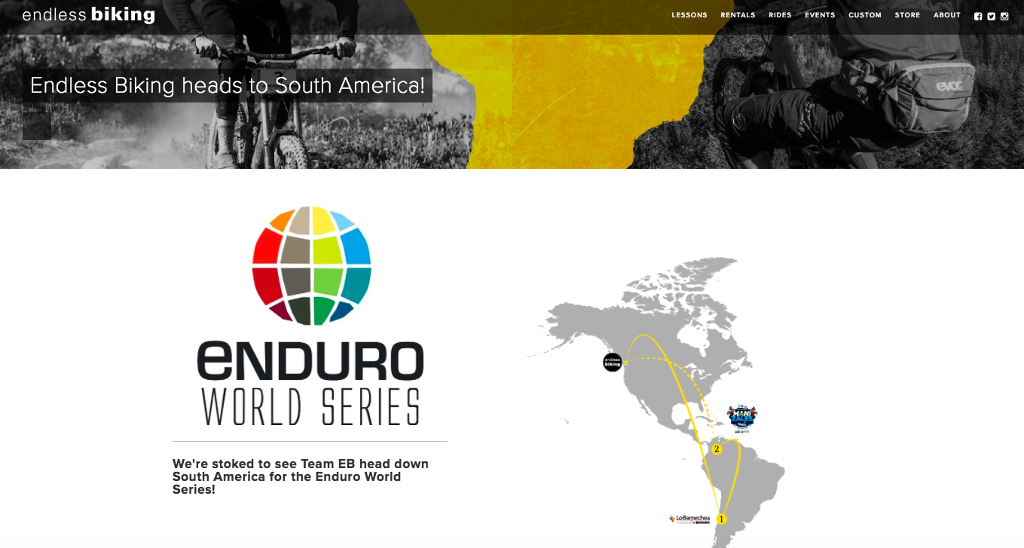
Endless Goes to South America
https://www.endlessbiking.com/eb-culture/2018/3/11/endless-biking-head-to-south-america

My son Levi is a sponsored Pro rider with Endless Biking, Rocky Mountain Bikes, Fox, Shimano and several other companies and is currently in Chile South America preparing for the first race in the Enduro World Series (EWS). Levi and his teammate Anthony will be Farellones Chile high up in the Andes in the next few days to get used to the altitude and prepare for their first EWS race of the season. They then head up to Manizales Columbia where the second EWS race will not only take them through the mountains but also through parts of the city.

The hard work and perseverance that comes from years of dedication and preparation are starting to pay off. The authentic learning experiences that Levi grew up with have prepared him to take on these intense challenges and I can only imagine what this and his future adventures will bring and what lessons will be learned.

You can follow Levi’s and Anthony’s adventures at @leapinlevi, @pocketpieman & @endlessbiking!

I often get asked what I am reading, watching or listening to. Another question I get is how do you manage to find the ideas that you do. Perhaps by addressing what I am reading, watching and listening to I may be able to answer both questions.

My interests in what I am reading, watching and listening to are continually changing so I am going to have to revisit and update this page on a regular basis.

Reading
Rather than re-create my GoodRead lists you can see what I am currently reading, what I plan to read and what I have just read on the side menu of my site. I learned to read before attending school as a child and due to discipline problems in elementary school I spent more time in the library reading and exploring the early media of the day then I did in the classroom. I kept on reading throughout my teenage years and I also read continuously from the time I dropped out of high school until I returned to school more than 10 years later. As an undergraduate, I majored in the English, Philosophy, and Theology so you will often see books on theology and philosophy appear in my GoodReads list. It was also during my undergraduate studies that I was exposed to Mortimer Adler’s How to Read a Book and his “Great Books” list and I have been slowly working my way through this list of 164 great books. You will often find a book from this Great Books list in my list of books I reading or planning to read. As more and more of these classic books find their way onto Audible or Libravox I am now able to listen to some of these books. I am in the process of building a recommended reading list but this is taking me much longer than expected because there are just so many good books to read.

In addition to reading many books, I am continually reading the latest research in on many different subjects and since I am a fan of primary sources I spend a great deal of time reading a wide assortment of articles. I also subscribe to many different blogs, magazines/ezines, and news sites so there is no shortage of interesting things to read. These contemporary sites provide a constant stream of new ideas. I have always been intrigued by new ideas so it is not uncommon for people to email or message me and say — hey have you seen or read this? For example, I have to thank my older son Levi for sharing the episode On Average on the site 99 Percent Invisible. It was through this post that first learned about Todd Rose’s book The End of Average which has effectively busted the myth of average.

YouTube & Websites
I also think it is important to acknowledge that I am in a constant pursuit of knowledge and that can come from many different perspectives. I think Eric Weinstein who referred to the Intellectual Dark Web on the Dave Rubin’s youtube channel summarizes the importance being willing to explore all kinds of ideas from a variety of perspectives:

The Intellectual Dark Web –

The following are some of people or sites I observe on YouTube or on the Web. Please note that I used the term observe rather than follow. This is a very important designation because I believe that you can observe a person’s site, or a channel and not have to endorse, support or commit to their beliefs or ideology. When you follow an individual there is a tendency to accept their position or beliefs. I am very selective in what I believe and follow so the distinction between observe and follow is very important. Therefore, I like to stay at the state of observation which enables me to explore diverse and contrary ideas. It is also important to note that I look into the people or organizations that I follow enough to be fully aware of what they stand for or believe. I will also go as far as lot look into the criticism of an individual or site to make sure that have a balanced perspective. Finally, it is important to note that some of these are links to YouTube channels and others are links to the individual’s site or the organization they most often represent.

I must reiterate that the inclusion of the following sites is not an act of affirmation of the site or person’s belief or position — I am simply observing the ideas expressed.

TED
The RSA
Big Think
99 Percent Invisible
TED-Ed
Veritasium
Crash Course
SciShow
SciShow Psych
It’s OK to Be Smart with Joe Hanson
Ben Shapiro & The Daily Wire
Noam Chomsky
Douglas Murray
Jordon Peterson
Joe Rogan Experience – Language warning!
Dave Rubin – The Rubin Report
Christina Hoff Sommers – Factual Feminist
Philip DeFranco  Language warning!
ReasonTV
Abby Martin – Empire Files
The Young Turks – Language warning!
Potholer54
John Lennox
CorbettReport
Global Mountain Bike Network
Marques Brownlee – MKBHD
Red Bull
2 Cellos

Many the above YouTube Channels and individuals have a podcast option so rather than duplicate individuals or sites I will simply point to what else I listen to in the podcast format. If a YouTube channel doesn’t have a podcast option and I want to listen to particular series or video I will convert the video to mp3 format and listen to it on my iPhone.

EconTalk
The Classicist with Victor Davis Hanson
Waking up with Sam Harris 
Tell me Something I Don’t Know
Defenders Podcast
Optimize with Brian Johnson
Accidental Creative
Dan Carlin’s Hardcore History
Ben Greenfield Fitness

I also listen to many books in audio format via Audible or Libravox and I will often get a book in audio format from a local library.

As I stated earlier I will be reviewing this list on a regular basis and will be adding or removing entries.

My son Caleb has been training for the 2018 DownHill Mountain Bike racing season and since it is his first year to compete as an Elite or Pro racer in the BC Cup and NorthWest cup he has been putting in some extra effort. He is also planning on competing in some Freeride competitions (Downhill plus stunts) so he is also working hard to add some new stunts to his repertoire of skills. I am always looking for ways to support Caleb’s training so I was planning on taking him and a few of his training partners out to do some training runs on one on one of the mountains on the North Shore the other day but the weather did not cooperate. We woke up to about 6 inches of snow and since we live at the base of the mountain you can imagine how much more snow there is as you go up in elevation.

Snowy Morning
An advantage of living in one of the most Mountain bike rider friendly locations in North America is that in addition to some of the best outdoor riding locations we also have indoor training facilities. Caleb and I spent the afternoon at the AiReCenter in a neighboring community. The following pictures reveal the scale training facility and the intensity of Caleb’s training:


In addition to major wooden features, the facility has 3 full lines of dirt jumps including a Pro Line with wooden kickers (launch ramps).

The following starting point/ramp should give you context for how big and intense the facility is:

The Pro Line dirt jumps are a great place to practice tailwhips, flips and many other stunts that Caleb will be using in FreeRide competitions:

Fortunately, one can practice backflips on the airbag or on a smaller ramp setup before doing the stunts on the dirt:

So what does Caleb’s training for his upcoming season have to do with learning? Or perhaps a better question is what can we learn about learning from Caleb’s training experience. The 20 hours a week of indoor training at the AiReCenter can be directly applied to Freeride but many of the bike control skills can also have a positive impact on racing. For example, a DH Racer spends a significant amount of time making split-second adjustments while in the air or as they skim the surface as they are propelled over the trail. The continual adjustments that Caleb makes as he repeatedly hits the dirt jump lines or performs black flips, tailwhips, and other stunts are very similar to the adjustments that he has to make in real time on a race or Freeride course. The better the bike control a rider has the more confident they are and the better equipped they are to deal with the challenges each unique course has to offer. The fastest racers also the best riders so the more diverse a rider’s skills the better they can perform in a race or Freeride course.

One of the most important lessons that Caleb has learned this past year in training and that we can also learn from is transfer. Being able to move from theory to practice or more specifically being able to apply knowledge or a skill from one instance to another is a crucial aspect of transfer. The skills and confidence that Caleb builds at the AiReCenter are transferable to his regular training runs and ulimate to his racing. In the next few weeks, Caleb is planning to move off his dirt jump bike and onto his DH race bike at the AiReCenter to practice his backflips and tailwhips so that when he is riding on the actual trails he can perform these stunts with greater confidence and ultimately limit the risk of injury. Downhill Racing and Freeride are rightly called extreme sports because the riders are always on the verge of serious injury. Reducing the risk of injury is so important to the long-term success of the rider and to the peace of mind of the rider’s parents.

On our way home from the AiReCenter Caleb informed me that he is ready for this upcoming season and is feeling very confident in his ability. The additional 20 hours a week of indoor training he has added to all this other training is paying off and in another three months when the season starts Caleb is confident that he will be best prepared he has ever been. He is also recognizing how important it is to build his skills slowly through consistent deliberate practice. He is breaking down each aspect of his stunts and is working on each component to make sure that he has addressed all the necessary factors. The continual and repetitive aspect of performing on the edge of one’s ability and then making slight but cumulative adjustments is the essence of deliberate practice. Making those small and cumulative adjustments are what separates the experts from the amateurs and in the case of extreme sports, it is what will keep an athlete out of the hospital–which is also a good thing for the athlete and his family.

Or if you prefer just the audio you can take in the podcast at – https://soundcloud.com/dr-will-deyamport-iii/dr-tilisa-thibodeaux-and-dr-dwayne-harapnuik-bonus-episode-disruptive-innovation-in-education

Never been a better time to be a learner
We live in an amazing time. The advancement of technology and innovation is moving at an unprecedented pace and we are starting to see some pivotal changes. For example, the World Economic Forum (WEC) estimated that in 2016 more than 30 countries electricity production from solar panels has reached grid parity with coal and natural gas (Bleich & Guimaraes, 2016). The WEC report also pointed to technological advances and falling costs in batteries and storage technology to the point where expanded production and use of electric vehicles is expected in the near future. We have reached an inflection point with renewable-energy cost-effectiveness and future advances will rapidly accelerate. Another example of amazing life changing advances comes from research at the University of Minnesota. Researchers at the University’s College of Science and Engineering developed a noninvasive brain-computer interface (BCI) using electroencephalography (EEG) that allows people to control a robotic arm in three dimensions, using only their minds (Meng et al., 2016). This research reveals the viability of controlling prosthetic limbs using only one’s mind which has the potential to help millions of people. Scientist are making amazing progress with this breakthrough technology and we may soon see the restoration of movement for those inhibited with spinal cord injuries (Regalado, 2017)

Another way we are seeing millions of people’s lives being changed is through connectivity. Diamandis (2016), a futurist, points to the wiring of the planet as one of the four primary driving forces that will transform our planet. He believes that we are less than a decade from every person having multi-megabit connectivity to the world’s information. Countries like Canada have recently declared high-speed internet an essential service so we are beginning to see a major commitment to these ideals (Kupfer, 2016). Fortunately, like most people in urban North America, I do not have to wait for this connectivity and have access to all the world’s information in the palm of my hand; therefore, I can easily state that it has never been a better time to be a learner.

I do need to qualify my optimism for learning by sharing that I have been proclaiming that it has never been a better time to be a learner since the early 1990s. As an undergraduate student in the late 1980s and graduate student in early 1990s, I had been using bulletin board systems (BBS) and campus mainframes through programs like Kermit and Telnet as well as campus-wide information systems (CWIS) through Gopher and Archie. When the first world wide web (WWW) browser, Mosaic, came out in November of 1993 and then Netscape was released in October of 1994, I knew that the world was rapidly changing and I could see that we were on the cusp of making all the world’s information easily and readily available. In the fall of 1995 when I created my first online course, I encouraged my students to embrace the belief that it has never been a better time to be a learner.

Seeing the rapid growth of internet connectivity from the late 1980s to mid-90s, I assumed that by the late 1990s or early 2000s that our education systems would rapidly move online and we would see a radical transformation in the way that we used technology to enhance learning. By the late 1990s, I had been teaching fully online for several years and developed several online courses, conducted workshops, professional development sessions, and shared my online teaching and learning insights through articles and conferences. However, I started to see that most of my colleagues were not as quick as I was to move to teaching online.

In my doctoral research, I developed Inquisitivism, which is an approach to designing and delivering web-based instruction. This approach shares many of the same active learning principles found in minimalism and other constructivist approaches. I believed that if you created an environment where you used active learning principles like guided discovery, collaboration, and real-world assignments you could help adult learners deal with the fear of technology and change, and encouraged them to use of the Inquisitivist mindset of “HHHMMM??? What does this button do?” moving to online learning would be much easier (Harapnuik, 2004).

By the early 2000s when I completed my graduate studies, I started to see that the move to using technology to enhance the learning environment and the move to online learning was not going as quickly as I hoped, so I started to look for reasons why the uptake was so slow. Even though I lived in Canada, one of the most connected countries in the world, in the early 2000s I realized that the notion that “all the time and anywhere connectivity” really was not the norm for most people. Despite the fact that I had been using a BlackBerry since 1999 most people viewed connectivity to the world wide web or the internet as more of a challenge than a convenience. By the early to mid-2000s, I realized that we needed a simple, convenient, and mobile way to access the internet if we wanted to see a major shift in the way we were using technology to enhance learning. This idea might enable more people to move to online learning. So, when Apple released the first iPhone in mid-2007 and then the iPhone 3G in the fall of 2008, I knew that mobile learning was going to change everything, and once again, I optimistically believed that it was the most amazing time to be a learner.

It has been over 10 years since Apple introduced the iPhone that really put the mobile into mobile learning and since that time Google’s Android has outpaced the iPhone to really make mobile computing ubiquitous. In the past decade, the growth of Apps on both the IOS and Android platform have enabled mobile phone and tablet users to switch between, Kindle, Audible, Evernote, DropBox, Google Drive, Google & Apple Maps and SOOOO many other apps on all types of mobile devices. With the growth of the cloud and Google Drive and some many other cloud-based services, one can hardly imagine why we relied on digital media like CD and DVD drives a mere decade ago. I am writing this post on my MacBook air but am also looking at books and articles on my iPad all the while I am getting text message and twitter feeds on my iPhone. I can’t recall the last time I actually purchased a paper-based book. It doesn’t make sense to purchase a hard copy when you can carry your entire library on your iPad. I have always been a big reader but I have been reading and listening to more books than I ever have. When you factor in all the digital journals that are now accessible online and the significant move toward open sources journals and the power of Google Scholar research has never been easier. When you factor in the convenience of listening to podcasts on every imaginable topic and watching videos on YouTube by some of the most renowned experts in the world I think I can once again say that there has never been a better time to be a learner.

References

Bleich, K., & Guimaraes, R. D. (2016). World Economic Forum renewable infrastructure 
investment handbook: A guide for institutional investors. Retrieved from 
http://www3.weforum.org/docs/WEF_Renewable_Infrastructure_Investment_Handbo
ok.pdf

Diamandis, P. (2016, December). Tech Blog [Web log post]. Retrieved from 
http://www.diamandis.com/blog/transformation-of-humanity

Gartner. (2017). Hype Cycle Research Methodology | Gartner Inc. Retrieved from http://www.gartner.com/technology/research/methodologies/hype-cycle.jsp

Kupfer, M. (2016, December 22). Canada’s telecom regulator declares broadband 
internet access a basic service. CBC News. Retrieved from 
http://www.cbc.ca/news/politics/crtc-internet-essential-service-1.3906664

Meng, J., Zhang, S., Bekyo, A., Olsoe, J., Baxter, B., & He, B. (2016). Noninvasive 
electroencephalogram based control of a robotic arm for reach and grasp tasks. 
Scientific Reports, (6)38565, 1-15. https://doi.org/10.1038/srep38565

Regalado, A. (2017) Reversing paralysis. MIT Technology Review. Retrieved from https://www.technologyreview.com/lists/technologies/2017/

U.S. Department of Education, Institute of Education Sciences. (2007). Effectiveness of reading and mathematics software products findings from the first student cohort (Report p. 140). Retrieved from https://ies.ed.gov/ncee/pdf/20074005.pdf