First Fifteen Minutes or More

Learning something new is frustrating. It involves being dumb on the way to being smart. Once we get good enough (at our tools, at our work) it’s easier and easier to skip learning how to do the next thing, because, hey, those fifteen minutes are a hassle. (Godin, 2016)

I have been thinking about this Seth Godin quote ever since he posted The first fifteen minutes to his blog in January. For the most part I think he is accurate. All too often we are not willing to deal with the fifteen minutes of hassle to learn something new that can save us hundreds or even thousands of minutes down the road. I said for the most part because Godin’s fifteen minute rule can only be applied to the simplest of tasks, tools or processes. It also only applies if the task, tool, or process impacts you as an individual. Once the you bring in other people into the picture the time factor can increase significantly. Regardless of the complexity of the task or the added complexity of a collaborative effort the short time pain for long term gain are still worth the effort. Let me explain.

Students in the Lamar University Master of Digital Learning and Leading (DLL) study online and use digital books and resources. When they transition from one course to the next it has become common practice to share the reading list for the next course to give them the opportunity to stay up with the high volume of reading. We only use digital resources in the program and due to the nature of Digital Learning these resources are constantly being updated. Keeping and sharing static lists of these resources for each of the courses in the Master program has become a challenge. Updating a shared Google document doesn’t offer enough power and flexibility.

This is why we planning a move to Zotero reference management software. I have been using reference management software of one kind or another since the mid 1990’s and have been using the open source, cloud based Zotero since it was first developed in 2007. Therefore, I didn’t have to spend fifteen minutes to learn the software. However, I did have to spend much more then fifteen minutes because I had to explore and test:

  • The best way to set up Zotero Groups which included determining the correct group and user permissions and access model,
  • How to add new users and how to invite and share access to the system;
  • How to instruct the group administrators and new users how access and use the online system.

Each of these steps took approximately fifteen minutes so Godin’s model does work if you multiply it by numbers of significant steps in the process. If you factor in the initial learning process I would have spent sixty minutes to get to the point where I could demonstrate to my colleagues that using Zotero would be the best way for us to share DLL resources.

But are the sixty minutes worth the effort. Godin argues:

The problem with evaluating the first fifteen minutes of frustration is that we easily forget about the 5,000 minutes of leverage that frustration earns us if we stick it out.

Once again Godin’s model is based on individual effort. When you factor in the six or seven full time faculty and dozen or so adjunct faculty who will use the Zotero system and the hundreds of students who will not only use Zotero to access the course reading lists, but will also share it with their students the impact can be much more significant then the 5,000 minutes of leverage that Godin points to.

Perhaps even more important than the time savings and leverage is the impact this can have on our future leaders. Our program is call Digital Learning and Leading so it is appropriate that faculty in the program model the digital leadership required to take the fifteen or sixty or more minutes of frustration in order to leverage the power of digital learning which will have an exponential effect. This is what leaders do and what leaders must model.

References

Godin. (2016, January 16). Seth’s Blog: The first fifteen minutes [Blog]. Retrieved from http://sethgodin.typepad.com/seths_blog/2016/01/the-first-fifteen-minutes.html

Similarities between School and Prison

School and Prison
Source: Learners Voice: Are we really listening? by Graham Brown-Martin

Obviously there are stark differences between school and prison but I couldn’t get the similarities out of my mind after reading the post Learners Voice: Are we really listening? by Graham Brown-Martin in which he points to Ivan Illich’s argument from in his book “Deschooling Society” (1971)

that schools, like prisons, offices and factories have become industrialized institutions hence their similarity in the forms of rules, behaviours and organization.

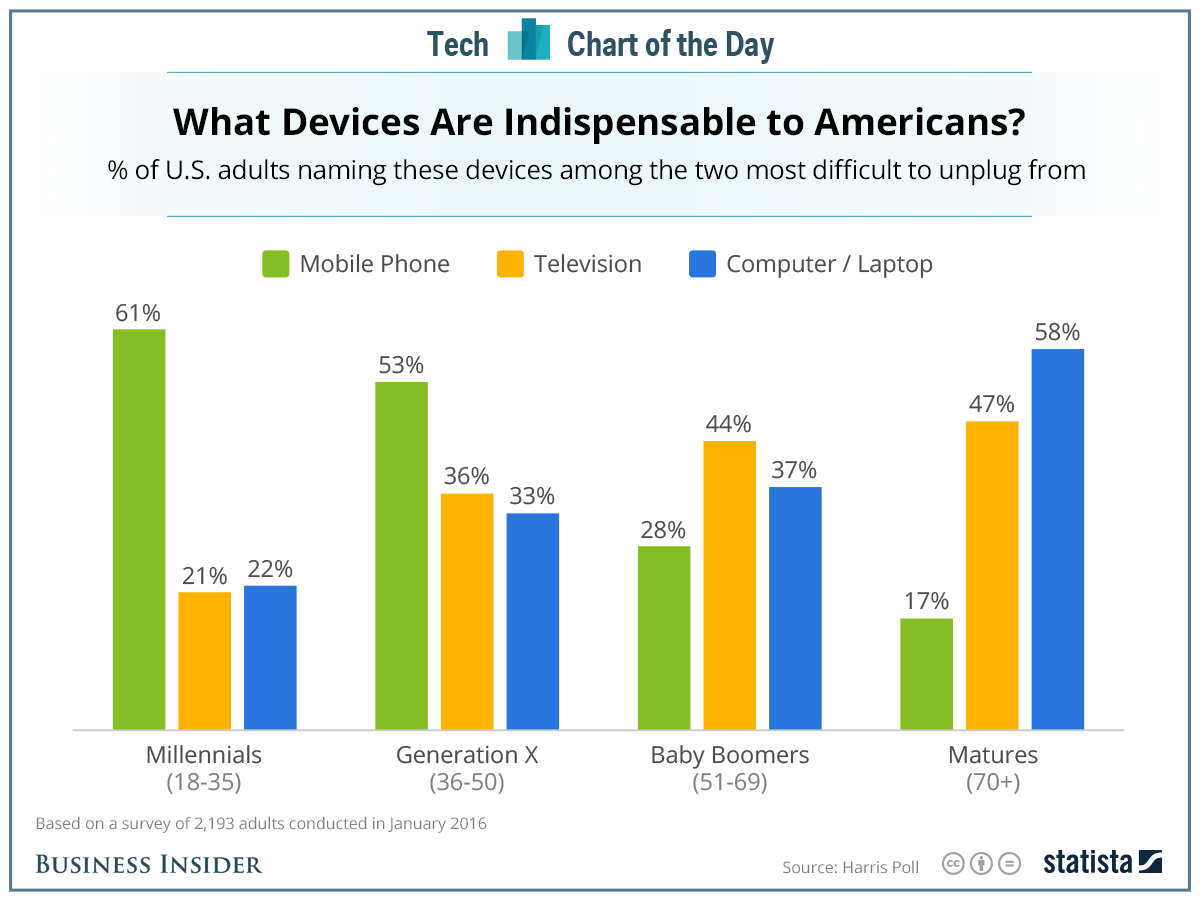
Is turning off their devices the same as turning off their learning?

devices_used by age group

Source: www.businessinsider.com/young-americans-cant-live-without-their-mobile-phones-2016-3

If Millennials and Generation X can’t live without their phones then shouldn’t we be using this as one of the primary tools for learning. I have two Millennial sons and it only takes a few minutes to see how useful their mobile phones are. There are very few aspects of their lives where they don’t rely on their phones. My boys are athletes and log their riding, nutrition and mosts aspects of their training. They both use Google forms to input their riding logs and depending on who is driving back from a training session one of the boys is using their mobile phones to update their riding logs. They do realize that it is more efficient to use their laptops or even their tablets for touch typing but he advantage of using the phone is that you don’t have to wait and can get the log out of way immediately.

Immediacy plays a very important role in their lives so relying on their mobile device helps them to deal with most issues as they come up. The notion of waiting to get back to their laptops isn’t something they are willing to do so when they are considering recording or writing anything their first thought is to use the phone. If they don’t have a good app to help then they search one out.

Even though I fit into the Baby Boomer category my device preferences are more in line with Millennials and Generation X so I can appreciate Millennials and Generation X reliance on their devices. However, when I design learning environments I have to admit that I am assuming that my students will be using a laptop or tablet to access the digital aspects of the course.

But is this a safe assumption? The more time I spend with people who truly appreciate the power of mobile devices the more I realize just how much can be done with a tablet or even a mobile phone. I used to think that other than writing a novel you can do most forms of digital creation on your mobile device. However, when I see just how much my son types into his riding log I am starting to realize that a mobile phone can also be used as writing device.

This forces me to ask… Are we really being reasonable when we ban the use of mobile devices in our classrooms? The knee jerk reaction is to point to the fact that students will use the device to text each other and engage in all forms of communication. Once again if you watch a group of Millennials you will see that while they are constantly texting each other they are also finding youtube videos, images and even articles that will add to the conversation. In addition to texting each other, it is not uncommon for these collaborators to pass their phone onto their neighbours so that they can share in the information. They aren’t isolating themselves, they using their mobile devices to enhance their collaboration and their learning.

Isn’t this what we want 21st Century or Digital Learners to do… to use technology to enhance their learning. Let’s think long and hard the next time we are inclined to ask our students to turn off their devices. In doing so we may be asking them to turn off their learning.


SWBAT – The Key to Writing Effective Learning Outcomes

Student will be able to… (SWBAT)

If you can keep in mind that an outcome must be stated in terms of what a student will be able to do and you use an action verb that describes what the student will be able to do within a specific context…then you will have a good outcome. A well written learning outcome must have 3 components:

  • Verb(s)
    Subject
    Context

One more thing – Avoid the term “understand” or its variant “develop an understanding“. Why?

You can’t measure “understand” or “understanding” and in order for an outcome to be effective or SMART is has to be measurable.

SMART Outcomes:

Specific – state clearly what the student/learner should able to do, and at what level
Measurable – you should have an idea of how the outcome will be assessed
Attainable – your student/learner must be able to accomplish the outcome
Realistic – similar to attainable but focuses on the appropriateness of the task
Time-appropriate – can the outcome be completed within a reasonable time frame

The following two documents provide more detailed information and can be used as a self check when you are writing learning outcomes: