
Archives For Learning

I am not one to long for the “good ole days” because I believe that there has never been a better time to be a learner, to be an entrepreneur, or to be alive in general. You can fill in the “to be” section of that statement with so many things. Now, I need to qualify a few points. I am referring to living in the west and in particular Canada but despite the unconscionable social injustices we see throughout the world and in particular the third world there has never been a better time to be alive. Don’t take my word for this–just refer to Hans Rosling amazing Ted Talk The best stats you have ever seen.

The opportunities for a learner today have never been better. Virtually all the worlds information is available in the palm our hands on our mobile devices. We can learn all the time and everywhere. Social networking enables a learner to move out of isolation and to connect to so many others who are striving to learn about similar, related or dissimilar things. These learning communities are so crucial for the advancement of ideas. Steven Johnson in the RSA talk Where good ideas come from points to the European Coffee Houses in the Age of the Enlightenment and the Parisian Salons of Modernism as places were ideas “bumped” into each other and significant advances in society were born. Johnson also argues that these virtually connected communities will further advancement today because “chance favours the connected mind. ”

The connected world of the Internet has also put significant pressure on our traditional educational institutions. At all levels we are starting to see a shift toward more student centric form of education. We see many teachers experimenting with online, blended and technology enhanced learning because they have starting to recognize that the problem of the deliver of content has been solved by technology. It has never been a better time to be a teacher. Teachers now have the opportunity to focus on helping students to go much deeper and discern what can be done with all the information.

We truly live in an amazing time and it has never been a better time to be a learner. Are you embracing all the opportunities that the 21st Century has to offer?

Stuck in the wash

Dwayne Harapnuik —  November 25, 2014 — Leave a comment

DrivingInRainWind_large
Source: https://www.travelers.com/iw-images/resources/Individuals/Large/DrivingInRainWind_large.jpg

Commuting in heavy rain is a normal part of living in North Vancouver and working in Burnaby. The other morning I was stuck behind a driver in a relatively new Mercedes who didn’t have enough confidence to drive past the rainy turbulence (wash) of an eighteen wheeled truck. Rather than deal with the spray or wash from the eighteen wheeler for a few seconds while passing the truck this driver chose to stay one lane over and beside the truck–in the truck’s blind spot and in the worst spray for way too long and too many kilometers. Not only was this dangerous for the driver of the Mercedes and the truck it put many other drivers at risk who were trapped behind these two vehicles. When the opportunity presented itself I managed to get around this dangerous blockage and noted that the Mercedes driver chose to stay in the truck’s wash and in the blind spot.

I acknowledge that driving past an eighteen wheeler in heavy rain can be somewhat unnerving. The truck sprays out so much water that your vehicle’s wipers become overloaded and you are almost driving blind for a second or two. You have to trust your driving ability and have enough confidence in your ability that you can maintain the right path past the truck. Once you push past the truck you only have to deal with the rain itself and can see a clear path ahead.

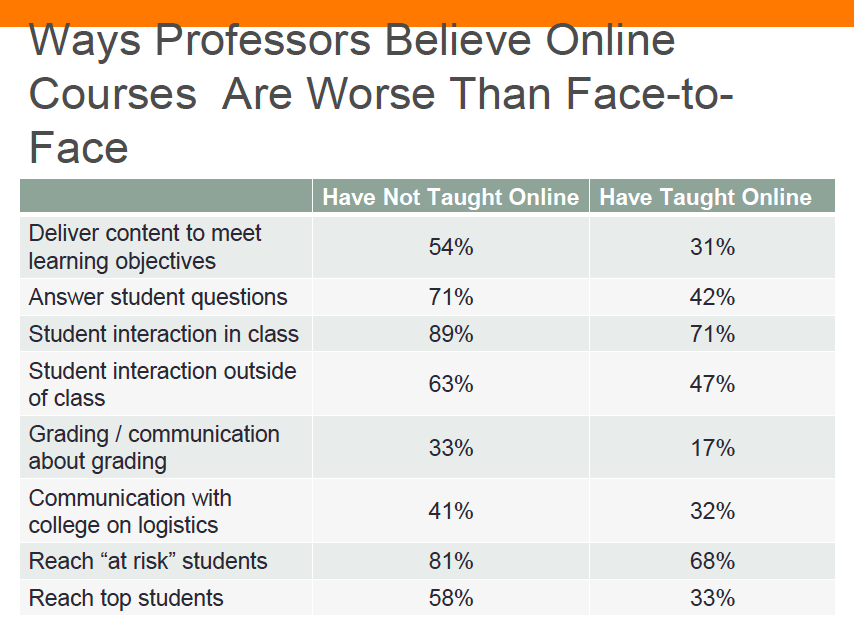
The fear of pushing past the wash from the truck reminds me of a situation that we are currently facing in Higher Education. The 2014 Inside Higher Ed/Gallup Survey of Faculty Attitudes on Technology reveals that despite the experimentation with online education many faculty fear that the record-high number of students taking those classes are receiving an inferior experience to what can be delivered in the classroom. Why? Whether faculty have experience in teaching online or have not taught online the majority of faculty believe that online classes are worse than face2face classes because they perceive student interaction inside class being much poorer online.
belief-online courses

The above table points to several aspects of student to Professor interaction and vise versa that is perceived to be poorer online. To be fair to these Professors I think they are right. I have a suspicion that deep down they already know that since their primary form of instructional delivery in the face2face setting is the lecture, their level of interaction in traditional classes is already quite poor and if they carry this same type of interaction forward into the online realm they are right to worry that their online classes will be poorer.

Research conducted by Finkelstein, Seal, & Schuster revealed that 76% of the 172,000 faculty across North America surveyed use lecture as their primary instructional methodology. Lecturing is simply a passive form content delivery that all too often involves very little active student engagement. I will acknowledge that there are some exceptional Professors who have a high level of discussion in their classes and others who use active learning instructional methodologies but the data suggests that they are the minority. Additional research by Nunn in the form of monitoring Professors in their classes also revealed that at most three minutes out of a fifty minute class are actual discussion and most often in the form of questions at the end of class.

Unfortunately, many Professors initial experience with or understanding of online learning is that is it simply a way to use technology to deliver content. Whether content delivery is done face2face or online it is still the predominant form of instruction in the post secondary setting. Not enough Professors view learning as an active and dynamic process in which learners construct new ideas or concepts based upon their current/past knowledge. The making of meaningful connections is key to the learning and knowing and until we take the advice of people like Sir Ken Robinson and many other highly regarded educational experts and have a Learning Revolution, our current limited face2face information transfer model will simply be moved online.

So, since most Professors are involved in delivering content with very little interaction or engagement in the face2face setting is there any wonder why those Professors who haven’t taught online would see online courses as being even less effective? Similarly, since many Professors who move online continue to use content delivery as their primary form of instruction is there any wonder why these Professors also view online courses as further limiting their already limited face2face student engagement?

Until we can change the way that Professors view their role and move away from the passive information transfer model to an active and dynamic process in which learners construct their own knowledge; and until we can change the way the way most Professors view themselves as the “sage on the stage” to the “guide on the side” or as a learning facilitators who create significant learning environments in which their students can come to know something, acquire knowledge, or to gain information and experience we can continue to expect to see these types of attitudes about online courses from faculty surveys.

This change of focus isn’t going to be easy. Due to a lack of formal training in active learning and all too often limited professional development many Professors are stuck in conducting their classes the same way that they experienced it when they were in school. This is very similar to the way that the Mercedes driver I referred to in my rain example was stuck in the wash behind the large truck–they didn’t have enough confidence in their own ability to push past the truck to see a clear path.

So once again it is not about the technology it is about the learning. Online technology is only a tool that can be used to enhance learning. But if our Professors are focused on teaching and disseminating information and not on creating significant learning environments then it doesn’t matter what tool we add to the mix, the student still loses out.

Finkelstein, M. J., Seal, R. K., and Schuster, J. The New Academic Generation: A Profession in Transformation. Baltimore: The Johns Hopkins University Press, 1998.

Nunn, C. E. “Discussion in the College Classroom: Triangulating Observational and Survey Results.” Journal of Higher Education, 1996, 67 (3), 243-66.

I have been trying to save the posting of exceptional videos for my Wednesday Watchlist but I just can’t wait with video.

1. Asking questions (Socrates 101)
2. Labeling technology and design challenges (Aristotle 101 )
3. Modelling problems qualitatively (Aristotle 102 or Hume 101)
4. Decomposing design problems (Descartes 101)
5. Gathering data (Galileo or Bacon 101)
6. Visualizing solutions and generating ideas (da Vinci 101 )
7. Communicating solutions in written and oral form (Newman 101)

By associating important figures in intellectual history with each of the seven thinking skills Goldberg points out that each of these problems have been already solved or addressed. He is also pointing out that our narrow form of contemporary education which emphasizes plugging numbers into a formula and the regurgitation of information not only which excludes these fundamental skills so well established in classical education but it is leaving our engineers, and I would argue so many other students, ill prepared to efficiently solve current problems.

Goldberg’s Slideshare presentation The missing basics: What engineers don’t learn and why they need to learn it is also worth checking out.

It doesn’t take much encouragement for me to share my passion for using YouTube to enhance the learning environment. In the YouTube in the Classroom workshop at the Learning and Teaching Centre at British Columbia Institute of Technology (BCIT) on November 5, 2014 we explored using YouTube and other media to enhance the face2face, flipped, hybrid or blended and fully online settings.

The following are all the Youtube clips and related links used in the workshop:

YouTube in the Learning environment slide deck in PDF – YouTube-Learning environment.pdf

How to instructions:

Introduce a concept

Start at 4:00 minute

Introduce a context & bridge into the subject

Start at 15:01

Introduce the Big Hairy Audacious Goal (BHAG) for an online course

Introduce yourself and make a connection with students

Humor & comic relief

Introduce the main point of an argument

Introduce the main point of an argument – Bonus

Definition and Explanation

Explore Controversy

Flipped classroom assignment
Link to Visible Learning assignment page

Perhaps one of the best talks on learning & education – My favourite TED Talk

This just one of many TED talks that I recommend. If you go to TED.com and filter by “Most viewed” you will see Ken Robinson’s talks as well as Simon Sinek’s talk about Why and many more amazing talks.

My blog post The Power of Media in informal learning offers the insights that I have found in using media to help my two sons in their pursuit of becoming professional downhill racers.

Finally, to easily download video clips from youtube and embed them into your Powerpoint or Keynote programs (educational acceptable copyright permitting–check with your department or library) you can use the site clipconverter.cc

Enjoy!

David Cearley, Gartner vice president, has been analyzing business and technology trends since Gartner started publishing the annual Top 10 Strategic Technology Trends. In the Top 10 Strategic Technology Trends for 2015 the following the top ten technology trends that organizations cannot afford to ignore in their strategic planning processes all rely on some type of interaction with cloud services.

  1. Computing everywhere
  2. Internet of Things
  3. 3D printing
  4. Advanced, pervasive, and invisible analytics
  5. Context-rich systems
  6. Smart machines
  7. Cloud/client computing
  8. Software-defined applications and infrastructure
  9. Web-scale IT
  10. Risk-based security and self-protection

Why is this important for Higher Education and especially Polytechnic institutions like British Columbia Institute of Technology (BCIT)? We are moving rapidly into a global marketplace that is functioning in the Cloud. Unless we are preparing our students for this type of a future we are robing them of tomorrow.

This means that technology driven institutions like BCIT must not only embrace these technologies we must use these technologies as the foundational infrastructure that we build our significant learning environments upon.

Read the full report…