Archives For DLL

Without being crystal clear about the results you wish to achieve and being zealous about measuring them you will not be able to identify the vital behaviors that are crucial to your change initiative. To be successful you must avoid three common mistakes:

  1. Fuzzy, un-compelling goals – the lack of clarity or a vague sense of what you want to achieve (Help students be successful…, Build the team…)
  2. Infrequent or no measure – if you don’t measure your progress you will not know if you are making any.
  3. Bad measures – measuring the wrong thing.

Focused and Measurable Goals

This is the point where where a lack of clarity will hinder your entire initiative. You must focus on measurable results you want to improve. Consider the following:

“I’d love to loose weight” vs.
“I need to eat fewer calories than I burn” vs.
“I will loose 40 pounds and 20% body fat by September 1 of this year”.

The final statement, loosing “40 pounds and 20% body fat” by a certain date is clear, measurable and timely. Deadlines are another measure that contribute to success by helping to create a sense of urgency. A clearly defined goal with specific deadlines, milestones, or points of achievement can be measured and it also helps us measure the right things.

In our weight loss example stepping on the scale on a regular (daily) basis will let you know how well you are moving toward your goal. Weighing yourself daily is also one of a few vital behaviors that can lead to the results you want.

What are Vital Behaviors

Vital behaviors are repeatable high-leverage actions performed crucial moments that will lead to the results you want.

For example the following are very simple behaviors performed at crucial moments that can prevent serious problems.

  • A health care provider washes their hands upon entering a patients room.
  • A food preparation worker washes their hands after visiting the restroom and/or prior to handling food.
  • Sneezing or coughing into one’s elbow.
  • Washing hands often during cold and flu season.

This list affirms that vital behaviours are often obvious and underused. It is a mistake to underestimate or ignore these obvious vital behaviors. Several years ago, a doctor failed to wash his hands prior to the examination of the treatment of a planters wart on my foot and passed on a staff infection that almost caused the loss of my foot.  My eldest son is zealous about washing his hands during cold and flu season and he is seldom sick. The power of using vital behaviors is that you only have to use one or two and you can influence significant change.

Additional Examples of Vital Behaviors

Vital Behavior Examples

How to Find Vital Behaviors?

The influencer authors point to the following four vital behavior search strategies:

  1. Notice the Obvious – recognize behaviors that are obvious but underused.
  2. Look for Crucial Moments – time when behavior puts success at risk.
  3. Learn from Positive Deviants – look to those who live in the same world but produce positive results.
  4. Spot Culture Busters – behaviors that reverse stubborn cultural norms.

The One or Must action

Perhaps one the most effective ways to help identify a vital behavior is look at a Crucial Moment and ask –

If you could do only one thing what is that one action that you must do that would change everything and give you the result you desire?

It is important to remember that you are looking for the fewest behaviors or even that one thing that will lead to change. It is also important to recognize that not all behaviors are vital and there is a tendency to confuse behaviors with process, workflows or tasks. Depending on the context a process can include multiple steps and many behaviors. You are looking for that crucial moment, that one thing, that vital behavior.

If we go back to our example of loosing weight. Conventional wisdom dictates that you need to eat fewer calories then you burn. So eating less and exercising more would be the logical behaviors to change. But these are not focused enough and don’t really get at the key vital behavior that will bring about the weight loss.

Planning out meals the day before, keeping a food log, or simply writing down everything that you eats are examples of vital behaviors that will lead to eating less. Similarly, driving to the gym, getting on your treadmill/bike/trainer, or putting on your running gear are the vital behaviors that will lead to exercising more.

Testing your Vital Behaviors

Behaviors are actions not results or qualities. You can test whether you identified vital behaviors by asking:

  1. Can you go and “do it”?
  2. Do these actions stop self-defeating and escalating behaviors?
  3. Do these actions start a reaction that leads to good results?
  4. What particular value is being lived?

Also keep in mind that there is also a tendency to confuse goals or outcomes with behaviors, especially if your goal or outcomes are action oriented. If it isn’t actionable, it isn’t a behavior. If you can’t go and “do it”, it’s not a behavior.

References:

Patterson, K., & Grenny, J. (2013). Influencer: The new science of leading change, Second Edition. McGraw-Hill Education.

Meier, J. D. (n.d.). Vital Behaviors [Blog]. Retrieved from http://sourcesofinsight.com/vital-behaviors/

In a skype meeting this morning I was asked the question – Are you a constructivist? I hesitated briefly and responded “Yes, I think I am.” I went onto to add… I am If you hold that a constructivist is one who believes we learn by making meaningful connections.

I have been pondering my hesitation and attribute it to the fact that I was debating whether or not go into the full blow definition of contructivism or use the shorthand definition that I have been using most recently- we learn by making meaningful connections.

As a result of this exchange I have reviewed Jerome Bruner’s (1960) definition of learning which states:

Learning is an active process in which learners construct new ideas or concepts based upon their current/past knowledge. The learner selects and transforms information, constructs hypotheses, and makes decisions, relying on a cognitive structure to do so. Cognitive structure (i.e., schema, mental models) provides meaning and organization to experiences and allows the individual to “go beyond the information given”.

An active process of constructing new ideas based on new and old information is what I mean when I state learning is the making of meaningful connections. It has been over 20 years since I first studied Bruner’s work and recognized that his definition of learning and his theory of instruction offered a sound foundation for creating significant learning environments. It is good to reflect on where our current beliefs come from and to confirm how we have grown and developed those beliefs.

No hesitation this time – I am a constructivist even in the classical sense.

What are you? What are your learning beliefs based on? When was the last time you revisited those foundational ideas?

These past several weeks my two boys, Levi and Caleb, have spent most of their days riding Silver Star and Whistler Bike Park, Whistler Aerodome and other DownHill and DirtJump locations in British Columbia. This type of riding is not only extremely hard on the human body (i.e. Levi’s concussion and recent shoulder injury and Caleb’s ongoing aching hands, too many bruises, scrapes and scratches to mentions) it may even be harder on the bikes. As result there is extensive daily maintenance and the all too often broken component that needs to be replaced as a result of bad hit, wipe out our simply the harsh terrain.

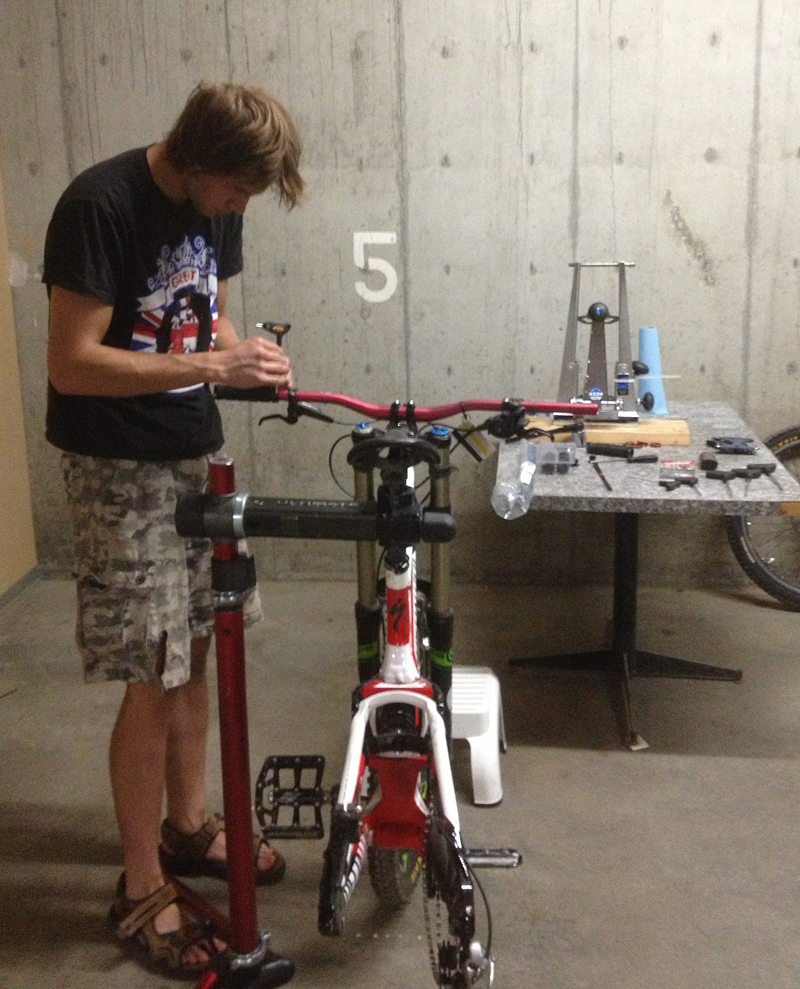
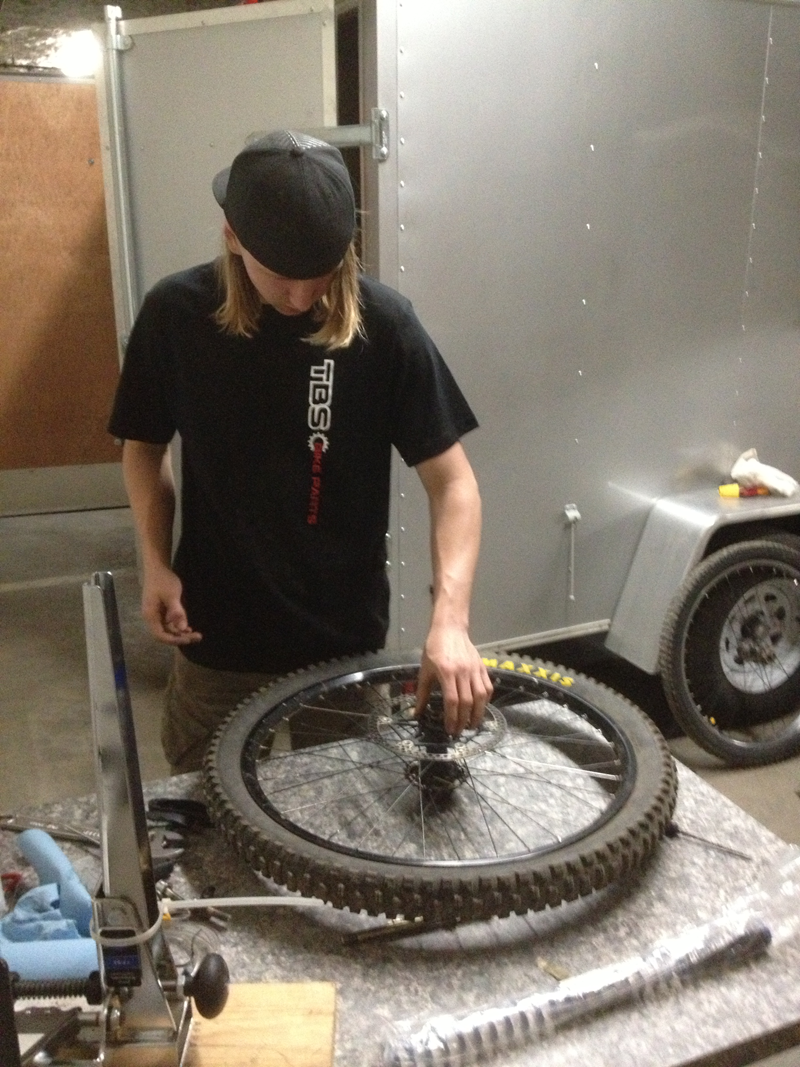
Up until this summer I had been supervising and directing this daily maintenance. Taking on a new position at BCIT means that I am not going to be able to ride with my boys on a daily basis and help them with their bike maintenance and repairs. That is why a recent Saturday morning at Silver Star confirmed that the gift of intrinsic motivation that I have been giving my boys for several years has not only finally been fully received, it has blossomed into the wonderful sight displayed in these pictures.

caleb wheelrepair

Cluster Removal

levi bikerepair

Lockon Grip Fastening

Two typical teenage boys (17 and 15) are not only cleaning, lubing and adjusting their high end DH bikes, they are spending sometimes up to 2-3 hours a day doing full repairs and preventative maintenance which ranges from replacing spokes, truing and tensioning wheels to changing fork oil, brake bleeds, replacing suspension bearings and every other aspect of maintaining and repairing their very expensive bikes. Most importantly they are doing it on their own without having to be told or directed. The gift of intrinsic motivation has finally been received.

While the title and initial focus of this blog post suggests that you can give someone intrinsic motivation I must concede the fact that you cannot give anyone intrinsic motivation. This type of motivation comes from within. You can however create the environment and influence the circumstances in which intrinsic motivation will not only emerge but will grow into a driving force.

I believe that we can help foster the growth and establishment of intrinsic motivation if we consider and foster the following five key contributing factors.

Modelling
James Dobson has repeatedly stated that “Values are not taught to our children; they are caught by them.” I suggest that intrinsic motivation is similar to values in that is not taught to our children but has to be caught by them. Ever since my boys first started riding their bikes they have also learned how to repair and maintain them–it is just something that I/we have always done. In addition to maintaining bikes I maintain our vehicles, our home and just about anything that we own. The years of rotating tires, changing oil, fixing the dishwasher, renovating and updating our homes and everything else that the boys were involved in helping their mom and dad do on a daily basis contributed to showing the boys how they could “catch” the intrinsic motivation required to work through the mundane tasks that are part of everyday life.

Expectations
Effective modelling will also convey or demonstrate what expectations, standards and criteria need to be met. Knowing what is expected and fulfilling those expectations is extremely important for children and teenagers because it will help them to develop responsibility and accountability. As adults our work is judged and often connected to our income so developing the ability to meet or exceed expectations for our children is not only very important, their future careers may also depend on this ability.

One of the biggest challenges with expectations is being realistic. The performance standard for an 10-12 year old child will not be the same as a 15-17 year old teenager or an adult. The desired end quality should not be compromised but the path to getting to that quality will depend on the age and skill level of your children so be patient. Unrealistic expectations are the source of too many disappointed fathers and children so remember when your 12 year old son or daughter is striving to meet their father’s expectations remember that they are just a 12 year old boy or girl. Similarly there is a point when challenging your 17 year old son or daughter to step up and perform as adult is crucial to their development.

Trust
The key to trust is letting go and letting your children do the task, make their own mistakes and learn from the situation. All too often we want to swoop in and direct and correct and interfere with the learning process. Or worse we think that it would be more time effective and less stressful to do the task ourselves or worse still outsource the job. When we trust our children to make breakfast, repair the doorknob, fix the flat tire or, in the case of my boys, build their own bikes from scratch we are telling them that we believe in them and that we value their effort and contribution. A father’s and mother’s trust is a major contributor to your child’s identity and to their intrinsic motivation. Knowing that someone else trusts and believes in them helps them to trust and believe in themselves. This instills confidence which is a fundamental contributor to personal motivation.

Ownership
Little boys and girls want to be like their mom and dad and have their own tool belts, hammers, appliances, bikes, cars and so many other things. This is one principle that I wish I would have fully grasped and understood sooner. When Caleb and Levi searched out and selected all the necessary components and built their own DH bikes up from a raw frame it really changed the way they approached maintaining their equipment. They now have a vested interest. They understand the work involved in putting the bike together and what it would take to replace or repair those components. More importantly, my boys now not only want to maintain their bikes they do so on their own and even appreciate preventative maintenance because they know the work that went into building up their bikes.

Consequences
Broken spokes are like deer; if you see one you inevitably will see another. A bad landing, a rock or root can cause a broken spoke and cut into prime riding time. Unfortunately, a poorly tensioned wheel will be more susceptible to damage than a well maintained wheel. There is often nothing better than natural consequences to motivate a young man to take the extra time necessary to properly tension his wheels to limit the downtime that can ruin an otherwise wonderful riding day. The idiom “an ounce of prevention is worth a pound of cure” is never fully appreciated until one is personally responsible for implementing that pound of cure. Letting your children suffer the consequences (as long as they aren’t life threatening) will be much more valuable to them in the long run than your intervening.

The lesson learned in the garage and on the mountain slopes, bike parks and dirt jump parks of BC have played a significant role in my sons’ acceptance of the gift of intrinsic motivation. As an intentional father it is my responsibility to create an environment at home, on the road and anywhere we are at where the above listed contributing factors will help my boys to grow into responsible men. Helping them with the gift of intrinsic motivation is just one part of this ongoing process.

Related Intentional Father Posts:

Becoming an Intentional Father
Catching the Openness to Change