Archives For Innovation

Readability

Dwayne Harapnuik —  December 14, 2009 — Leave a comment

This is one of those simple tools that can make all the difference in the world in one’s browsing experience. In a single click Readability removes all the clutter from a web page and simply leaves you with the text formatted in a way that makes reading online very comfortable. Rather than trying to explain what Readability does consider the following:

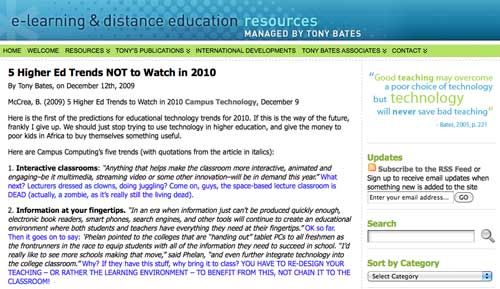
The following is a screen capture of Tony Bates blog in its raw state. While it is not a busy as some blogs it does have some activity at the top and bottom.
bates-before

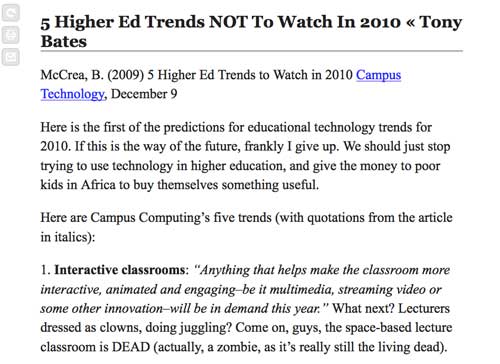
After clicking on the Readability button in the browser, Tony’s blog is now completely uncluttered and easy to read.
bates-after

The tool is so simple and easy to use that it doesn’t require any installation or usage instructions other than what are available on the Readability site.

The Italian cartoonist, Federico Fieni, portrayal of how Google is challenging Microsoft with Chrome is very appropriate considering how many ways Google has encroached on what was once a Microsoft domain. Consider the following…

Mashable.com announced today that Google Chrome Launches for the Mac. Google recognizes the growth of Mac user due to the the huge success of the iPhone and doesn’t want to miss out on any part of this growing market. In contrast MS killed IE for the Mac.

Google Apps for Education: The 19th National Survey of Computing and IT in Higher Education reveals that 59% of 4-year universities and colleges use hosted email named Google as their provider.

The only reason that Microsoft is still holding onto to second position is that many institutions are using Exchange and the MS online suite fits much better with the existing Exchange and MS Office infrastructure. A closer look at these situations would also reveal that MS Office and Exchange are more important to institutional administration than they are to faculty, learners and general staff.

The eweek article Five Reasons Why Android Could Kill Windows Mobile points out that Googles Android mobile operating system will more than likely kill Windows Mobile because:

  • Android’s Market Share Is Climbing Fast – while MS Windows Mobile has dropped significantly.
  • It’s an App, App World – Open source holds promise for the development of thousands of app. Lets not forget that Apple has close to 100.000 apps in its app store.
  • Lack of Other OS Competitors – other than Apple no one else is actively attempting to port an operating system onto an mobile phone.
  • The Hardware Pairing – the Motorola Droid sold over 250,000 units in its first week which is much more than any Windows device but significantly less than Apple which sold 1.6 million 3GS units in the first week.
  • Windows Mobile 7 Is an Unknown – still several months away from release no one knows how well the OS will do against Android or iPhone.

It will be interesting to watch and see what else Microsoft looses over to Google. While I appreciate the options that Google now offers I am concerned that we may be trading in one monopoly for another. Time will tell.

iPhone RFID Reader

Dwayne Harapnuik —  November 19, 2009 — Leave a comment

There is no release date or pricing for the device on the iCarte site but until Apple releases their next generation iPhone with RFID this should provide a suitable alternative.

More than an ebook

Dwayne Harapnuik —  September 22, 2009 — Leave a comment

The french publishing group Editis’s short fictional video is about the likely future of books.
Filmed in 2007, this is the latest version with english subtitles.

[youtube]_vBb3_aZN7g[/youtube]

http://mashable.com/2009/08/08/iphone-live-tv/

iPhone TV: Top iPhone Apps for Live Streaming Television via kwout

When you start to see major networks and the Television industry in general adopt a device like the iPhone for the delivery of their content then you know that this device must have hit the mainstream. While some of these apps will not work that well over 3G and the battery life of the iPhone will be zapped quickly by streaming video there is no denying that the iPhone is a mainstream device. Some would argue that with over 80 thousand apps and counting being developed in the past year for the iPhone, it is not just mainstream it has become a new standard. Nine to twelve months ago this question was still worthy of discussion but I argue that it is time to move on.

A second reason I suggest that this device is now a mainstream device is that IT shops and CIOs in particular are starting to recognize its impact. Jason Hiner the Editor in Chief of TechRepublic points out that while a majority of CIOs still reject the iPhone the resistance to the device is weakening.

http://blogs.techrepublic.com.com/hiner/?p=2345&tag=nl.e101

Majority of CIOs still reject the iPhone, but resistance is weakening | Tech Sanity Check | TechRepublic.com via kwout

While it is refreshing to see that IT is slowly catching up with what is happening in the “real world” we need to take a lesson from this story. If you are looking to IT and in particular to your CIO for technological innovation and vision then you may be looking in the wrong place. Yes there are a few CIOs who possess the courage and passion to be visionary but for the most part IT is responsible for making sure that technology is safe and reliable. If the lights are flashing, the fans whirring and the bells ringing then we know the IT and the CIO are doing a good job. Unfortunately, safety and reliability have very little to do with progress and innovation. As much as I wish it wasn’t, innovation – disruptive not the sustaining kind, is messy and occasionally unreliable.

The key here is who does your organization look to for technological innovation. If its is IT and the CIO and you have an IT group that is very traditional then you and your organization may be safe but you are not going anywhere. Innovation requires vision and courage to go places and do things that most are not willing to do.

Perhaps IT and the CIO should not be visionary leaders==perhaps their role is to provide the reliability of a utility. With virtualization, and cloud computing maturing to the point where computing is moving into the realm of a utility it may make more sense to accept the fact that the role of IT is to provide security and reliability and not ask them to be innovative.

If you want innovation and effective change then you have to look to who your innovators are and support them rather than asking groups and people not comfortable with innovation to be something that they are not.