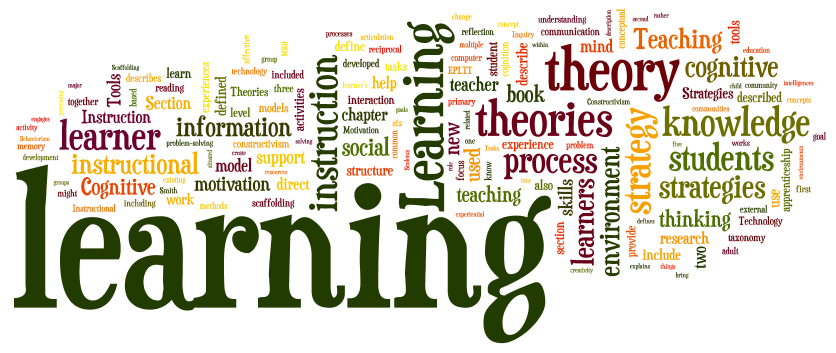
LearningWordle
Image source: http://epltt.coe.uga.edu/images/4/4c/IntroWordle.png

History of Learning Theories site highlighted in the video – https://kb.edu.hku.hk/learning_theory_history/

If you run a quick google search on the phrase “main learning theories” the results will reveal that there is inconsistency in what people agree are the main learning theories. You will also find that many sources will shift their perspectives on learning theories. For example back in 2016 when I first wrote this post, United Nations, Educational, Scientific and Cultural Organization (UNESCO) which should be considered an authority listed the following 7 learning theories:

  • Behaviorism
  • Cognitive Psychology
  • Constructivism
  • Social Learning Theory
  • Socio-constructivism
  • Experiential Learning
  • Multiple Intelligence
  • Situated Learning and Community of Practice
  • 21st Century Learning or Skills

When I updated this post in November of 2021 UNESCO revised their original list and now lists the Most influential theories of learning as:

  • Behaviorism
  • Cognitive Psychology
  • Constructivism
  • Social constructivism
  • Experiential Learning
  • Multiple Intelligence
  • Situated Learning theory
  • Community of Practice

While the changes are small, combining Social Learning Theory and Socio-Constructivism into what is now called Social Constructivism, lifting Situated learning to the level of a theory, removing 21st Century Learning or Skills and, moving Community of Practice into a separate category these changes reflect a shift from a contemporary or postmodern epistemological interpretation to a critical theory narrative.

Relationships of Dimensions of Teaching and Orientations to Learning & Learning-approaches-principles-and-theories Tables used in the above video.

Wikipedia points to Behaviourism, Cognitivism, and Constructivism as the main theories but also points to a wide assortment of related links. Learning-theories.com which was once a scholarly project but has now turned into an add riddled site suggests that there are the following 5 major paradigms which the different learning theories fall under:

  • Behaviorism
  • Cognitivism
  • Constructivism
  • Design-based
  • Humanism
  • 21st Century skills

Depending on the theoretical preference of the author(s) and when the site you land on was originally written or last updated you will find many of the theories from the lists above.

Back in the late 90’s when I was researching learning theories for my doctoral thesis and in 2003 when I taught my first graduate course on learning theories most texts and literature pointed to the following as the main theories:

  • Behaviorism
  • Cognitivism
  • Humanism

Today the term Humanism is seldom used in the learning theory context and Constructivism has been pulled out of the Cognitive camp to stand on its own. Design is involved (or at least it should be) in most theories so I fail to see how this is a learning theory itself. Similarly, 21st Century learning is much more of a popular phrase of the day and since one could argue that all learning happening today is in the 21st Century, this really isn’t a learning theory.

Therefore, I suggest that the primary learning theories today are:

  • Behaviorism
  • Cognitivism
  • Constructivism

But which list is accurate? Perhaps a more important question is why is an understanding of learning theories important? The following four key points should serve as a good start for why understanding learning theories is so important:

1. Knowing what you really believe about learning is important because this foundational belief should drive the way you create significant learning environments and the way you engage learners.

2. Knowing that your beliefs about learning are supported by evidence and are shared with others should give you the confidence to move away from the role of sage on the stage to guide on the side as you give your learners more choice, ownership, voice, and authenticity (COVA) in their learning experiences.

3. Knowing the full breadth of the learning theory or theories where your beliefs about learning fall will help you to analyze, assess, and choose the appropriate technologies that can not only fit the needs of your learners but enhance the learning environment.

If we don’t choose to take a proactive approach to understand what we fully believe about learning and purposefully design the learning environment, we choose to follow tradition. As Christopher Knapper warns there are consequences to blindly doing what has always been done:

…there is an impressive body of evidence on how teaching methods and curriculum design affect deep, autonomous, and reflective learning. Yet most faculty are largely ignorant of this scholarship, and instructional practices and curriculum planning are dominated by tradition rather than research evidence. As a result, teaching remains largely didactic, assessment of student work is often trivial, and curricula are more likely to emphasize content coverage than acquisition of lifelong and life-wide learning skills. (2010, p. 229)

Understanding what we believe about learning has never been more important. We are living in the age where we no longer are asking if we should use technology to enhance learning but are asking how well are we using technology to enhance learning. Tony Bates has spent decades researching how to use technology to enhance learning and in his post Learning theories and online learning he points to the fundamental role the understanding of theories of behaviorism, cognitivism, and constructivism play in online learning and more importantly reminds us that our thinking must continually evolve as these theories evolve. Bates also reminds us that we need to be open to new theories as these new and old learning theories evolve we must move from theory to practice. We need to be flexible enough to adapt and grow in our thinking about learning to develop effective learning environments that meet our learner’s needs.

This flexible and eclectic approach to understanding and adopting learning theories have driven my thinking about learning since the late 90’s when I developed Inquisitivism which is an approach for designing and delivering web-based instruction that shares many of the same principles of minimalism and other constructivist approaches. Being eclectic in my thinking about learning theories has enabled me to not limit my understanding of learning to one system but I have continually considered and selected the best elements from all systems.

Putting this in the 21st Century vernacular one could argue that I prefer the mashup theory of learning because creatively combining and mixing the best elements of learning theories is the best way to address the needs of 21st Century learners. Don’t assume that my mashup theory of learning is just a willy-nilly approach to being pragmatic. On the contrary, the quality of a mashup is totally dependent upon the quality of its components—remember I am continually selecting and mixing the best elements.

This finally takes me to my fourth key point why understanding learning theories is so important.

4. The better you know and understand specific learning theories the better able you will be to select the best elements from all the theories which will help you to mashup the most effective learning environment.

Regardless of where you land in your thinking about learning the fact that you are thinking about learning and how learning works means that your learners will benefit. When we strive to create significant learning environments we can all agree that it’s about the learning.

References

Knapper, C. (2010) ‘Changing Teaching Practice: Barriers and Strategies’ in Christensen Hughes, J. and Mighty, J. eds. Taking Stock: Research on Teaching and Learning in Higher Education Toronto ON: McGill-Queen’s University Press

Originally posted on March 11 and revised on November 10, 2021

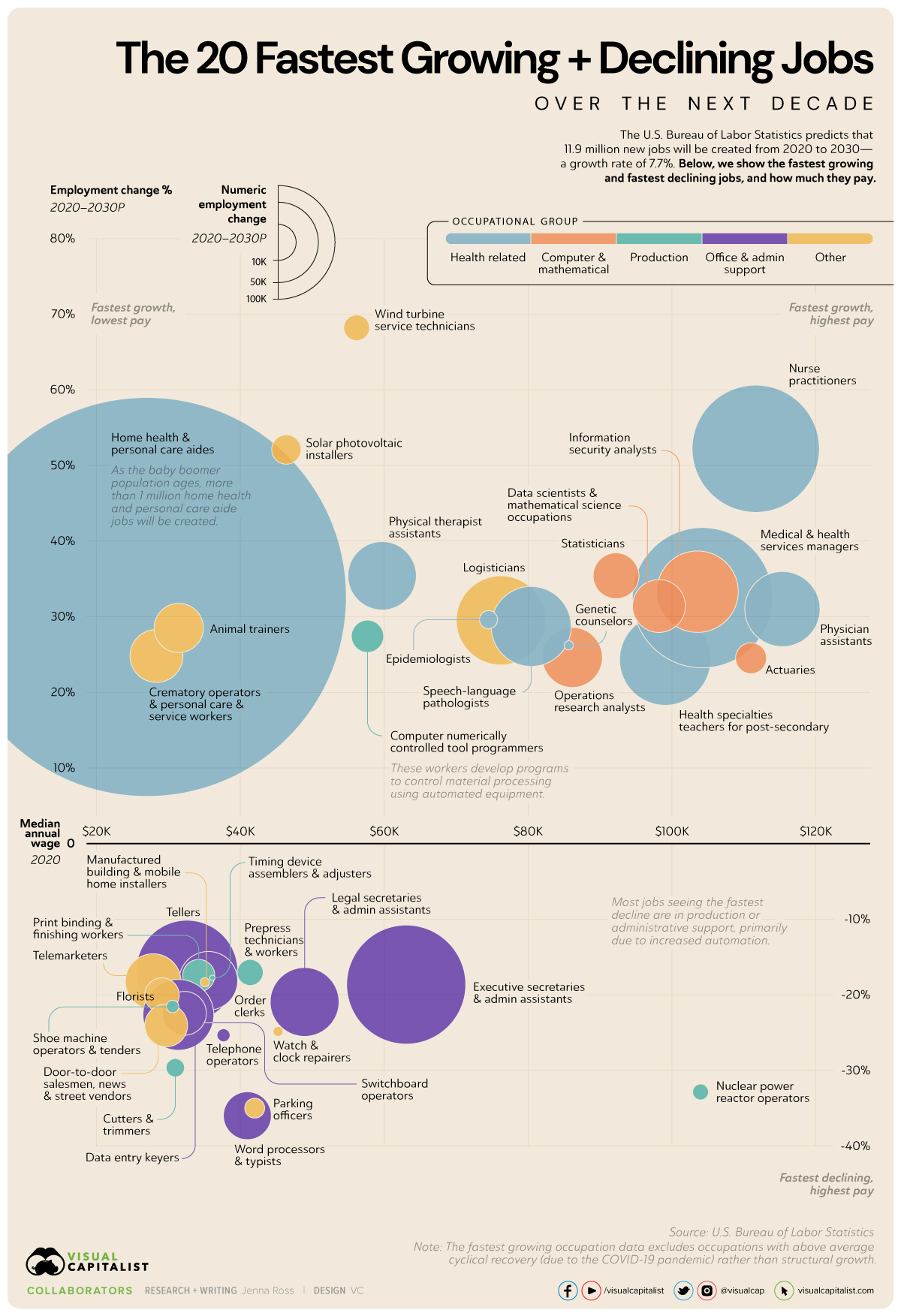
Fastest Growing Jobs

Source: https://www.visualcapitalist.com/the-20-fastest-growing-jobs-in-the-next-decade/

If Genius Hour and 20% Time, Passion projects, and other similar project-based engagement activities are so helpful in promoting learning why don’t we spend more time on these activities and not limit them to an hour a week or 20% of our learner’s precious time? Why don’t we flip Genius hour and 20% time with the time we spend on test preparation. Perhaps if we move our learners away from the time-wasters of rereading and highlighting and get them engaged in the effective study skills of self-testing, distributed practice, elaborate interrogation, self-explanation, and interleaved practice we could flip the time we spend on test prep to 20% and spend 80 of our learner’s time engaged in Genius Hour type activities. The research is clear and the Scientific America article on study skills What Works, What Doesn’t – https://www.researchgate.net/publication/273626957_What_Works_What_Doesn’t confirms what study skill yields the best results and also points to a large body of research on this topic.

While flipping Genius Hour and improving our learner’s study skills may be a great first step it isn’t enough. Trying to apply a simple solution like flipping Genius Hour to the more complex problem of deeper learning within our current educational system will not work unless we address all the other key factors of this complex problem. We need to help change our educator’s and learner’s thinking about learning, their approach to learning, and we need to change the learning environment. I am not alone in calling into question the use of Genius Hour and 20% Time as a treatment without addressing all the other factors.

In a recent post The Research Behind PBL, Genius Hour, and Choice In The Classroom – https://www.ajjuliani.com/blog/research/ A.J. Juliani argues for the benefits of project-based activities that promote choice and give learner’s the opportunity to engage in learning activities that are important to them. Juliani is an advocate of these useful learning activities and in his post, he points to some research and larger body anecdotal or experiential support for these types of activities. He also deals with some of the objections to challenges to these activities and points to Ewan McIntosh’s 2013 post 20% Time and Schools: not the best of bedfellows – https://edu.blogs.com/edublogs/2013/08/20-time-and-schools-not-the-best-of-bedfellows.html where McIntosh points to the problem with our system of education that limits the effectiveness of these types activities in this statement:

The problem is, that students given this open stretch of time often don’t know what to do, or beyond their initial couple of passions they run out of steam. Their end-products are largely under par of their capacity. Sure, there are moments of genius, just as in Google, 3M or any other corporation that introduces 20% time. But, just like them, they are by a small proportion of students, with the vast majority of ideas failing to hit the mark.

McIntosh is pointing out that many, perhaps even most, of our learners are not prepared for this type of deeper learning. He suggests that that experimenting with these individual activities is a start it would be better to include more student autonomy in everything one does. This is not the first time we have heard an educator point to the sobering reality that too many of our students are not prepared to learn. In his book Failure to Disrupt: Why Technology Alone Can’t Transform Education Justin Reich points out that pandemic inspired move to online learning hasn’t worked well because most students are not able to learn online because they are not self-directed and are not able to learn independently. Reich does a good job pointing out the complex problem but doesn’t offer a solution. Fortunately, in the post We Need More Autodidacts we offer a solution to this complex problem.

As you should have heard in the Learner’s Mindset Discussion video above we agree with McIntosh about student autonomy, but once again we go a fair bit further and address all the aspects of this complex problem. Incorporating more student autonomy is a good start and so is Genius Hour. But if these activities are used as treatments or stand-alone activities we argue that they won’t work because the problem that we need to address is much more complex and requires a much broader focus. Unless we adopt a Learners Mindset where you change your thinking and your learner’s thinking about learning, change the approach to learning, and create a significant learning environment in which you give your learner’s choice ownership, and voice through authentic learning opportunities you run the risk of running an interesting learning activity that will have minimal long term impact.

Related posts:

How to Avoid EdTech Quickfix Traps
How to Change the World One Learner at a Time
Computers in Schools – Not Working…Yet
Why do so many prefer passive learning?

I have been exploring how to bring about effective organizational change for many years. A quick search for the word “change” on my blog will reveal many posts. My analysis and evaluation started back in 2010, when I was still advocating for Kotter’s Eight-Stage Process of Creating Change but I was starting to see that there were some significant challenges to this process. By 2012 I was starting to explore broader ideas and looking for more of a synthesis to leading change as the post Recommended Readings on Leading Change In Education will reveal. I was recognizing that if you really wanted to bring about effective change you had to Practice Change by Living It and you had to acknowledge that The Head Won’t Go Where the Heart Hasn’t Been.

My synthesis of thinking about change started to come together after some significant failures in a few change strategies I had undertaken in 2011-2012. I had religiously used Kotter’s Eight-Stage process and I even focused on creating a sense of urgency but there was something missing. Without going to significant details on the situations my evaluation of what had happened and my analysis of what could be doing better revealed that there were many other factors that all had to come together. The following is an excerpt from a 2014 post I made in reaction to Seth Godin’s post – People Who Like This Stuff. This post is where the synthesis of effective organization change that is outlined in the Learner’s Mindset Discussion had its formation. Most of my thinking is still the same but in the last six years, I have added a Crucial Conversations component to the self-differentiated leader’s section because of the challenges everyone is facing today in trying to have conversations about even the smallest things.

One of the advantages of working through authentic projects is that they force one to continually evaluate what is working and what can be done better. If one hopes to change their own world and the world for their learners one must remain in the higher-order thinking of evaluation, analysis, synthesis, and creation which is also a key aspect of the Learner’s Mindset.

To see the full post you can go to People who like this stuff…like this stuff.

Why is change in education so slow and so difficult? I think Seth Godin offers one of the most simple and elegant explanations…

“People who like this stuff…like this stuff”

Godin goes onto explain that:

“…for those that are already in it, you can’t push too far, because they like the genre. That’s why they’re here.”

Those who have walked away probably aren’t just waiting around for you to fix it. Those who have never been, don’t think the genre has a problem they need solved.”

If we apply this elegant thinking to the challenges we face in improving education, then most educators who like this stuff [traditional learning environments}… like this stuff. Most people who don’t, have walked away as we can see by homeschooling, unschooling, and uncollege movements. Perhaps more importantly, for those (students, parents, and politicians) who have never been behind the scenes of our traditional educational system, there is no problem. Or the problems that they can see are simply ones that appeal to emotions like class size or special needs. These issues become hot buttons for political sound bites and the 6:00 news but sound research by people like John Hattie reveals that student achievement is not impacted significantly by class size but by many other factors that just aren’t as newsworthy.

How then do we get people who like this stuff (traditional education) to like new stuff (digital learning environments)? While innovating the learning environment has been a significant challenge for the past century (John Dewey was calling for a change to progressive education almost 100 years ago) it is possible and involves the following four steps.

1 Start with Why – In his popular TED talk Simon Sinek makes the argument that “people won’t buy what you do they buy why you do it”, so rather than telling traditional educators what they should or need to be doing to improve learning you need to provide a reason why they would want to add to or improve the current system. This has to be an emotional appeal. Sinek provides a fully developed argument for starting with why and how to use the Golden Circle in his book Start with Why: How Great Leaders Inspire Everyone to Take Action.

2. Identify and enlist key influencers – There are key social leaders within all organizations that have the influence to bring about the small activities that can start the behavioral change that leads to organizational change. Once you can identify one or two key activities and give these influencers the reason why they should be making these changes you can start the process of implementing digital learning to enhance the traditional learning environment. Once these influencers like the new stuff they will give others reason to like the new stuff as well. The book Influencer: The New Science of Leading Change, Second Edition provides an exceptional explanation of how to start behavioral change.

3. Install an effective execution strategy – You can’t change everything within an organization at once. You still have the whirlwind of the day-to-day activities that will consume 80-90% of your efforts. However, the key activities that your influencers are willing to change can become the one or two wildly important goals (WIG) that make up the foundation of The 4 Disciplines of Execution: Achieving Your Wildly Important Goals (4DX) change process that has proven to be an effective strategy in executing organizational change. Once one or two aspects of the traditional environment are changed you can then move on to the next one or two activities and so on. The key is to have an effective strategy and to execute.

4. Enlist and empower self-differentiated leaders – Edwin Friedman in the book A Failure of Nerve: Leadership in the Age of the Quick Fix posits that having the conviction to keep on moving forward when everyone in your organization is screaming for the status quo is a key ability of the self-differentiated leader. These people do not need validation from the group but are able to see beyond the challenges to the broader goals of serving learners in new and productive ways. These people practice change by living it and have the ability to lead by example and can show people why they like the “new stuff” and why liking the new stuff is better for our learners and for our society as a whole.

This is not an easy process but we owe it to our children and to the young men and women who are going to our universities and colleges with dreams of building a better world.