
Source: New Relic
Creating Significant Learning Environments
For the past couple of weeks the post by Allison M. Vaillancourt, the vice president for institutional effectiveness and human resources at the University of Arizona, regarding academic disdain for the popular press or books that are on best sellers lists has been on my mind. Vaillancourt makes the argument that we (academics) should “lighten up” and accept the fact that
the ability to make connections using elements of popular culture can help us be more relevant to those who don’t live in our world.
While I appreciated Vailliancourt’s admonishment to the academy to accept non traditional academic writing as a source of useful information, the post also stirred up a long lasting frustration I have with the academy regarding what is deemed to be worth-while reading. The response of “my grade 7 math textbook” to a radio talk show text in survey asking what is the last book you have read was the final push I needed to finally vent my angst. Too many people do not read. Academic scorn toward popular press or best sellers contributes to this problem.
I was first exposed to the scorn that so many academics have toward popular books when I was a undergraduate student. I have always been a voracious reader and heading back to school in my 30’s was a wonderful opportunity to immerse myself in an environment where reading and writing and the discussion of what one was reading would be the central focus–or so I thought. I quickly found that reading and discussion were not the primary focus… it was taking notes and regurgitating empty information on exams. To be fair to a some of my English, Religion and Philosophy professors there were a few classes where reading was intriguing and the discussions were genuine but for the most part my undergraduate studies were simply a process of what I refer to as recipe and regurgitation. I also quickly learned that most of my student peers did not do the required readings but relied on lecture notes to get by, so the lively discussion that I sought didn’t happen in the classrooms or in the hallways. I also quickly learned that professors were not very comfortable being challenged with students who not only read all the required and supporting material but who could approach the material from a different perspective or who pulled in references from alternative sources. Too many professors just wanted to lecture, test and be left alone.
Fortunately, there were are few who were willing to enter into challenging and interesting debates but even a few of these academics were not willing to, or were hesitant to engage in, discussions on popular books that were on New York Times best seller lists. I am still bothered that I was not able to find any professors who were willing to enter into a debate or discussion on Allan Bloom’s book, The Closing of the American Mind. Bloom’s main argument was that the “great books” of Western thought have been devalued as a source of wisdom and students were no longer being exposed to this level of thinking. Back then I found the paradox of these professors scorning a best selling book that itself scorned popular pop culture and stressed a return to the Great Books frustrating, but today I realize just how harmful this scorn can be.
This was my first experience with academic scorn or arrogance toward popular books and, unfortunately, it would not be my last. I found that many of my student peers were put off by this elitist attitude. Too much of this attitude also finds its way into Schools of Education and ultimately the K-12 system. Anything that discourages reading is harmful not just to individuals but to society as a whole. The Pulitzer prize winning author Ray Bradbury argued:
“You don’t have to burn books to destroy a culture. Just get people to stop reading them.”
Granted, Bradbury was not an academic and was only a fantasy, science fiction, horror and mystery fiction writer and since so many of his works were adapted into comic books, television shows and films perhaps my academic peers can ignore his argument. However, they will have to acknowledge an academic among academics. Robertson Davies the Canadian novelist, playwright, critic, journalist, professor and the founding Master of Massey College at the University of Toronto stated:
The great book for you is the book that has the most to say to you at the moment when you are reading. I do not mean the book that is most instructive, but the book that feeds your spirit. And that depends on your age, your experience, your psychological and spiritual need.
The notion of a book feeding one’s spirit is not only refreshing it is good. Similarly the notion that any book that can do this a great book is not only refreshing it is should be instructive. Books should not be scorned because they do not fit into the required academic model.
To be fair to my peers in the Academy most professors are well intentioned. Many see the consumption of pop culture through popular press, books, television and now through youtube and other media as the primary contributor to the decline in reading. Dr. Mark Bauerlein, English professor at Emory University and the author of the book, The Dumbest Generation: How the Digital Age Stupefies Young Americans and Jeopardizes Our Future (Or, Don’t Trust Anyone Under 30), is a prime example of a well meaning academic who misses the point when it comes to accounting for the decline in reading. Bauerlein’s central argument is that our culture’s dependence on the screen, first the TV and now media through the internet, has not only contributed to a decline in reading but also a decline in reading ability because screen media:
minimizes verbal intelligence, providing too little stimulation for it and intense long term immersion in it stultifies the verbal skills of viewers and disqualifies them from most every academic and professional labor.
While Bauerlein’s point that a diet of only screen consumption will reduce or limit a person’s vocabulary is valid it is only an issue if the screen is the only source of information for an individual. Rather than blame media altogether, I would suggest that we also look at the accessibility of print in which Mr. Bauerlein refers. What I mean by accessibility is how engaging is the print or more specifically how easy is the print to read and understand. Bauerlein’s book is also a very good example of high brow academic writing that is inaccessible to most people. I have read thousands of books, and usually read one to more books a week as well as hundreds of blog posts and articles, I have a Ph.D. and a healthy vocabulary but I still found Bauerlein’s book very difficult to read — by far one of the most difficult books I have read in the past few years. Why? I spent so much time looking up words in dictionary.com and re-reading sections of text to fully understand the content that I could never develop any flow in my reading. In addition, I couldn’t get a clear understanding of his main point until 130 pages into the book when he finally stated why this generation is the dumbest generation (lower exposure to rare vocabulary on screens than in print). I struggled through the remaining hundred or more pages simply to see if he hand another point. Dr. Bauerlein truly has an amazing vocabulary which is much higher than mine and most other people I know and is no doubt a brilliant man, but his writing and vocabulary are not very accessible. I took the time to review some of the articles that he published and confirmed that he is very consistent in his writing and equally inaccessible. His book didn’t say very much to me and it didn’t feed my spirit because it was so difficult to read. I wanted to stop reading it after just a few paragraphs.
I understand why many people do not like reading especially if they have had to curl up with a good dictionary when trying to struggle through a highly acclaimed academic text. I also understand why people are discouraged to read when some academics are so quick to roll their eyes and dismiss anything popular as“psychobabble” and “common sense”. Like Vailliancourt, I appreciate familiarity with contemporary thinking and want to be in the know when someone refers to:
super connectors” (Malcolm Gladwell’s The Tipping Point), “flying too low” (Seth Godin’s The Icarus Deception), “right people on the bus, wrong people off the bus” (Jim Collins’s Good to Great), or the importance of “purpose, mastery, and autonomy” (Daniel Pink’s Drive).
I have read (or in the process of reading) all these contemporary best sellers and have to acknowledge that I learned more about psychology and motivation from Daniel Pink’s book, Drive, than I did in all my psychology classes (my Ph.D. is in Educational Psychology). Similarly, I gleaned more from Collin’s book, Good to Great, then I have more traditional academic business texts.
To dismiss these types of books because they are popular and accessible is not only arrogant, it is ignorant and I am embarrassed for my academic peers who hold this lofty attitude. Furthermore, it is our responsibility as highly educated members of society to promote reading of all sorts of diverse material. A high brow attitude and scorn for certain types of books or material doesn’t help. And as we all know…If you are not part of the solution you are part of the problem.

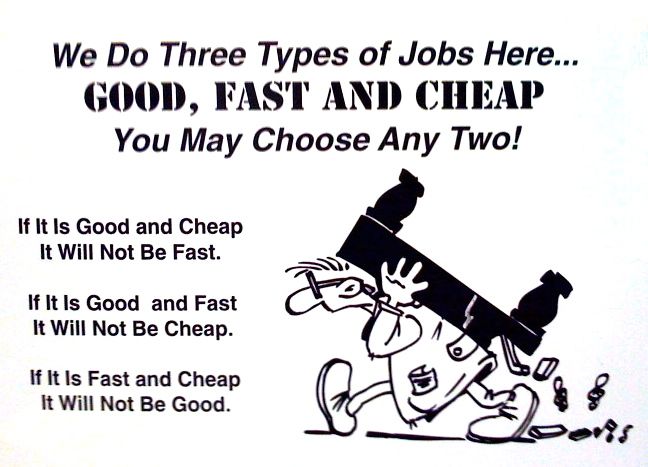
I first heard this phrase when I was in my teens working as a lot boy/mechanic’s helper at a car dealership. A former race mechanic was explaining to a customer that there are always trade offs when it comes to performance and one has to choose what is most important. He told the customer to “pick two… good, fast or cheap.” Since that time I have heard this constraint triad referenced in IT, Educational Technology, Instructional Design, Web Design and many other projects. The challenge is that all three constraints of a project are interrelated and it is impossible to realize all three. One of the contraints or properties will always suffer.
Personal experience with many projects confirms that if you want something that is good and cheap then it won’t be fast… if you want something that is good and fast… then it won’t be cheap and if you want something fast and cheap… then it won’t be good. I have yet to find an situation where this principle doesn’t apply and more recently I have seen an expansion of this constraint triad apply to another area – the glacial pace of change in Education.
Consider the following constraint triad for Education:
“Pick any two—innovation, change or stability”
To ensure that we don’t get caught up in semantics I will use the following definitions sourced from dictionary.com:
If you want innovation and change in Education then you won’t have stability. If you want innovation and stability then you won’t have change and if you want change and stability then you won’t have innovation. This is NOT a new idea. Clayton Christensen the author of the concept of disruptive innovation points to the challenges that Education faces in the book Disrupting Class which focuses on K-12 Education and the book Innovative University which deals with Higher Education. Christensen points to years of research that confirms that true innovation is disruptive because it introduces something new and upsets or disrupts the status quo. He also uses the term of sustaining innovation that explains that a product or service can improve over time but this type of innovation has no real transformative effect because it doesn’t introduce something new or significantly different.
Therefore, when you examine the stated positions of the leadership and faculty in Education you will note that while they may be willing to talk about innovation in Strategic Plans, Vision and Mission statements, Academic Plans or even list innovation as part of their organization’s Core Values, their actions reveal a preference for stability. Once again I am not the first author to point to this inconsistency. In the article Innovation in Higher Education? HAH! Ann Kirschner Dean of William E. Macaulay Honors College at the City University of New York argues that College leaders need to move beyond talking about transformation to actually transforming Higher Education before it’s too late. If you have any doubt about the lack of innovation and proactive change in Education please refer to the dozens of articles, blog posts and books that I have reviewed or summarized in the Change category on this blog.
Since stability is so important to many of the leaders and faculty in Education it comes at the expense of innovation. When you pick stability and innovation you do so at the expense of change and at best you may get sustaining innovation which really is just a slight improvement on the status quo – blackboards to whiteboard, overheads to PowerPoint, large lecture halls to MOOCs and so on. When you pick stability and change you loose out on innovation all together. Unfortunately, educational reformers dating back to the likes of John Dewey and earlier (see post Progressive Education – Are We There Yet) have been pointing to the need for innovation in our educational system.
Perhaps if we challenged the leaders and faculty in Education to “pick any two—innovation, change or stability” then we would at least be able to account for why things change so slowly…or better yet may be able to motivate educational leadership and faculty to face the reality that if they really want innovation then they can’t have the levels of stability that are they are so accustomed. The renowned educational reformer Ken Robinson argues that we don’t need evolution in Education we need a learning revolution. Where do we start?
Stop hiring so many traditional risk adverse leaders and faculty. I have sat on many selection committees where the majority of the group is simply looking for the “safe bet”. Rather than embrace an individual’s potential, entrepreneurial spirit and unconventional career path or out of the box thinking most selection committee members will look for a stable work history, a traditional promotional path and other safe factors. We need to heed the advice often attributed to Albert Einstein. Although he never actually offered the following quote this notion of challenging conventional thought is still useful:
Insanity is doing the same thing over and over again and expecting different results.
It is impossible to become an innovative or entrepreneurial organization by continually hiring traditional and conventional people. Educational organizations need to hire innovators and entrepreneurs and once they do, let them do the work that they were hired to perform. This takes courage. Innovative, entrepreneurial and out of the box thinkers push the limits, ask uncomfortable questions, offer unique solutions and make some people feel uncomfortable. But this is good. Educational institutions should be learning organizations and learning must be at their core. Learning is a messy, uncomfortable endeavour and innovation and change is just part of the learning process–shouldn’t it be part of organizational culture?
Does your organization genuinely embrace innovation and change? Or is stability and the status quo the top priority?


