While I appreciate the message in the video and agree that we need to empower our learners to become more self-directed the author doesn’t really provide any suggestion on how to do this. This is where the Learner’s Mindset and the CSLE+COVA approaches come in. Don’t just talk about empowering your learners, take the steps to make this happen.
Even though the authors of this video subtitled the video “The Science of Better Learning” the reality is most of these tips deal with memorization and studying and have much less to do with learning which is the making of meaningful connections.
I wish that educators would get the language right. Regardless if you are in a situation where you need to engage in information retrieval or you want to be honest with your learners and help them prepare for standardized testing then the following video will help your students improve their information retention and regurgitation.

PDF of Video Slide Deck
Finks Resources
The first half of the video points primarily to the traditional cognitive alignment that we should strive for in our instructional design and curriculum development. If you are engaged in competency-based education that is part of a skills-based program, introductory to intermediate courses, instruction that is designed to prepare students for a credentialing exam, or other forms of standardized testing and evaluation then the cognitive alignment which we outline is the minimum alignment you should apply.
Alignment

If you are working at a higher level or are able to incorporate authentic learning opportunities through project-based learning and are using an outcome-based design then you will have the opportunity to expand your scope of alignment and incorporate more aspects of the affective and the psychomotor domains and better address the whole learner. If you are not familiar with the difference between competency-based education vs outcome-based education or need confirmation of how I am using these two concepts please refer to the post Why I Don’t Use Checklists, Progress Bars & Other Activity Monitors to explore these ideas further.
To explore alignment at a higher or more wholistic level you need to first change your focus:
When you create a significant learning environment (CSLE) in which you give your learners choice, ownership, and voice through authentic learning opportunities (COVA). The CSLE+COVA framework shifts the focus from the curriculum, skills, and abilities to the authentic learning opportunity which ideally should be a real-world project that will have a significant impact on the learner and their learning community. The skills and abilities may still need to be developed or supported but the learner takes on the responsibility to become more of a self-directed learner who acquires or learns those skills and abilities in a just-in-time fashion as they work toward solving the challenge of the authentic learning opportunity. The instructor takes on more of the role of coach, guide, and facilitator and helps shift the learner from assessment of and for learning to assessment as learning
Alignment is one piece of the learning environment and we must warn against the notion of looking for a quick fix or simple application of a tool to help you find this alignment. This is part of a well-thought-out and planned instructional design or curriculum development process.
Additional resources to consider:
Collecting dots vs connecting dots
Assessment OF/FOR/AS Learning
Feedforward Vs. Feedback
We Need More Autodidacts
How to Change the World One Learner at a Time
3210 Curriculum Resources
COVA eBook
Dwayne’s Recommended Reading
To Script or Not To Script…
The more instructional videos that I make the more I have learned to rely on scripts to ensure that I am conveying an effective message. I now use a script for the following:
- 2-3 minute or less introduction, promotion, bridge video,
- 4-10 minute overview, contextual, foundational, tips, video
- 10-18 minute informational, TED Talk style of video
To estimate the time of my script I will often refer to the Voice Over Script Word Counter at thevoicerealm.com
Even in my long-form discussions I still work on an outline with my collaborator so there is some form of guide or script. When I create a Tips or Tutorial video and I use a tool like screencast-o-matic to insert my talking head into the video on the bottom corner of the screen, I will use the slide deck, website, article, document, or other resources I am explaining as the script. I also plan out what the key points will and what parts of the resources I will highlight.
The only time I don’t script is when I create the 2-8 minute feedforward videos I create for my students when I am giving them educative or formative assessment. But even in this context, I have a format that I follow so while I am conversational in my feedforward I still have a specific structure or a very loose script.
While I have spent most of my emphasis on why I script I cannot ignore why scripting, narrating, or as I like to say telling a good story can be powerful and transformational. I have been exploring these ideas for several years and the following posts have the potential to take you down quite the rabbit trail. Don’t worry it is a worthwhile journey:
- Want To Change the World – Tell a Good Story
- Power of Story
- Video – Short and Simple is More Engaging
- The Human Mind is a Story Processor, Not a Logic Processor
- Video Vision Casting in Transformative Scenario Planning
- How to Use The Power of Video
- Power of video & sound
- Apply to Goucher College Using Video
Teleprompter
Since I use a script for most videos I also use a teleprompter. Finding the right teleprompter has been a bit of a journey. When first started to formalize my video creation process I used my whole living room as my studio and I used a DIY teleprompter and either a full-sized Android tablet to project my scripts.
This worked great but, the space needed, the setup (20-30) and take downtime (15-20) and the need for an assistant to run the camera and teleprompter limited my options. As the need to create more videos increased I shifted to more of a permanent setup in my small office space.

I experimented with a web-based teleprompter CuePrompter. Even after positioning the script directly below my camera I still found that it looked like I was reading because my eyes were not directly focused on the lens of the camera. After researching several lens mounted options I have been using the Parrot Teleprompter from Padcaster.
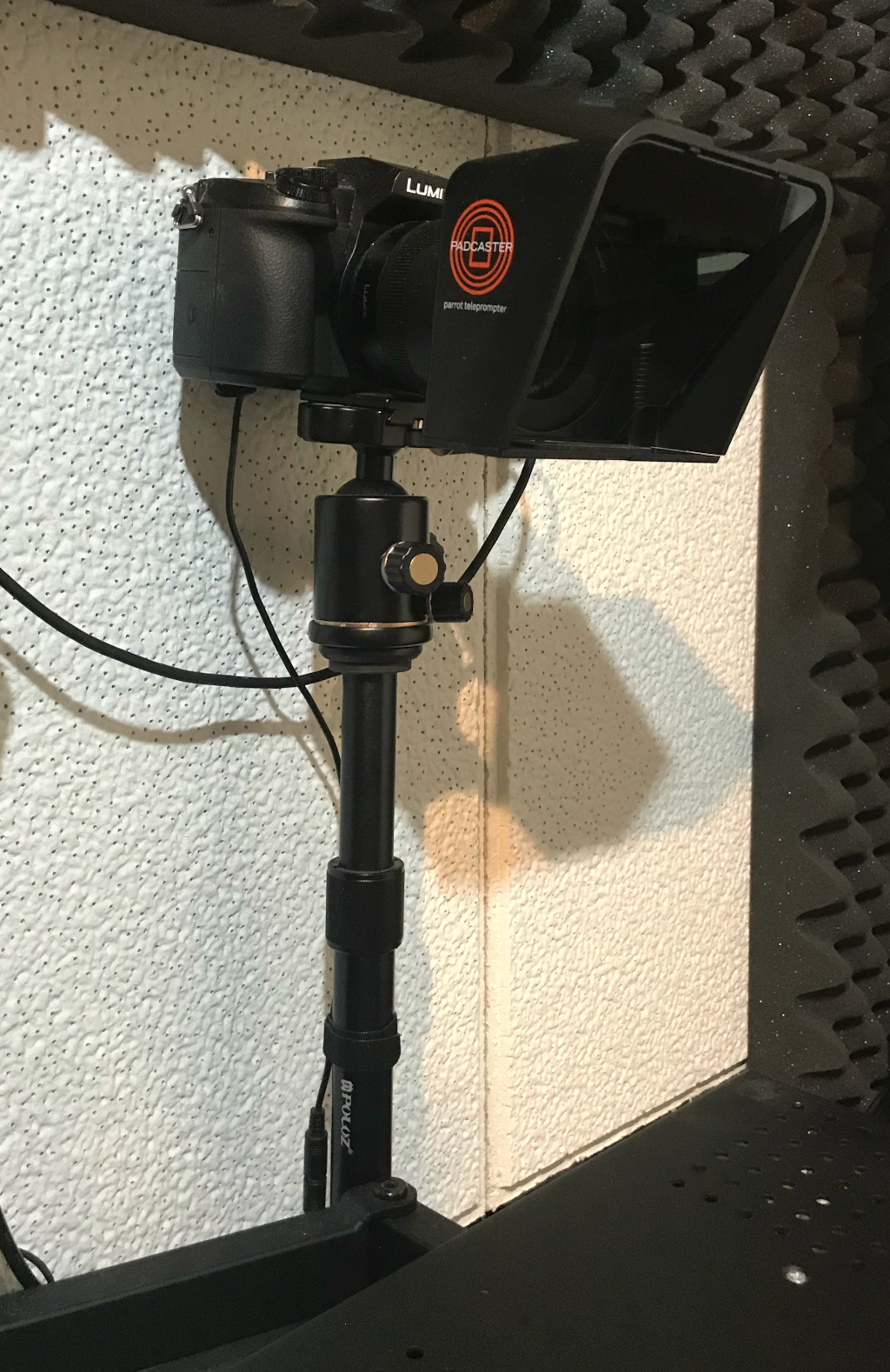
At $100 US or $175 CDN it is a reasonably priced solution that is very simple to set up. You just screw on a mounting bracket to your lens and the teleprompter slides into place. You slide the iPhone into the bottom shelf and you are ready to go in less than a minute.
The plastic teleprompter that mounts on your DSLR lens is great but when you combine it with a voice-activated app that will track your voice and scroll your text as you talk you are at a whole other level of productivity. the SmartPrompt Pro app that I am currently using enables me to stop and start and control the teleprompter as I go through my narration
Because my camera is so close I can reach out and simply scroll the teleprompter script back to the section I want to re-shoot and restart the teleprompter. This lens-mounted teleprompter is one of the last pieces to my video production setup that I wish I would have explored sooner. This is one of many pieces to the video production puzzle that I have been working on over the past few years. While have finally gotten to the point where I can be up and running in just a few minutes there are still many areas of improvement that I am continuing to explore.
Please refer to my DIY Video setup posts for more details on the audio and lighting considerations.
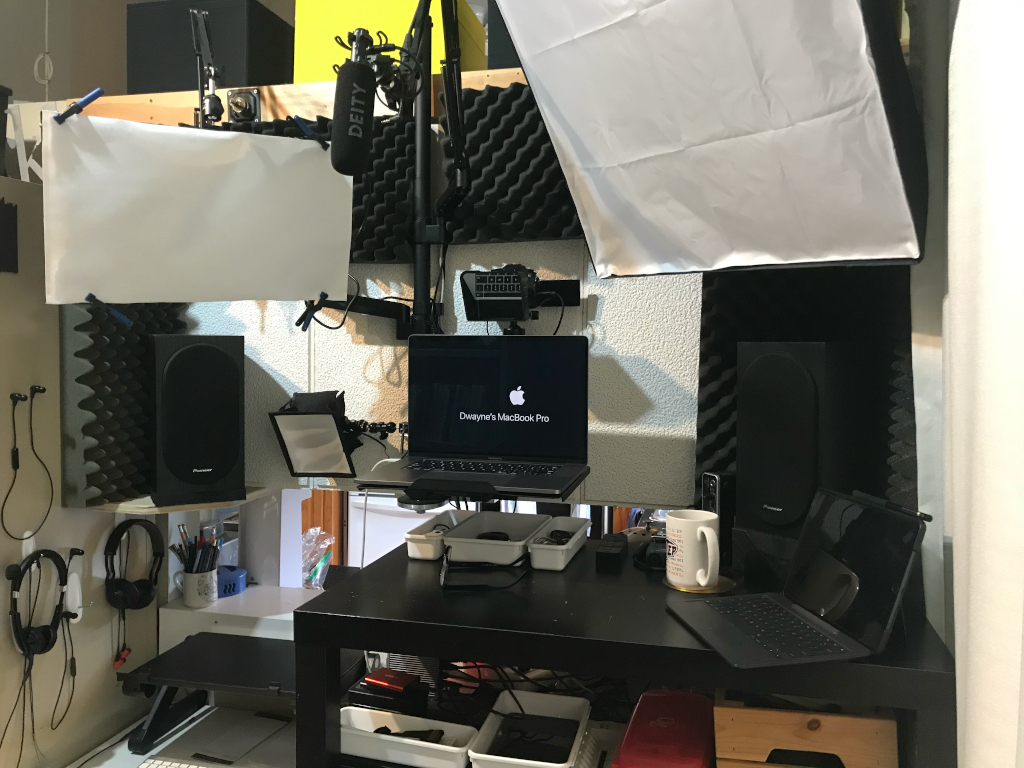
Also, remember that my office setup is very compressed so the limited space that I have to work in is a very important consideration. If you have more space you will have many more options. If you are like many people dealing with the COVID pandemic of 2020/2021 you may be working from home so your space or lack of space will also be a consideration.
Regardless of your situation, I trust these ideas that I have shared will help you become more efficient and effective at creating videos for your instructional setting.
Recommendations:
Voice Over Script Word Counter at thevoicerealm.com
Parrot Teleprompter from Padcaster
SmartPrompt Pro
Dwayne’s DIY Video Setup series:
Dwayne’s DIY Video Setup – Part 5 Audio & Lighting Update
Dwayne’s DIY Video Setup – Part 4 Audio
Dwayne’s DIY Video Setup – Part 3 LED Lighting Update
Dwayne’s DIY Video Setup – Part 2 Lighting & Background
Dwayne’s DIY Video Setup – Part 1 Teleprompter & Tripod
Dwayne’s DIY Video Creation Toolbox
My Video & Media Tools


