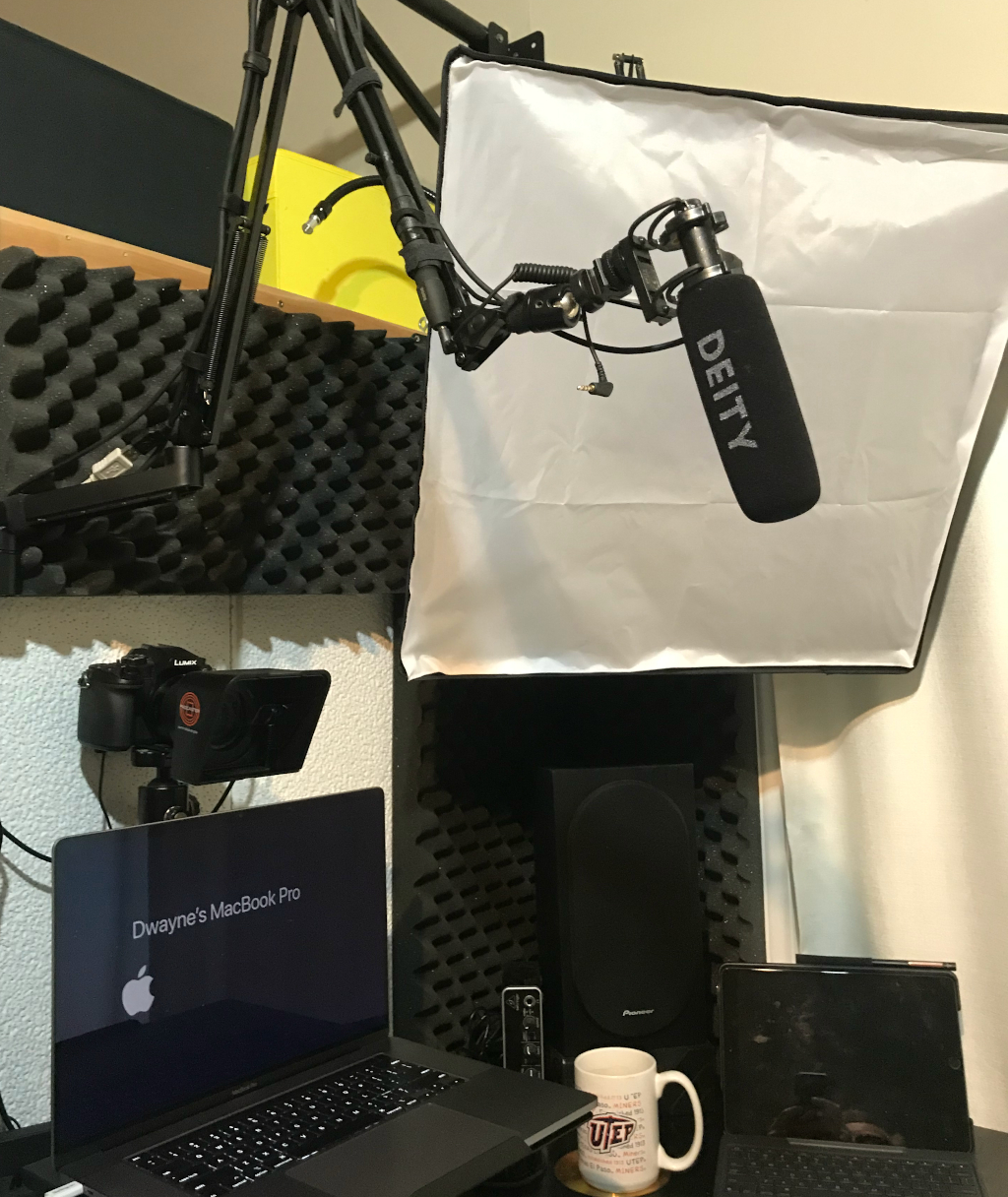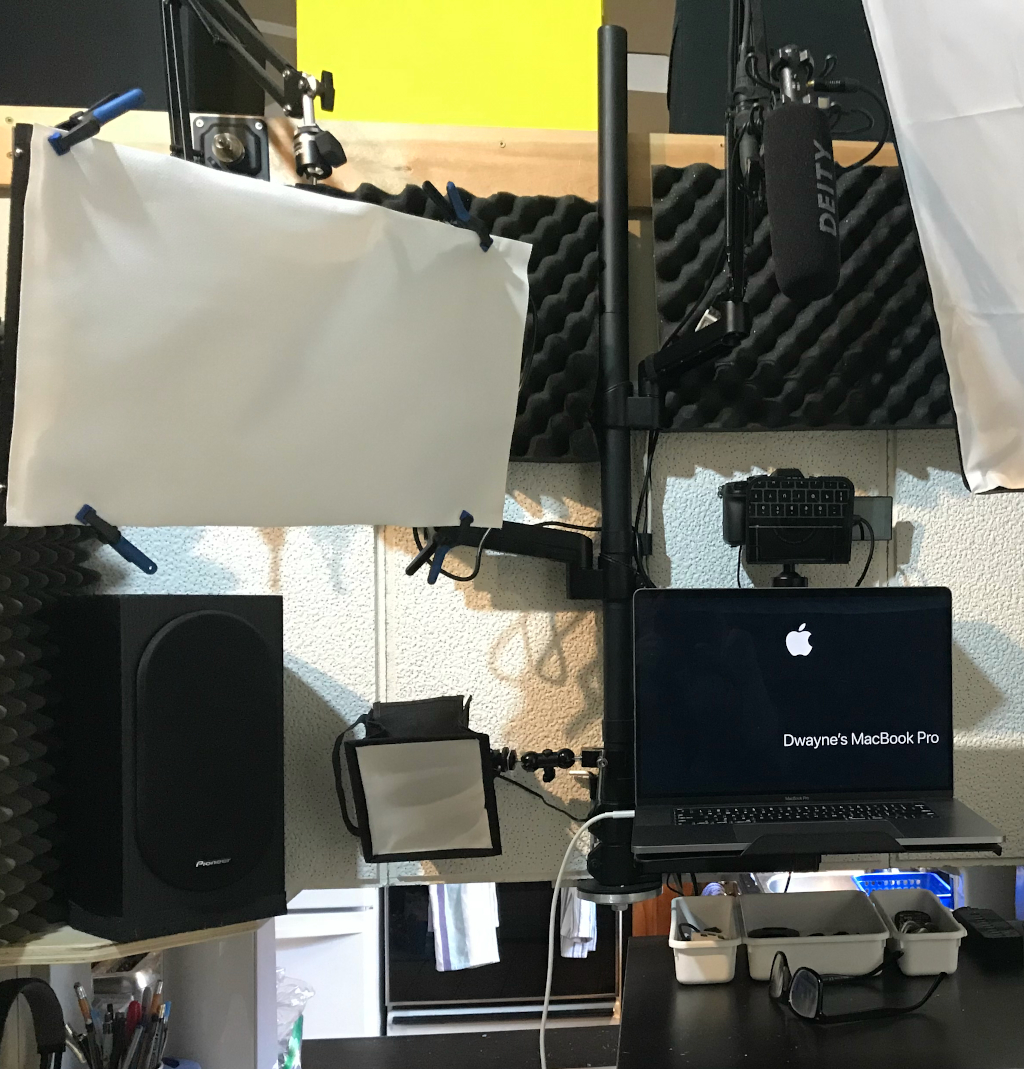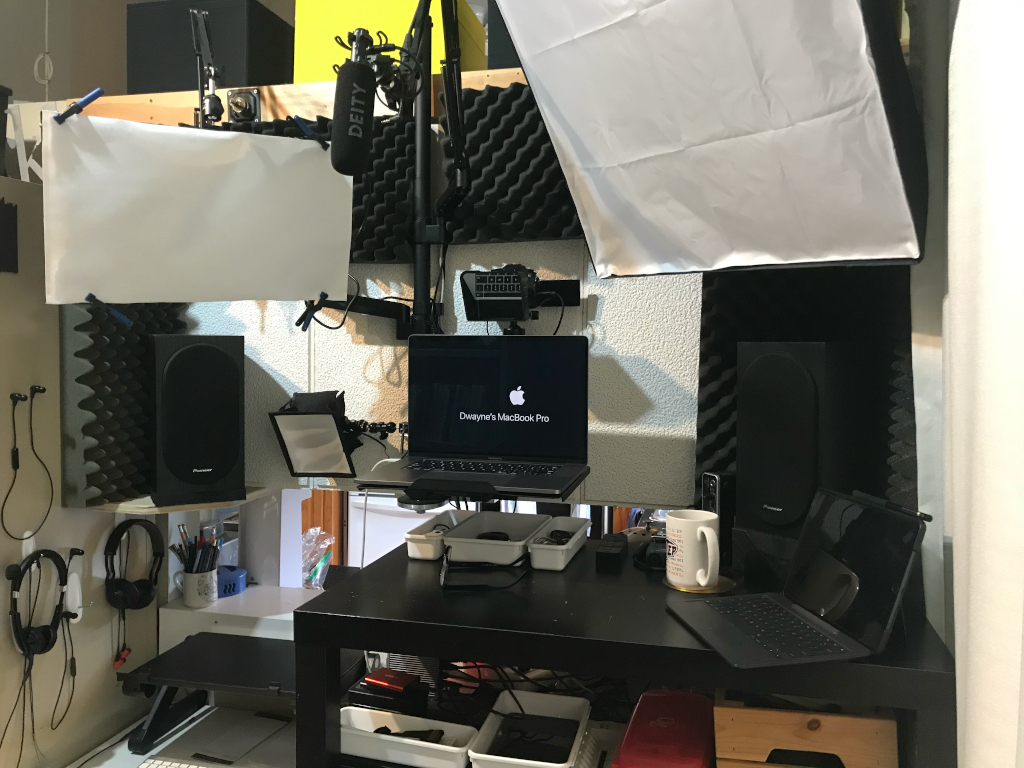
My last posts about my DIY Video setup were back in March and April of 2019 and since that time I have continued to refine my office/studio. I had been planning on posting another part of this series earlier but each time as I was about to start writing I would wait because I had one more tweak to make or had one more item coming in that I was going to test out and integrate into my setup. I shot a video last fall about my long and costly journey to my latest shotgun/boom mic the Diety D3 Pro which I finally edited and posted last week – How to Avoid Paying $600 for a $300 Mic. I create these posts with the intent to share my lessons learned and offer some well-informed recommendations but I have just been so busy with tweaking my setup, doing research, writing articles, working on a new book, and creating and developing learning environments.
Between the start of this post and the final edits have added the Zoom PodTrak P4 and will be experimenting with this new audio interface and which should help improve and balance out the audio between my colleague and I when we do our Learner’s Mindset Discussions. I have to face the facts that I will continually be improving my video setup and my studio and I just need to take a snapshot in time. I will try to be as brief as possible and will be linking back to previous posts for those who want more details. I also initially planned on providing a full overview of my entire studio/office setup but as I started going through my audio and lighting updates I realized such a comprehensive post would be too long so I am only doing an audio and lighting update.
I will do another post where I will share more details on the hardware and equipment I am using, the physical space, the furniture, the soundproofing, and all the connective components that most people are not aware of. I will also be providing a short recommendation at the end of each of the sections below with affiliate links to where I purchased the equipment. As you can tell I have spent more than I should on my setup so if you click through and buy something from Amazon I will get a few cents that I will use to keep on improving and sharing my ideas. Please keep in mind that I am working in an extremely compressed space so size and flexibility are factors that play into my decisions and recommendations. Your situation may vary.
Audio – Getting the sound right
Microphones for Instructional Video
It is widely accepted that people will put up with a video that isn’t sharp but they will not tolerate poor sound. As you can see from my earlier post: Dwayne’s DIY Video Setup – Part 4 Audio I have been experimenting with more traditional podcasting condenser style microphones and used a variety of microphone stands. I have learned that since I use a standing desk I have the tendency to move too much, talk with my hands, and at times tap my desk so the more traditional podcast setup doesn’t work well for me. I am currently using a Diety D3 Pro shotgun mic that is attached to an extendable arm. One of the drawbacks of using a shotgun or boom mic is that they are very sensitive and will pick up ambient sound. With a bit of planning and scheduling as well as making sure I turn off technology notifications, fans, air conditioning, or other noisy devices the ambient sounds can be managed.
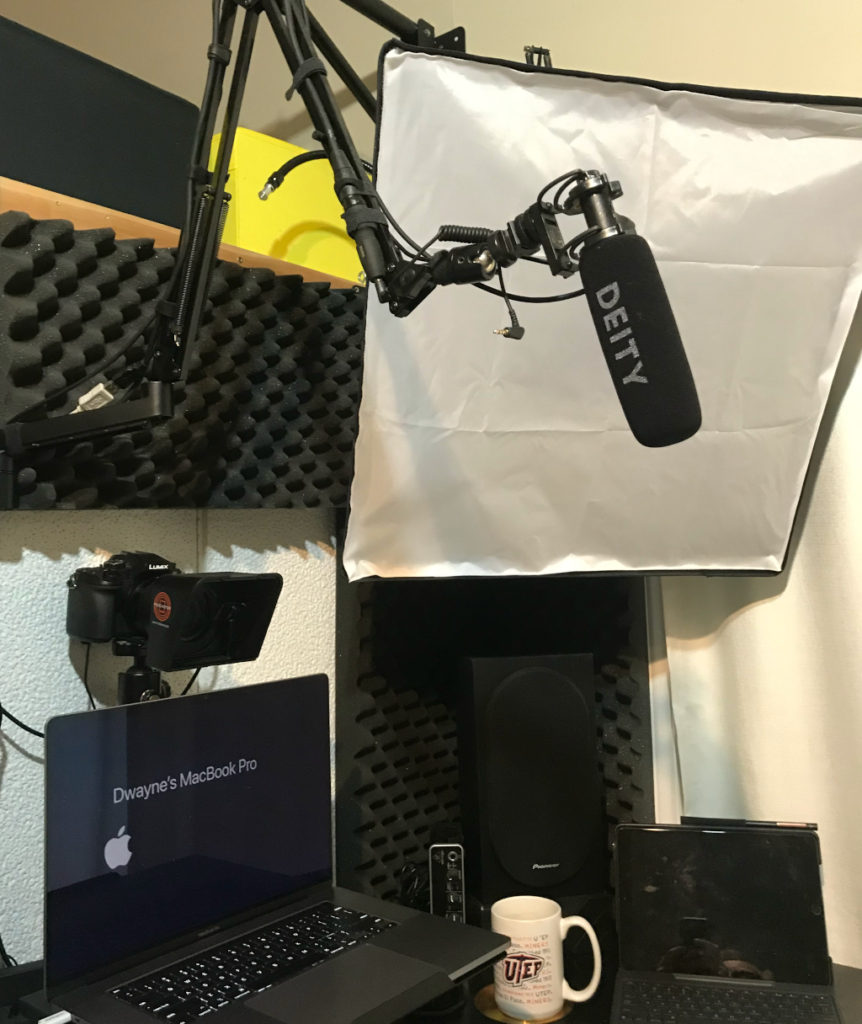
The Deity D3 Pro is a powered mic with adjustable gain which can be plugged directly into my DLSR which I do when I create my talking head type instructional videos. Deity D3 Pro can easily be adapted to XLR with the Diety XLR adapter and connected to an audio interface so it is very versatile and is currently my main mic.
Microphone/Headset for Zoom
Even before the pandemic of 2020 hit I had been using Zoom and a variety of other video conferencing solutions to engage with my students. In the 25 plus years of teaching online, I have experimented with and used every imaginable solution to improve the audio quality of my meetings. It didn’t take me too long to learn that while the inexpensive consumer-grade headsets from Logitech or Microsoft or other popular brands did offer acceptable audio they really weren’t built to last. I have spent thousands of hours in video conferencing meetings and have created thousands of feedback videos for student evaluation so I do use a headset much more than the average person. I started exploring professional or call centre type headsets and found that the audio quality and durability of these solutions justified the additional cost. I also need to point out that my office is on the main floor of an open concept area in my home so ambient noise from life is a constant challenge. I use a headset to filter out this noise as much as I use it to have quality sound in my meetings. I also do travel a fair amount (when not locked down by COVID) so it is not uncommon for me to hold meetings or create feedback videos for my students in coffee shops, airports, hotel lobbies, or other public places.
I am currently using a 4-year-old Jabra Evolve 20 headset that is discontinued but I would not hesitate to purchase the new Jabra headset. Last year I got the Jabra Evolve 40 headset for my wife when she started to teach online. I have used her headset and it works as well as the older version I currently use. When my current headset finally dies I will be replacing it with another Jabra headset. The sound quality and durability are exceptional and they just work. If you need a wired stereo headset then the Jabra Evolve 40 is one of the best wired solutions I have used.
What about wireless?
I have been experimenting with wireless headsets, headphones, and earbuds for many years and I have spent several hundreds of dollars and have quite the collection of devices. Wireless works great when you are simply listening to music or audiobooks but there can be latency issues with some Bluetooth devices which makes them less reliable for video conferencing. Latency is just the lag that happens with the Bluetooth connection. Most latency is in the millisecond range so it is not noticeable when listening to music but it can cause some issues with video conferencing. For example, it is difficult to get wireless headsets to work reliably with Adobe Connect Pro. They will connect but there are often reliability or sound quality issues. Zoom is a much more robust system and I have found that I have had better results with wireless devices and Zoom.
For example, I am currently using the Apple AirPod Pro which I recommend if you are using an Apple ecosystem and I have had greater success with AirPod Pro and Zoom. The AirPod Pro enables me to switch from my iPhone to my iPad to my MacBook Pro without any special configuration which makes then the most convenient but expensive solution. As convenient as the AirPod Pros are I will still use my wired Jabra headset when I can using video conferencing. Why? Much better sound and total reliability. You don’t purchase the AirPod Pros for the sound you get them for the convenience of switching from or between your Apple devices.
I can’t talk about wireless earbuds without mentioning the Aukey Wireless Headphones. These retail for $25 US or $40 CDN on Amazon so they are quite inexpensive but sound great, have full base, and the magnetic backs allow one to keep these corded wireless headphones around your neck when they are not in use. I purchased a pair for everyone in our household and my wife’s pair are still going strong after about 3 years. Both of my boys use these headphones on a regular basis as workout headphones. These are my go-to headphones when I am working out, running or when I am on my bike. They have proved to be almost indestructible and even if they do get damaged the replacement cost is so low that it doesn’t matter. I am on my second pair in the last 3 years which is significant when you consider how much I use them. I must admit the reason I needed to replace my first set is that I accidentally ran them through the wash. I did dry them out and they did work for a while but then the right channel finally died. If you don’t want to damage your $300+ AirPod Pros at the gym or lose them on the bike trail I recommend the Aukey Wireless Headphone.
Wireless Audio
Rode Wireless Go is my latest wireless experiment and so far it has proved to be a wonderful solution. The Wireless Go functions as a clip-on microphone or belt pack transmitter for a lavalier/headset microphone. Since it operates on its own 2.4GHz digital wireless transmission frequency it isn’t subject to the same latency or reliability issues that plague Bluetooth systems. The receiver can be attached directly to a DLSR and you can use either the built-in mic on the transmitter or plugin a lavalier mic. My older son who races Downhill and Enduro mountain bikes is currently experimenting with this system while recording his rides with a GoPro. So far, the Wireless Go has proved to be easy to use and very reliable. Once the COVID situation lifts and I am a bit more mobile I can see many more uses for this system.
Lavalier
A good lavalier mic offers one of the simplest ways to get quality audio. Several years ago I plugged a Rode Lavalier Go into my iPhone and I was able to improve my audio quality in my videos with this simple addition. You do have to sync the additional audio track to your video in post-production but this process is very simple if you have the right software.
I recently added the BOYA BY-M1 Lavalier Microphone kit to my audio gear and for a very low price, you get two professional-grade lavalier mics that can be plugged into an audio interface or my Rode Wireless Go. I originally got the BOYA mic to give my boys the option of using a lavalier while making their biking and automotive videos. These mics are very inexpensive and so if they get damaged which is more than likely in an extreme sports setting, getting a new set isn’t that much of a financial hit. We have found the audio quality to quite good and have been using these more than initially expected.
Recommendations:
Shotgun/Boom mic – Deity D3 Pro
Podcast Style mic – Blue Yeti
Wired Headset for Video Conferencing – Jabra Evolve 40
Wireless earbuds/headphones – Apple AirPod Pro & Aukey Wireless Headphone
Wireless audio – Rode Wireless Go
Lavalier – Rode Lavalier Go or SmartLav & BOYA BY-M1
Audio Interface
I have used a few different audio interfaces that range from entry-level Behringer U-Phoria UMC22, the Zoom H5, and more recently the Zoom PodTrak P4. When you use higher quality XLR microphones or need to mix audio from an off-site collaborator via a Zoom video conference these interfaces can simplify the task. The Zoom PodTrak P4 enables me to bring in my colleague’s audio in via Zoom and balance and mix it with my own audio. It has a built-in mix-minus feature that prevents echo or feedback for my co-host. I simply push one button and the mix-minus is on. This is so much easier than using additional cables, sound routing, and the configuration hoops I had to jump through to make this work on my Zoom H5. One of the challenges you have, when you start introducing more devices, are the additional configuration and complexity. I have been working at trying to simplify my entire workflow and limit complexity as much as possible. Learning to limit complexity is a tough lesson.
Just because you can do something it may not be the right thing to do. I had used my Zoom H5 as the pre-amp and routed the audio from the Deity D3 Pro to the H5 before feeding it back into my DSLR. It took me some time to find the right shielded audio cables that limited the audio feedback and even though I was able to have more specific control over my audio the improvement was negligible. My Panasonic G85 DSLR has clean enough pre-amps that I can simply plug my Deity D3 Pro directly into my camera which saves me having to sync my audio in post-production. While I am still going to explore more microphone and audio interface options my ultimate goal is to save time and effort in my workflow.
Recommendations:
Entry-level option – Behringer U-phoria UMC22
Portable option – Zoom H5 mobile recorder
Multisite video conferencing and podcasting option – Zoom PodTrak P4
Lighting
When it comes to lights bigger and softer are better. LED lights can not only save you space their brightness and light spectrum can be easily configured. I am still using the Aputure AL-F7 LED light as my key light and the Neewer 24″X24″ softbox which I talked about in greater detail in the post Dwayne’s DIY Video Setup – Part 4 Audio. I have incorporated the Neewer’s Rollable 30x53cm Flexible LED Light Panel Mat as my secondary light and shifted the use of the ESDDI 176 LED light to my seated video conferencing light. If I were starting from scratch and I didn’t have much space, I would consider using two Neewer Flexible LED Light Panel Mats. They take up very little space, are so lightweight they can be attached to almost anything, can easily be softened by simply adding diffusion material, and the remote control option to turn the lights on and off as well as to adjust the intensity and spectrum make them very easy to use.
Perhaps the biggest lesson I have learned with lighting is to soften or reflect the light so adding a softbox to my Aputure AL-F7 and other LED lights has been the first step to balanced lighting. If I had space I would get the largest softbox I could accommodate. Unfortunately, I am working in a very tight space so the 24X24” softbox is the most that I can fit. LED lights are so powerful that you can dial up the intensity and with the reflection in the softbox combined with appropriate diffusion you can get very natural and consistent lighting. To add additional diffusion I simply cut a piece of diffusion silk and clamp it onto the light with clamps.
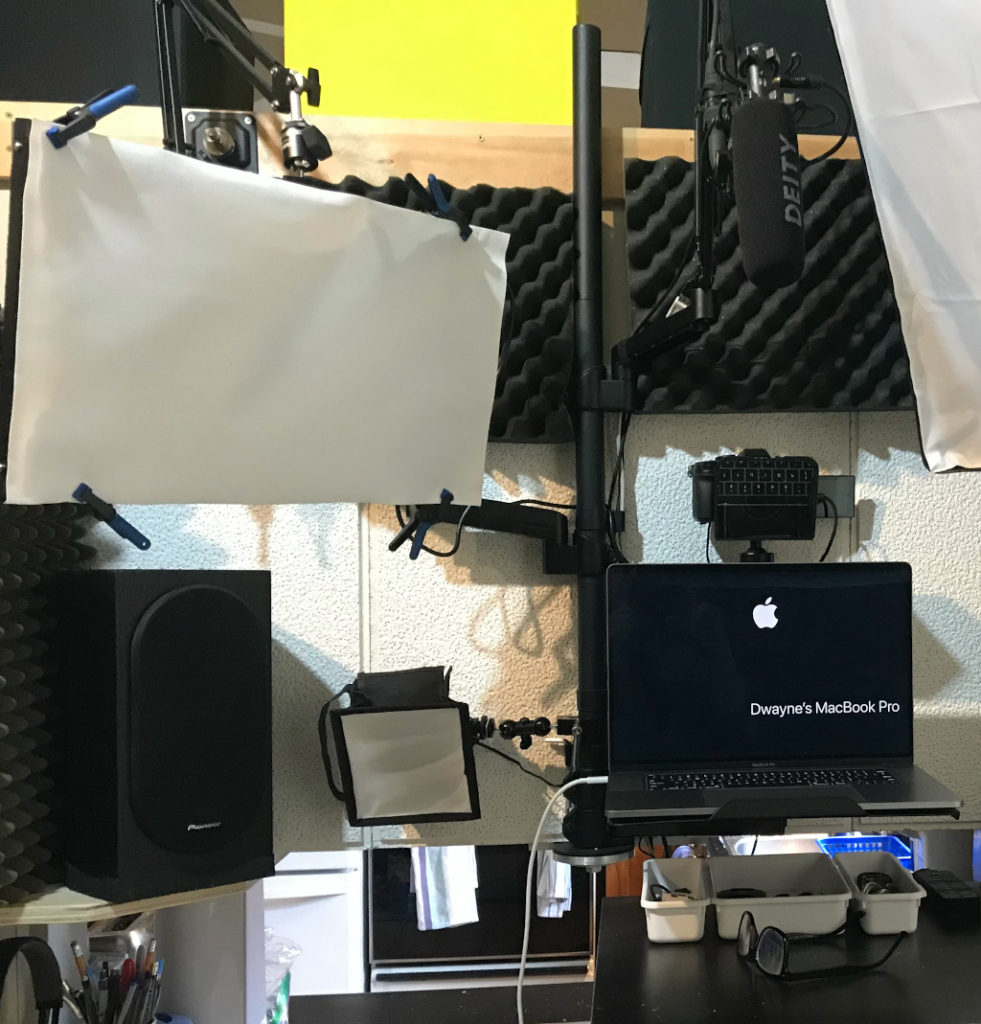
I am still experimenting with the Neewer Rollable Flexible LED Light Panel Mats but as I mentioned earlier if I was starting over I would more than likely get two of these lights or another LED mat style light. Why? They are so thin and light that I have much greater flexibility in positioning them. This light takes up a fraction of the depth of my softbox setup with my Aputure AL-F7 and as result, I am able to position it far enough out of my shot that it limits the reflection in my glasses.
This may seem like a minor point but it is actually another significant lesson I have learned. Because I wear glasses I have to always be aware of the fact that if I don’t position my lights in a wide and high enough angle I will get a reflection. I have also learned that I need to dial down the brightness on my computer screen to limit the reflection in my glasses.
Because sitting for extending periods is not the best for your health, I stand while I work and while recording most of my videos so I have configured my audio and lighting to accommodate this position. I do also sit occasionally and so I also have another light that I use for video conferencing or when I am doing video evaluation. By simply dialing down the intensity on my ESDDI 176 and by adding a mini softbox I am able to get the benefits of a rim light without having to be limited by its layout.
Recommendations:
Key Light – Aputure AL-F7 Or Aputure Amaran AL-528
Fill/Key Light – Neewer Rollable Flexible LED Light Panel Mat
Fill & Background/Rim Light – ESDDI 176
Diffusion Silk – Neewer 2 Yard x 60 Inch/1.8M x 1.5M Nylon Silk White Seamless Diffusion Fabric
Softbox – Neewer 24” X 24”Softbox
While audio and lighting will have the biggest impact on your video set up there are many other aspects to setting up your office/studio for an effective workflow. Stay tuned for another post where I will point to the hardware and equipment, the physical space, the furniture, the soundproofing, and all the connective components that I use to improve my video setup and my workflow. The following are the links to my previous posts in this series:
Dwayne’s DIY Video Setup – Part 4 Audio
Dwayne’s DIY Video Setup – Part 3 LED Lighting Update
Dwayne’s DIY Video Setup – Part 2 Lighting & Background
Dwayne’s DIY Video Setup – Part 1 Teleprompter & Tripod
Dwayne’s DIY Video Creation Toolbox
My Video & Media Tools