Make – Learning at its finest

Jason Hiner of Tech Republic offers his take on Gartner analyst David Cleary’s predictions on the technology trends for 2012. The first 5 items on the list are all aspects of mobile computing:
- Media tablets and beyond
- Mobile-centric applications and interfaces
- Contextual and social user experience
- Internet of Things
- App stores and marketplaces
There should be no surprise that mobile computing and all that it entails is at the top of the technology trend. We are living in a mobile world and as the technology gets better and better we will focus less on the technology and more on what it enable us to do.
While Hiner was surprised by cloud computing’s drop from number one in 2011 to tenth in 2012 I simply see this as the logical progression in a technology implementation that is successful. The cloud is necessary to make mobile computing work and as we focus more on the things we need to do with mobile technology cloud services are there to make things work but we no longer are making a bid deal over this development. Some would argue that the cloud’s drop in significance is due to the fact that there are still too many advantages to running enterprise systems like ERP and the like over a closed network. This is a fair assessment for now but if businesses wish to remain competitive in the global market they will have to embrace mobility and the cloud sooner than later.
Some of us have been using mobile technologies as early as the late eighties or early nineties so while this current emphasis on mobility may be appear to be the “flavor of the day” to skeptics, it is an overnight success that was in the making for the past 25 years. We are finally getting to the point where an average user is able to use an iPhone, Android or tablet to not only access the conveniences of life but to help them do their work.
Case in point–I am writing this post on my MacBook Air at the airport waiting for my connecting flight. I am also using my iPhone to check the status change for my flight on Tripit. When I get to my destination I will be using the Map app to help me navigate to my hotel which was booked on my iPhone.


I have been waiting for this official announcement for many months. While I was still at Abilene Christian University (ACU) early this past year I learned about this new system when ACU was informed that Perason and Google were combining forces and ACU was chosen to be a test site. At the time of this early trial the system that is now called OpenClass didn’t even have a name. Now that my colleagues at ACU are no longer bound by a non disclosure agreement I look forward to quizzing them about their experience with this new system.
Having another option to Blackboard and Moodle means we can perhaps see some true innovation in the course/learning management space. If OpenClass works as well as the rest of the Google Apps for Education suite we are all winners because the more competition there is to Blackboard (who controls over 80% of the course management space) the more choice and flexibility educators will have.
The only downside to this is the fact that OpenClass will more than likely have an initial impact on Moodle which is a free open source platform many institutions are using rather than Blackboard. While Moodle is free it really doesn’t offer much of an alternative to Blackboard because it simply mirrors Blackboards functionality and it requires a significant amount of time, effort and resources to maintain. With Google hosting OpenClass the maintenance and support issues of hosting an CMS/LMS go away.
Time will tell if OpenClass will the same postive impact on Higher Ed that Google Apps for Education have had. I know we (Concordia) will be exploring this options as soon as we can.
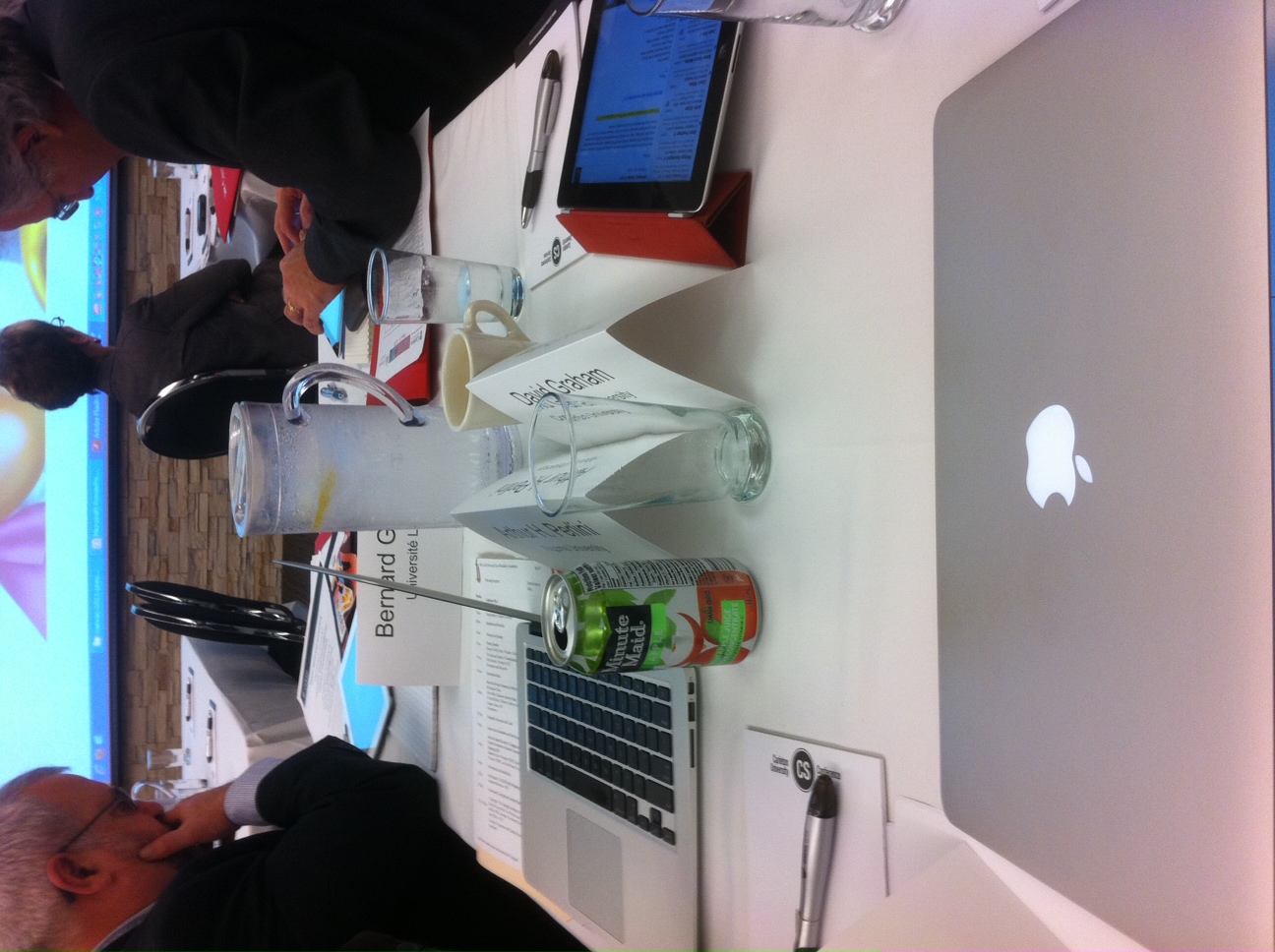
This is a shot of the technology use at my table at NATVAC 2011, the national meeting of Canadian Provosts and Vice President Academics, in Ottawa. In addition to the 2 MacBook Air there are 3 iPads as well as 5 iphones being used at my table. We were allowed to self select where we sit so this concentration is not planned. There are several other tables with all 5 members who are using iPads or other technologies. I took the time to scan the room and out of the 65 attendees there are only two people using PCs and most people are using iPads, MacBook Airs or MacBook Pros. Similarly the smart phone of choice is the iPhone and most people are using the iPhone 4.
More than 3/4 of the VP Academics in attendance are actually using technology in this session. Yes, the iPads or MacBooks are on the tables are being used as the sessions run. A quarter or less people are using paper to take notes during this session and many of those taking notes on paper are also using iPhones to check email or whatever else they need to do.
Why is this significant? This is my first meeting but I have talked to a few other longer term attendees and they confirmed that this is a very recent phenomenon. With more iPads in use than any other device one can only speculate that the iPad was the device that has changed the way that the VP Academics work. Many of these people are no longer just passively listening they are either engaged in taking notes or are engaged in some aspect of work. This is very good to see. If the iPad or similar technologies are good enough to use in workshops/meetings at this level then it isn’t a stretch to promote this type of technology use in the classroom.

“Its about the learning” or a least it should be according to several authorities quoted in this Globe and Mail article. Canadian universities must place as much emphasis on teaching and learning as they do on research. This is not a new warning and organizations like the Association of Universities and Colleges of Canada (AUCC) have seen the proverbial writing on the wall and are looking at how Canadian universities can proactively address these challenges and has developed a website called Great Beginnings that points to examples of innovative teaching and learning in undergraduate education. Institutions like Concordia are in a unique position to provide leadership in undergraduate education because for the most part we have been focusing on teaching and learning while balancing our research efforts.
The call to action for Universities to change here in Canada by AUCC the Federal and Provincial governments and many other stakeholders echo similar calls for change that we are seeing in the US. Richard Arum points to even greater challenges in Higher Education in the US in his book Academically Adrift:Limited learning on college campuses. Arums findings show that 59% of students show no significant difference in their critical and thinking skills after 4 years of undergraduate education. The solution to the problem is really not that difficult and is well within the reach of all academic institution. Arum recommends that if students were to simply read and write more then most of these problems will vanish. The solution really is this simple–we need to embrace the fundamentals of reading and writing with in a context of critical analysis and our learners will be better prepared to learn how to learn.
We need to move from the passive educational environment of main lecture points, rubrics, individual competition and standardized testing to an active educational environment of interactive presentations, critical and analytical thinking, collaboration and meaningful projects. We already do this at Concordia but we can do it better and we also need to let the world know what we have to offer.


