 An initial response to this question would be: the learner/student. It is their work so they would own it – wouldn’t they? However, if you look at current eportfolio practice and the research into learner engagement, agency, choice and voice you will find that even though the students are doing the work, more often than not they do not own the ideas and are not making meaningful connections, they are simply completing assignments and giving the instructor what they want (Barrett, 2005; Hopper & Standford, 2007; Lindren & McDaniel, 2012; Atwell, 2013; Buchem, Tur & Holterhof, 2014).
The following student statement collected as part of UBC’s ePortfolio Pilot Project confirms this unwritten instructional arrangement (Tosh, Penny Light, Flemming & Haywood, 2005):
The things we are supposed to do for it [the e-portfolio] are kind of like assignments and no offense but everybody knows, for assignments, you give them what they want – you give them what they want and they give you your mark, that’s basically the way it works.
Unfortunately, jumping through the hoops prevents deeper learning and is killing the meaningful connections that come from reflections on learning in an eportfolio (Barrett, 2005).
Gardner Campbell (2009) proposed that we move beyond the template-driven, plug-and-play, turnkey web applications where we point students to data buckets and conduits we’ve already made. In contrast, we must enable students to create personal cyberinfrastructures where students become effective architects, narrators, curators, and inhabitants of their own digital lives. This personal cyberinfrastructure has been realized in University of Mary Washington’s Domain of One’s Own and similar initiatives at other universities (Watters, 2015).
Even if we get the Domain of One’s Own piece right and give students the control over the selection of the eportfolio tools and environment we can still limit the effectiveness of the eportfolio experience if we fail listen to our students and address two additional key factors.
1. Ownership of ideas and learning
In the provocative student voice post Do I Own My Domain If You Grade It? Andrew Rikard points out:
Giving a student ownership over data means nothing if it doesn’t allow them to determine that data. At that point the student once again loses agency in relation to the institution. Promoting digital ownership is different than assigning work in publicly accessible spaces (2015).
Rikard displays wisdom beyond his years by challenging us to acknowledge that:
‘Domains’ is radical not because it is a technological shift, but because it encourages a pedagogical shift… The question bigger than data ownership is how to make ownership over ideas happen (2015).
It is this ownership of ideas that leads to deeper learning. In order to make meaningful connections one has to take ownership of those ideas and concepts in order to construct meaning. Eportfolio proponents all point to the power of reflection but unless the student is reflecting on ideas that they own rather than reflecting on artifacts and data the power of this reflection is lost. Making meaningful connections is what leads to learning.
Therefore, we have to not only give students a choice, ownership, voice and agency (COVA) over their digital domain we have to give them COVA (Thibodeaux, 2015) over their ideas. The best way to do this is through a learning environment and pedagogy that provides authentic assignments and gives the student the opportunity to solve real world problems in their own institutions or organizations.
Educators also have to create and model this type of learning environment if they wish to help bring out change in education.
2. Modeling – Walk the talk
Once again we need to look to what our students are saying about how well we model or walk the talk. The research into UBC’s ePortfolio Pilot Project Tosh et al (2005) revealed that students wanted to be shown good examples of eportfolios, be given evidence of how the eportfolio will benefit them in their studies and future work and, most importantly, have the instructors show them one of their own portfolios. The following statement from a disillusioned students in the UBC ePortfolio Pilot Project (2005) captures the essence of not being able to walk the talk:
In terms of promotion the problem is the people trying to explain it [the eportfolio] have probably never used it so in a way they have no clue what they are talking about, basically. To put it frankly – after listening to them you would be like, Okay so you as an outsider who never even used it is telling us we should do this because it is the best thing since sliced bread but you have never used it – you can’t find someone who did use it – you don’t have enough information to tell us how to use it – and now you’re telling us use it and we’ll grade you on it – this kind of makes it hard for students to accept or appreciate it.
Educators need to realize that we if expect to maintain any level of credibility and respect with our students we can only ask our students to do things we are willing to do ourselves. John Hattie points to feedback within a trusted relationship between and teacher and a student as one of the important factors in student achievement. If we effectively model what we expect our student to do with their eportfolios by showing them ours, then the feedback we can provide to our students will be much more valuable and more openly received.
Fortunately, there are instructors who are effectively modeling deeper learning in the Domain of One’s Own project at MWU (Groom & Lamb, 2014) and several other institutions who have adopted this model.
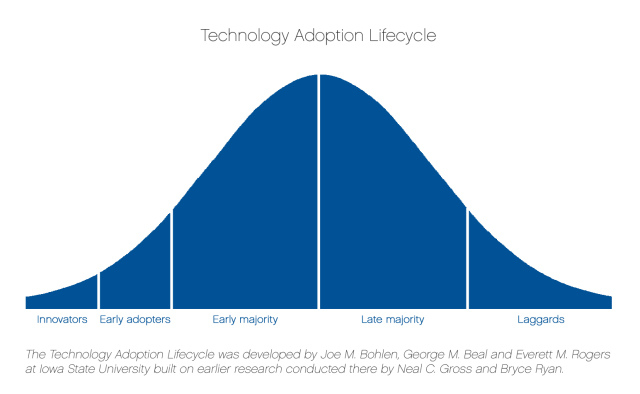 Image Source: https://marcabraham.wordpress.com/2015/02/24/book-review-crossing-the-chasm/
Our challenge is to move this beyond the early adopters and encourage the early and later majority of instructors to utilize and model eportfolios. Perhaps we are closer to this becoming a reality than ever before.
References
Attwell, G. (2012, September). Who owns the e-Portfolio? Retrieved from http://www.pontydysgu.org/2012/09/who-owns-the-e-portfolio
Barrett, H. (2005) ePortfolios for learning(Blog). Retrieved September 21, 2005 from: http://electronicportfolios.org/blog/
Buchem, I., Tur, G., & Holterhof, T. (2014). Learner Control in Personal Learning Environments: A Cross-Cultural Study. Journal of Literacy and Technology Special Edition, 15(2), 14–53.
Domain of One’s Own. (2015). Retrieved from http://academics.umw.edu/dtlt/2014/06/23/domain-of-ones-own-video/
Groom, J., & Lamb, B. (2014). Reclaiming Innovation. EDUCAUSE Review. Retrieved from http://www.educause.edu/visuals/shared/er/extras/2014/ReclaimingInnovation/default.html
Hattie, J. (2013). Visible learning: A synthesis of over 800 meta-analyses relating to achievement. Routledge.
Hattie, J., & Yates, G. C. (2013). Visible learning and the science of how we learn. Routledge.
Hopper, T., & Sanford, K. (2007). E-portfolio in teacher education: Pre-service teacher ownership of their learning and the Standards to be certified as teachers. University of Victoria. Retrieved from http://web.uvic.ca/~thopper/Site%20articles/Report%20e-portfolio.pdf
Lindren, R., & McDaniel, R. (2012). Transforming Online Learning through Narrative and Student Agency. International Forum of Educational Technology & Society, 15(4), 344–355.
Rikard, A. (n.d.). Do I Own My Domain If You Grade It? (EdSurge News). Retrieved September 8, 2015, from https://www.edsurge.com/news/2015-08-10-do-i-own-my-domain-if-you-grade-it
Thibodeaux, T. (2015) The idea for abbreviating choice, ownership, voice and agency as COVA came out of a conversation with my Lamar University colleague.
Tosh, D., Light, T. P., Fleming, K., & Haywood, J. (2005). Engagement with electronic portfolios: Challenges from the student perspective. Canadian Journal of Learning and Technology/La revue canadienne de l’apprentissage et de la technologie, 31(3).
Watters, A. (2014, April). Beneath the Cobblestones… A Domain of One’s Own [Blog]. Retrieved September 11, 2015, from http://hackeducation.com/2014/04/25/domain-of-ones-own-incubator-emory