After a lifetime of engaging in what is commonly referred to as DIY (do it yourself) projects, I knew I was going to have to review the parts list in my DIY Teleprompter project before I could pass on an updated parts list to a colleague. Why? Unlike going to Ikea that will provide not only detailed instructions and all the necessary components for what you need to assemble, DIY projects involve finding a variety of parts that may be used for a variety of purposes and modifying those parts to serve an entirely new purpose. So when I reviewed the 15mm rod support and baseplate system for my DIY teleprompter I quickly learned that it was no longer available from Amazon. My experience of sourcing these types of projects led me to check and see if all the parts were still available. After searching for and exploring a wide assortment of alternatives I realized that the best that I could do is provide a list of parts that I would more than likely use if I were building my DIY Teleprompter from scratch today.
DIY projects by their very nature require exploring and considering a wide assortment of options in order to create or build a project that can address your unique needs. There is no right answer. There is no quick fix. There is only inquiry, exploration, and trial and error. Unfortunately, most people do not have the learner’s mindset that will enable them to do this sort of problem-solving. We quench this type of exploration and experimentation out of our students with a steady diet of recipe and regurgitation followed by standardized testing.
Fortunately, the DIY movement is strong on the Internet and there are a small number of people willing to explore, experiment and find alternative ways to do it themselves. The rebels or mavericks who are willing to look for a better way, a different way, or simply a cheaper way to solve a problem will keep the DIY movement alive. We are also seeing this type of mindset supported through the maker spaces which are taking the place of shop classes of old. We can also help to keep DIY alive by supporting the learner’s mindset that comes out of creating significant learning environments that give learners choice, ownership, and voice through authentic learning opportunities.

Back in 2013, I wrote a post titled Pick Two – Innovation, Change or Stability where I used the following constraint triad:
When I applied it to Education I came up with:
“Pick any two—innovation, change or stability”
I made the argument that this could explain why innovation was so slow to happen in education and I also challenged educational leadership and faculty to face the reality that if they really want innovation then they can’t have the levels of stability that are they are so accustomed. In my argument summary, I suggested that it is impossible to become an innovative or entrepreneurial organization by continually hiring traditional and conventional people. I also acknowledged the fact that innovative, entrepreneurial and out of the box thinkers push the limits, ask uncomfortable questions, offer unique solutions and make some people feel uncomfortable.
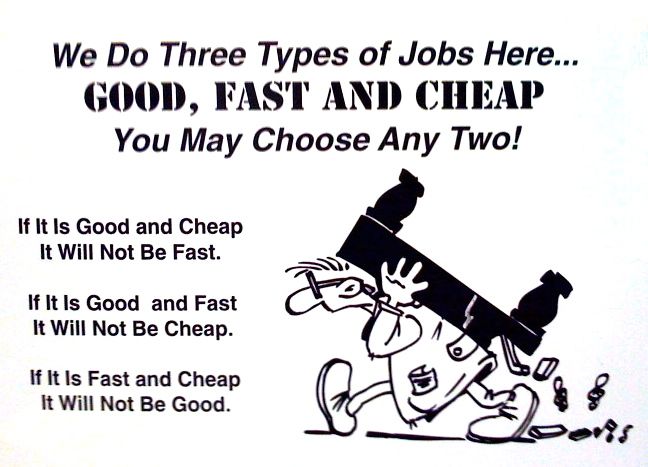
I have continually reflected upon and repeated the Good, Fast, and Cheap — Pick Two constraint triad so when I saw Seth Godin’s blog First, Fast, and Correct I immediately knew I had another useful constraint tool to add to my ideas toolbox. Godin’s post is so short and concise that I will simply repeat it:
First, fast and correct
All three would be great.
First… you invent, design, develop and bring to life things that haven’t been done before.
Fast… you get the work done quickly and efficiently.
Correct… and it’s right the first time, without preventable errors.
Being first takes guts. Being fast takes training. And being anyone takes care.
All three at once is rare. Two would be great. And just one (any one) is required if you want to be a professional.
Alas, too often, in our confusion about priorities and our fear of shipping, we end up doing none and settling for average instead.
I think that the final statement is key to understanding why constraints are so important. If you do not focus on just one priority and try to do all three you may not achieve any of the desired results or if you are lucky you have to settle for an average which is just another term mediocrity.
Constraints are extremely important because they force one to make choices. When one makes choices the consequences of those choices will be realized. If we recognize this going in we can effectively use choice and constraints o get the results we want. If we want to be first or innovative then we can make this choice and recognize that a trade-off may be accepting some level of errors or some loss of speed. But that is OK if we recognize this going in. It will also mean that we may need to get used to the fact that errors and error correction are simply part of the process of inventing, design, developing and bring to life things that haven’t been done before.
Are you using constraints to help you make effective choices? Are you trying to do it all and settling for nothing or mediocrity? The choice is yours.
References
Godin. S. (2018). First, fast, and correct. [Blog]. Retrieved from: https://seths.blog/2018/09/first-fast-and-correct/


