
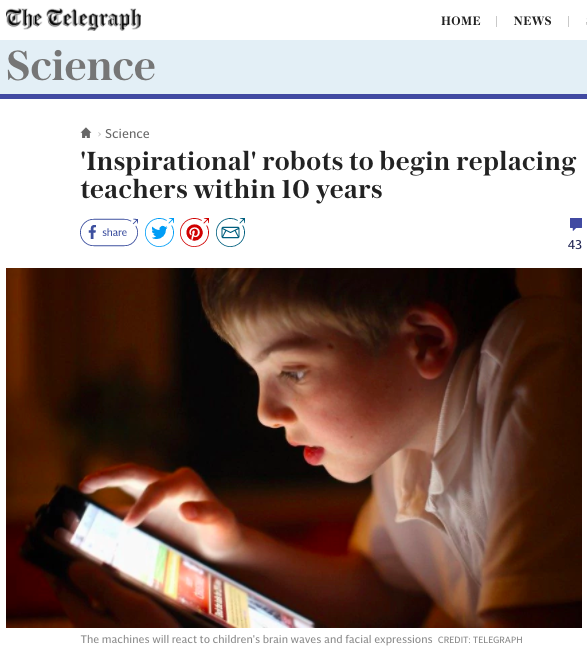
Over the past 25 years that I have been involved in education, I have seen so many claims that this or that technology will begin to replace teachers in “X” number of years. Years ago, my initial response to these types of articles was humor and occasional annoyance because I know from first-hand experience that there is much more to learning than just delivery of content. Unfortunately, authors of most of these types of articles are wrongly assuming that learning just involves the delivery of content and then the regurgitation of that content by the student. This commonly held and very naive understanding of how we learn goes back for centuries. If you look at the notion of the Nuremberg Funnel from the 17th century that is depicted in this image/stamp you will see that this idea of pouring information or content into the brains/heads of our students is a very old idea.

The 19th-century commercial artist Jean-Marc Côté created a series of picture cards as inserts that were intended to depict how life in France would look in a century’s time. The education card depicts the notion of pouring information directly into the student’s minds.
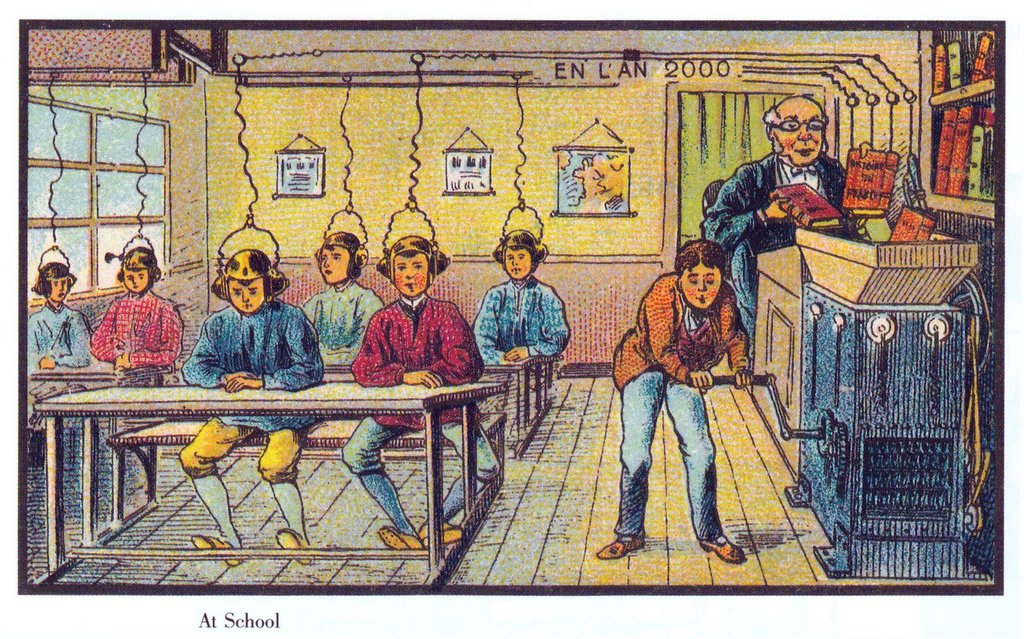
While some may see this as an early prediction of the audiobook the notion of pouring information into the learner’s minds is the focus of the image and is at the heart of the problem with these types of depictions/predictions. Before I focus on what I believe is the primary issue I need to acknowledge that there is a very long history of unrealistic claims of how technology would reform education. The following three contemporary authors have documented how schools have failed to effectively use technology to enhance learning. Larry Cuban’s Teachers and Machines: The Classroom Use of Technology Since 1920, addresses how the potential of film, radio, TV, and computers has been wasted in the classroom. Todd Oppenheimer’s The Flickering Mind: Saving Education from the False Promise of Technology expands on Cuban’s work and further reveals that the creative power of computers has been squandered due to their use as standardized testing tools. Both these authors acknowledge the potential and power of technology but show how we have failed to leverage that power for learning.
In the timeline History of Teaching Machines Audrey Watters points to the list of teaching machines that have been invented, patented, and promoted as time-saving solutions to the problems of education. We see major figures like Thorndyke, Skinner, and even Neo from the movie Matrix promising a future of instant learning. In her discussion of the dystopian future portrayed in the Matrix Watters questions how we value the process of learning when we so often want to supplant it with something that is, fast, cheap and instant. She argues that this desire for instant learning will continue to resurface time and time again and in the more recent stages of her timeline she points to Kahn Academy and MOOCs as the most recent iterations of the teaching machine.
This brings me back to the heart of the matter. Are we using technology as a tool to help make meaningful connections and to address the challenges of tomorrow or are we just using technology to deliver content and confirm that the student can regurgitate that content? There was a time not so long ago when getting access to information was the greatest challenge. We only have to look back a few years to a time when the Internet didn’t exist and we had to go to the library or other repositories of information to get at the content. I am not that old but I can recall a time in the 1960s when a set of encyclopedias was one of the most important purchases a rural family could make; I grew up searching those books for all kinds of answers. In the last 15-20 years the explosive growth of the Internet and more recently the ease with which we can find information with Google, YouTube, or other search tools and then can share that information on blogs, social media, and in so many other ways has changed the way we need to view our challenges regarding information. The greatest challenge of the industrial age was accessing information and now that we have moved into the digital information age our greatest challenge or problem is assessing information. This means we need to reassess our primary role or job as teachers.
If I imagine my primary job as a teacher is to serve information, am I helping solve the current informational problem or do I make it worse?
And given the vast complexity of the informational network, if I insist on my centrality and authority, does that establish or harm my credibility as a teacher?
If assessing information – and the wisdom & experience that this requires – is the central challenge of the current informational age, then are teachers more or less necessary?
Depending on how you answer this question should determine if your role as a teacher can easily be replaced by a computer or an inspirational robot. If you believe that your primary job is to deliver information to your students then these predictions will come true sooner than you expect. Technology is at the point where the delivery of information and the assessment of the reception of that information through some form of standardized test is already happening and can easily be automated. If you are a teacher that practices content delivery as the primary way to prepare your students for standardized tests then you can easily be replaced by a computer, robot, or other technology.
If you are a teacher who believes it is your responsibility to inspire your learners and to help them assess information and make meaningful connections by creating significant learning environments (CSLE) in which you give your learner choice ownership and voice through authentic (COVA) learning opportunities it will be impossible to replace you with technology. Furthermore, if you hold to the CSLE+COVA approach then you are not afraid of technology and can put technology in its proper place by using it to enhance the learning environment.
Before you breathe that sigh of relief that your teaching job is secure because you believe in the student-centered rhetoric of Dewey and other constructivists you may want to have a look at your practice. Are you talking the talk of Dewey but walking the walk of Thorndyke? Along with the long history of misapplying technology in education, we also have a long history of using the constructivist or progressive rhetoric of Dewey but practicing the behaviorist methods of Thorndyke’s standardized testing (Labaree, 2006).
If you really don’t want to be replaced by an inspirational robot then you need to not only talk the talk of Dewey but walk the walk. Does your practice match your rhetoric? If it doesn’t what are you doing about it?
References
Bodkin, H. (2017, September 11). “Inspirational” robots to begin replacing teachers within 10 years. The Telegraph. Retrieved from http://www.telegraph.co.uk/science/2017/09/11/inspirational-robots-begin-replacing-teachers-within-10-years/
Hill, D. J. (2012, October 15). 19th-century French artists predicted the world of The future in this series of postcards. Retrieved October 3, 2017, from https://singularityhub.com/2012/10/15/19th-century-french-artists-predicted-the-world-of-the-future-in-this-series-of-postcards/
Labaree, D. F. (2005). Progressivism, schools and schools of education: An American romance. Paedagogica Historica, 41(1–2), 275–288. https://doi.org/10.1080/0030923042000335583
Nuremberg Funnel. (2017, January 6). In Wikipedia. Retrieved from https://en.wikipedia.org/w/index.php?title=Nuremberg_Funnel&oldid=758530021
Watters, A. (2016, March 2) The allure of ‘Matrix-Style Learning.’ Retrieved from http://hackeducation.com/2016/03/02/matrix
Watters, A. (2016) History of teaching Machines. Retrieved from http://teachingmachin.es/timeline.html


