
Archives For CSLE

Stuck in the wash

Dwayne Harapnuik —  November 25, 2014 — Leave a comment

DrivingInRainWind_large
Source: https://www.travelers.com/iw-images/resources/Individuals/Large/DrivingInRainWind_large.jpg

Commuting in heavy rain is a normal part of living in North Vancouver and working in Burnaby. The other morning I was stuck behind a driver in a relatively new Mercedes who didn’t have enough confidence to drive past the rainy turbulence (wash) of an eighteen wheeled truck. Rather than deal with the spray or wash from the eighteen wheeler for a few seconds while passing the truck this driver chose to stay one lane over and beside the truck–in the truck’s blind spot and in the worst spray for way too long and too many kilometers. Not only was this dangerous for the driver of the Mercedes and the truck it put many other drivers at risk who were trapped behind these two vehicles. When the opportunity presented itself I managed to get around this dangerous blockage and noted that the Mercedes driver chose to stay in the truck’s wash and in the blind spot.

I acknowledge that driving past an eighteen wheeler in heavy rain can be somewhat unnerving. The truck sprays out so much water that your vehicle’s wipers become overloaded and you are almost driving blind for a second or two. You have to trust your driving ability and have enough confidence in your ability that you can maintain the right path past the truck. Once you push past the truck you only have to deal with the rain itself and can see a clear path ahead.

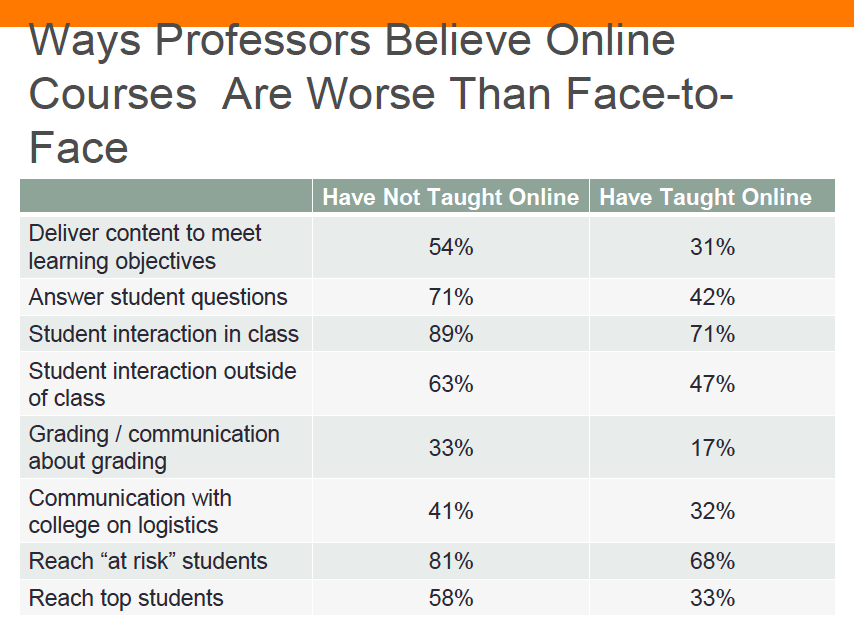
The fear of pushing past the wash from the truck reminds me of a situation that we are currently facing in Higher Education. The 2014 Inside Higher Ed/Gallup Survey of Faculty Attitudes on Technology reveals that despite the experimentation with online education many faculty fear that the record-high number of students taking those classes are receiving an inferior experience to what can be delivered in the classroom. Why? Whether faculty have experience in teaching online or have not taught online the majority of faculty believe that online classes are worse than face2face classes because they perceive student interaction inside class being much poorer online.
belief-online courses

The above table points to several aspects of student to Professor interaction and vise versa that is perceived to be poorer online. To be fair to these Professors I think they are right. I have a suspicion that deep down they already know that since their primary form of instructional delivery in the face2face setting is the lecture, their level of interaction in traditional classes is already quite poor and if they carry this same type of interaction forward into the online realm they are right to worry that their online classes will be poorer.

Research conducted by Finkelstein, Seal, & Schuster revealed that 76% of the 172,000 faculty across North America surveyed use lecture as their primary instructional methodology. Lecturing is simply a passive form content delivery that all too often involves very little active student engagement. I will acknowledge that there are some exceptional Professors who have a high level of discussion in their classes and others who use active learning instructional methodologies but the data suggests that they are the minority. Additional research by Nunn in the form of monitoring Professors in their classes also revealed that at most three minutes out of a fifty minute class are actual discussion and most often in the form of questions at the end of class.

Unfortunately, many Professors initial experience with or understanding of online learning is that is it simply a way to use technology to deliver content. Whether content delivery is done face2face or online it is still the predominant form of instruction in the post secondary setting. Not enough Professors view learning as an active and dynamic process in which learners construct new ideas or concepts based upon their current/past knowledge. The making of meaningful connections is key to the learning and knowing and until we take the advice of people like Sir Ken Robinson and many other highly regarded educational experts and have a Learning Revolution, our current limited face2face information transfer model will simply be moved online.

So, since most Professors are involved in delivering content with very little interaction or engagement in the face2face setting is there any wonder why those Professors who haven’t taught online would see online courses as being even less effective? Similarly, since many Professors who move online continue to use content delivery as their primary form of instruction is there any wonder why these Professors also view online courses as further limiting their already limited face2face student engagement?

Until we can change the way that Professors view their role and move away from the passive information transfer model to an active and dynamic process in which learners construct their own knowledge; and until we can change the way the way most Professors view themselves as the “sage on the stage” to the “guide on the side” or as a learning facilitators who create significant learning environments in which their students can come to know something, acquire knowledge, or to gain information and experience we can continue to expect to see these types of attitudes about online courses from faculty surveys.

This change of focus isn’t going to be easy. Due to a lack of formal training in active learning and all too often limited professional development many Professors are stuck in conducting their classes the same way that they experienced it when they were in school. This is very similar to the way that the Mercedes driver I referred to in my rain example was stuck in the wash behind the large truck–they didn’t have enough confidence in their own ability to push past the truck to see a clear path.

So once again it is not about the technology it is about the learning. Online technology is only a tool that can be used to enhance learning. But if our Professors are focused on teaching and disseminating information and not on creating significant learning environments then it doesn’t matter what tool we add to the mix, the student still loses out.

Finkelstein, M. J., Seal, R. K., and Schuster, J. The New Academic Generation: A Profession in Transformation. Baltimore: The Johns Hopkins University Press, 1998.

Nunn, C. E. “Discussion in the College Classroom: Triangulating Observational and Survey Results.” Journal of Higher Education, 1996, 67 (3), 243-66.

After spending two full days in the Creating Significant Learning Environment (CSLE) workshop with some highly motivated faculty from School of Business at BCIT I am convinced that the future is very bright for BCIT students. Our primary focus was creating significant learning environments that would take advantage of technology to enhance learning. We explored using technology to enhance the face2face, flipped, hybrid or blended and fully online settings. All the technology related activities were grounded with well defined learning outcomes and we continually looked at the balance in aligning the outcomes with effective technology enhanced activities and assessments which confirmed the learning outcomes would be achieved.

The following are all the Youtube clips and related links used in the workshop as well as several of my favourites that we unable to view due to the lack of time.

CSLE slide deck in PDF – CSLE 2-Day SoB Workshop.pdf

How to instructions:

Introduce a concept

Start at 4:00 minute

Introduce a context & bridge into the subject

Start at 15:01

Introduce the Big Hairy Audacious Goal (BHAG) for an online course

Introduce yourself and make a connection with students

Flipped classroom assignment
Link to Visible Learning assignment page

Humor & comic relief

Introduce the main point of an argument

Perhaps one of the best talks on learning & education – My favourite TED Talk

This just one of many TED talks that I recommend. If you go to TED.com and filter by “Most viewed” you will see Ken Robinson’s talks as well as Simon Sinek’s talk about Why and many more amazing talks.

My blog post The Power of Media in informal learning offers the insights that I have found in using media to help my two sons in their pursuit of becoming professional downhill racers.

Finally, to easily download video clips from youtube and embed them into your Powerpoint or Keynote programs (educational acceptable copyright permitting–check with your department or library) you can use the site clipconverter.cc

Enjoy!

This past Wednesday, I had the honour and privilege of working with the dedicated faculty from the BSN program in the BCIT School of Health Sciences. We spent the morning exploring and discussing the following topics as we worked to prepare for the upcoming curriculum redesign that the BSN program is undertaking this fall:

Start with Why – Download PDF of slide deck SoHS Why

Videos used in the session:
John Kotter – Heart of change

Simon Sinek: How great leaders inspire action

Creating Significant Learning Environment – Download PDF of slidedeck CSLE-SoHS

Blog post Significant Learning Environments supporting the session.

Connecting the dots vs collecting the dots – Download PDF of slidedeck Connecting Dots

Video used in the session:
Seth Godin – Stop stealing dreams

Blog post Experts connect dots not just collect dots supporting the session.

Mindset for change Download PDF of slidedeck Mindset for Change

Video used in session:

Blog post Fixed Vs Growth Mindset = Print Vs Digital Information Age supporting the session.

We design information systems, smart buildings, ecological friendly communities, learning spaces and so many aspect of our society but we unfortunately do not apply this holistic approach to designing learning environments. Apple has always designed excellent hardware but with their iPhone, iPad and the whole IOS ecosystem they gone a step further and have designed a mobile communication or networking environment that just works. If we apply a similar purposeful design to our learning environments we also can create a significant learning environment that just works. Whether we are purposeful in its design or we just allow the circumstances to dictate its development education at all levels are providing learning environments. Rather than allow the environment to come together on its own and respond reactively to the learning dynamics that arise I suggest that educators become more proactive and create significant learning environments.

Therefore it is exciting to see an emphasis on purposeful design in the list of resources on Design Thinking for educators. Design thinking consists of four key elements:

Defining the Problem, Creating and Considering Multiple Options, Refining Selected Directions, and Executing the Best Plan of Action. (InformEd, 2013)

Several of the resources listed are links to a either the IDEO group or related sites that have been influenced by the working and writings of Tom Kelly and Tim Brown, who are two of the foundational thinkers behind design thinking.

View the full list of resources…

Absence of Thought in Education

learning

I have been pondering Grant Wiggins blog post on the absence of thought in education. The following quote demonstrates Wiggins frustration with our current system or process of education–which is a frustration that I share:

If all I do is “teach” you things and then you have to show me you “learned” them, strictly speaking, there is no need for either of us to really think. A need to think only emerges when the work itself is designed to make us both question, really question what we are doing.

Thus, even good schooling may make a “good” student or teacher even less thoughtful. How could it be otherwise, if we simply just do our work, and the work is time-consuming? Our students may graduate without having learned to be thoughtful and many teachers may never grow. One can get straight A’s in almost every school if one merely does all the work. This is not a new idea: I am just updating Plato’s Allegory of the Cave.

I have been a critic of the information delivery model of education or what I like to refer to as “recipe and regurgitation” model of instruction my entire academic career. I have not only been a critic of this model I have been working to provide alternatives both in my professional and personal life. Back in 1997 I developed constructivist learning approach called Inquisitivism which emphasizes stimulating a learner’s latent or lost curiosity by creating a learning environment that offers learners “real world” and hands-on learning experiences. This approach has been the foundation for all my instruction and the graduate and undergraduate courses I have taught face2face and online. It has also been a fundamental component of the Creating Significant Learning Environments institutes and various workshops that I have conducted as the Director of Faculty Enrichment at Abilene Christian University.

Making it About the Learning

Because of my dislike of our current model of instruction and my belief in creating significant learning environments my wife and I have also home educated our two boys. We have chosen to create a learning environment in our home and community that uses all aspects of daily life as opportunities for learning. My boys have learned by living, doing, exploring, and creating and have grown into very intelligent and well-rounded teens. It is fair to say that because of my roles as a Home Educator, Learning Theorist, a Professor, Manager of Educational Technology, Director of Faculty Enrichment and most recently as a Vice President Academic I not only have some inside knowledge of our system I also have many years of experience trying to “fix the system” by promoting and applying alternatives…SO I have earned the right to be critical. I also have the right to be critical because the failing in our current educational system adversely impacts my eldest son Levi.

Levi’s Story

Over the past several years we have lived in smaller cities that had very vibrant homeschool communities so my sons were involved in drama companies, bands, sports teams, volunteer organizations and in general had an exceptionally vibrant social experience. Upon our return to Edmonton, Alberta which is ten times larger than where have lived before, we found that opportunities for connecting to a homeschool community that provided a strong social outlet were lacking. In addition, the influence and sway of Alberta Education and the Alberta curriculum were very strong. So when Levi decided he would like to give a traditional public high school a try because we wanted to experience the social dynamic of a school setting I obliged.

Levi’s started public high school half way through his grade 10 year and his first term experience by his standards was satisfactory. He played rugby, co-wrote and performed a drama production, made several friends and had a very positive social experience. Academically, he found that there was lots of busy work but overall public school was much easier than home education he didn’t have to go as deep and make the learning his own. I managed to keep my frustration in check as I helped him with his Science and Social 10 programs which were designed on the information dump principle and used the recipe and regurgitation model of instruction. Levi lucked out in Math 10 to get a recent University graduate who was still somewhat idealistic and caring enough to think that learning was important so his Math 10 experience was very positive. His math experience was also improved significantly through his tutorial sessions with Dr. Zoltan Berkes and amazing Physics Professor from Concordia University who took Levi under his wing and helped him to appreciate how Mathematics combined with Physics can explain the world. Levi’s final overall average for the year was high enough for him to qualify for the Rutherford Scholarship.

When Going Till You Know is Too Much

When we reviewed Levi’s first semester experience in public school this past summer the social factor of school that he enjoyed so much (there are many more girls at school then there is a home) was enough for me to begrudgingly overlook the long hours, make work assignments and the recipe and regurgitation approach that he was experiencing. Ironically and unfortunately, Levi found the recipe and regurgitation approach easier because he didn’t have to work as hard despite the greater time commitment. I repeatedly reminded myself and my wife that the fundamentals of learning that we instilled in Levi would ensure that he could do well in a public school or any other environment. Furthermore, when he was highly motivated or serious about learning something he was interested in he still applied the “go till you know” or “mastery” learning approach that he grew up with…this made me feel a bit better about the learning aspect of his high school experience.

This fall, Levi’s experience with public high school is not as positive as was his first semester…but he is dealing with it much better than I am; hence this post. Since he did well last term he decided to take on the University prep route and register in all 20 level courses. Social, Biology, and Math 20 were the core academic courses for this first term and Chemistry, Physics, and English are the planned core courses for next term. When you factor in his electives and other extracurricular activities he is a typical busy teen. Despite the recipe and regulation nature of Biology and Science in general in the Alberta curriculum, the class is going well. Social is much better because the instructor requires that all readings be done outside of class to prepare for deep discussions in class, so this is a very positive.

Math is not so positive. The instructor’s priority is to cover the content to prepare the students for Math 30. He warned the students that they would be moving through the content quickly so it was their responsibility to keep up. In addition to the focus of “covering the content” the Math curriculum in Alberta has changed and instructors and students are facing “new math”. Unfortunately, when your priority is to cover the content then nothing will be missed in the new curriculum because it takes most instructors one or two terms through the content to determine what is really necessary. Levi’s tutor Dr. Berkes, a highly regarded Physicist, wasn’t too clear on where this new Math curriculum was going so the tutorial sessions were not as helpful as they could be because he wasn’t able to help Levi make a meaningful connection between the math and the real world.

All these factors combined and resulted in Levi spending large amounts of time on his math homework yet he struggled to make meaning in the work. After doing poorly on his first quiz and being concerned about the second quiz Levi was beginning to be concerned that all the extra time he would need to spend on Math to understand it fully would take away from the time he needed to spend on Biology and Social. When I asked Levi what he wasn’t understanding or was missing he replied:

…it’s not that I don’t understand the Math, there is just so much stuff to cover and it takes me longer to get through the work… I don’t just want to understand 60 or 70% of it and move on, I need to understand it all and I just don’t have the time. If I spend all my time on Math my grades in Biology and Social won’t be as good…

As a result of a subsequent conversation with Levi and my wife, we felt that it would be best for Levi to drop the Math and do it at a later time–but we needed to be certain. We also considered Levi switching to the lower level Math for this term to help him prepare for redoing Math 20 in the future so my wife and Levi had a conversation with the Math 20-2 instructor and the school guidance counselor. We found that there is very little connection between the two levels of Math and since Levi is a month into the term he has a lot of content to cover in order to catch up. This would mean that he would be spending significant time on his own catching up on the three units of work he missed while staying current with the new content. The instructor said that the first three units were not cumulative and didn’t build on each other so it was possible to do all the catch-up work while working on the new content. If Levi did all the work then he would do fine in the course.

Preparation for Learning doesn’t Prepare one for School

So Levi’s problem is that he doesn’t want to just do the work and understand 60% or even 70% material he wants to understand it all but this just takes too long. Perhaps, this is where I am to blame and need to apologize to my son for not preparing him for school. In a home education environment, you can take the time to fully understand every concept before you move on and this is how Levi spent the previous 16 years. In contrast, by grade 10 most kids in the public system have 10 years of “covering the content” and “doing the work” and the “A” students, for the most part, are the ones have done the work. The “A” students are also, for the most part, the students who have figured out how the educational system works and know that if they do the work they will get the grades that they want regardless if they have learned anything or not. Many of these students not only expect an “A” but demand it because they have learned to equate doing the work with an “A”.

This leads me back to my opening thought about Grant Wiggins post on going deeper and the absence of thought in education. There are consequences to these sorts of idealistic musing. Educational reformers like Wiggins and myself can postulate and promote all these wonderful notions of going deeper and changing our classrooms and even our schools to be learning centered, but until we fully reform our system kids like Levi and many more will be caught in between where they will be suited for learning but not suited for school.

Levi will be fine. He will do Math 20 and 30 but he may need to do them in a different way… in a way that will give him the time he needs to fully understand and learn. Despite all my work at trying to change the system I still need to apologize to my son.

Sorry Levi, I have prepared you for learning but I didn’t prepare you for school.

Is an apology enough or should we be doing even more to fix these problems?