Learning something new is frustrating. It involves being dumb on the way to being smart. Once we get good enough (at our tools, at our work) it’s easier and easier to skip learning how to do the next thing, because, hey, those fifteen minutes are a hassle. (Godin, 2016)
I have been thinking about this Seth Godin quote ever since he posted The first fifteen minutes to his blog in January. For the most part I think he is accurate. All too often we are not willing to deal with the fifteen minutes of hassle to learn something new that can save us hundreds or even thousands of minutes down the road. I said for the most part because Godin’s fifteen minute rule can only be applied to the simplest of tasks, tools or processes. It also only applies if the task, tool, or process impacts you as an individual. Once the you bring in other people into the picture the time factor can increase significantly. Regardless of the complexity of the task or the added complexity of a collaborative effort the short time pain for long term gain are still worth the effort. Let me explain.
Students in the Lamar University Master of Digital Learning and Leading (DLL) study online and use digital books and resources. When they transition from one course to the next it has become common practice to share the reading list for the next course to give them the opportunity to stay up with the high volume of reading. We only use digital resources in the program and due to the nature of Digital Learning these resources are constantly being updated. Keeping and sharing static lists of these resources for each of the courses in the Master program has become a challenge. Updating a shared Google document doesn’t offer enough power and flexibility.
This is why we planning a move to Zotero reference management software. I have been using reference management software of one kind or another since the mid 1990’s and have been using the open source, cloud based Zotero since it was first developed in 2007. Therefore, I didn’t have to spend fifteen minutes to learn the software. However, I did have to spend much more then fifteen minutes because I had to explore and test:
- The best way to set up Zotero Groups which included determining the correct group and user permissions and access model,
- How to add new users and how to invite and share access to the system;
- How to instruct the group administrators and new users how access and use the online system.
Each of these steps took approximately fifteen minutes so Godin’s model does work if you multiply it by numbers of significant steps in the process. If you factor in the initial learning process I would have spent sixty minutes to get to the point where I could demonstrate to my colleagues that using Zotero would be the best way for us to share DLL resources.
But are the sixty minutes worth the effort. Godin argues:
The problem with evaluating the first fifteen minutes of frustration is that we easily forget about the 5,000 minutes of leverage that frustration earns us if we stick it out.
Once again Godin’s model is based on individual effort. When you factor in the six or seven full time faculty and dozen or so adjunct faculty who will use the Zotero system and the hundreds of students who will not only use Zotero to access the course reading lists, but will also share it with their students the impact can be much more significant then the 5,000 minutes of leverage that Godin points to.
Perhaps even more important than the time savings and leverage is the impact this can have on our future leaders. Our program is call Digital Learning and Leading so it is appropriate that faculty in the program model the digital leadership required to take the fifteen or sixty or more minutes of frustration in order to leverage the power of digital learning which will have an exponential effect. This is what leaders do and what leaders must model.
References
Godin. (2016, January 16). Seth’s Blog: The first fifteen minutes [Blog]. Retrieved from http://sethgodin.typepad.com/seths_blog/2016/01/the-first-fifteen-minutes.html
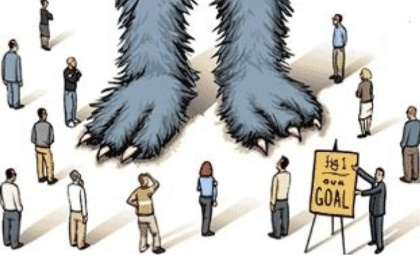 The notion of a Big Hairy Audacious Goal (BHAG) was first introduced by Jim Collins back in 1994 in the book Built to Last: Successful Habits of Visionary Companies. Collins and many others since have used the notion of a BHAG to help define a visionary type goal that is more strategic and emotionally compelling rather then being simply tactical.


