http://youtu.be/rlF49zDcwdQ
This has to be one of the most beautiful and achievable inspirational video that I have ever watched.
Enjoy the amazing videography and the powerful message!
Creating Significant Learning Environments
http://youtu.be/rlF49zDcwdQ
This has to be one of the most beautiful and achievable inspirational video that I have ever watched.
Enjoy the amazing videography and the powerful message!

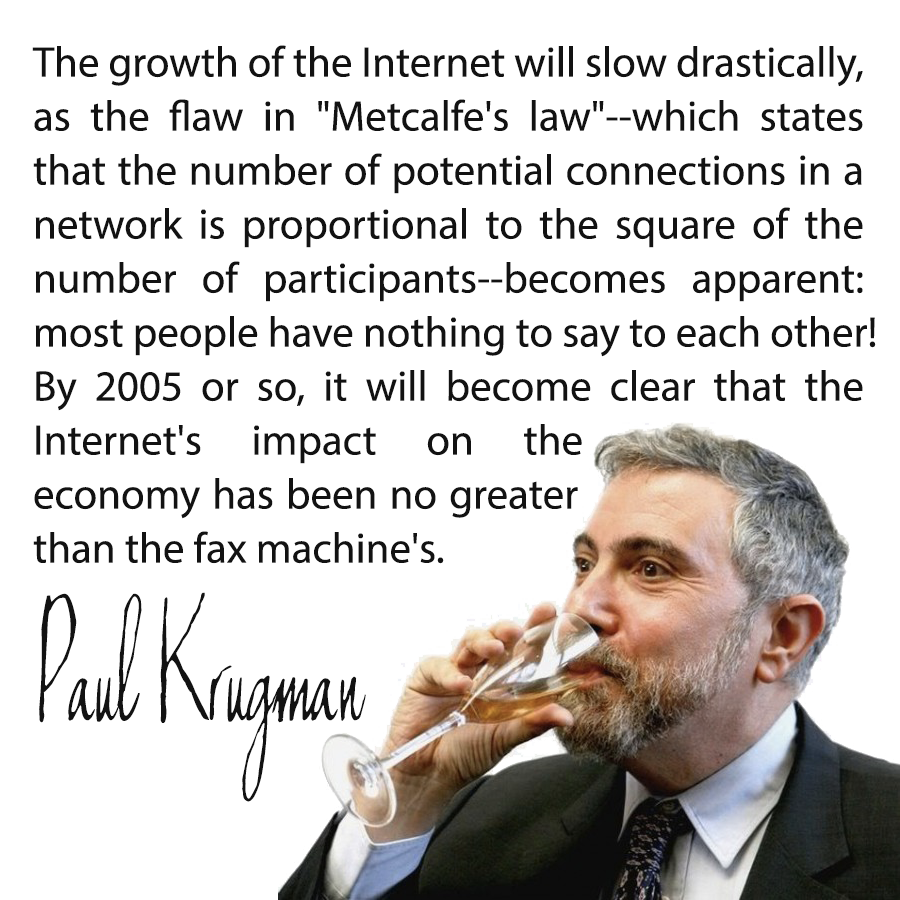
Source: imgur.com
One of the biggest challenges with making any sort of prediction with circumstances beyond our control is that we can be terribly wrong. Krugman can join the ranks of many others who have been very wrong about the predictions that they have made.
What can we learn from this? While it is very important to be optimistic and speculate realisticly on just how far technology can take us it is equally important to control the variables that you can and in the words of Mahatma Gandhi:

The following links include several list of terribly wrong predictions about technology:
Top 10 Bad Tech Predictions
Top 30 Failed Technology Predictions
Use It Better: The Worst Tech Predictions of All Time
26 Shockingly Bad Predictions
This well made video Monopoly of Dreams is a wonderful example of why we need to help our young people learn how to cultivate their passions as opposed to simply trying to follow them. To many of the young people in the video were not able to really identify what they were really passionate about and would be interested in pursuing if money were no object.
In the blog post Follow Your Passion is Crappy Advice Joshua Fields Millburn points to the work and research of Cal Newport, a 30-year-old assistant professor of computer science at Georgetown University, who is exploring why some people lead successful, enjoyable, meaningful lives while so many others do not. Newport points out that while the advice of following your passions which is “regurgitated everywhere” on the internet and in the above video is appealing because it’s both simple and daring it is empty because he has found that most people don’t have preexisting passions.
In contrast Newport recommends that you “cultivate” your passions which implies that you work toward building passion for your something whether it is your job, your studies or other aspect of your life. He also points out that this is a longer process that requires you to approach your work like a craftsman.
Honing your ability, and then leveraging your value, once good, to shape your working life toward the type of lifestyle that resonates with you.
This is where a parent’s and especially a father’s role is so important. Because our children often are not even aware of what their passions are it is our responsibility to create and foster an environment in which it is not only safe but crucial for our children to explore, experiment and experience the fullness and diversity of life so that their passions can develop and grow. Helping our children, especially our teen agers, cultivate their passions is the next step in this process.
This leads me to ponder:
Are we modelling a life of cultivating our own passions?
Does our walk match our talk?
Have we created an environment where the exploration and cultivation of passions is safe and rewarding?

The Future Is Now: 15 Innovations to Watch For – Commentary – The Chronicle of Higher Education via kwout
I have been monitoring innovation in education for the past 20 years so I am always looking for new insights so any post, article or story that points to “innovations to watch for” catches my attention. Even before I fully read the article I did a quick look up of the author Steven Mintz to see if he had the credentials or the experience to be offering these types of predictions. He does openly warn he readers he is a “historian and far better at interpreting the past than forecasting the future.” In addition to being a Professor of History, University of Texas at Austin, Mintz is also the Executive Director for the Institute for Transformational Learning in the University of Texas System. Finally, he points to over a decades worth of teaching with technology and walks the talk with a personal website http://stevenmintz.com/ that demonstrates his belief and skill in using technology to enhance learning.
Mintz points to following 15 innovations that he suggests will alter the face of higher education over the next 36 months:
1. e-Advising
2. Evidence-based pedagogy
3. The decline of the lone-eagle teaching approach
4. Optimized class time
5. Easier educational transitions
6. Fewer large lecture classes
7. New frontiers for e-learning
8. Personalized adaptive learning
9. Increased competency-based and prior-learning credits
10. Data-driven instruction
11. Aggressive pursuit of new revenue
12. Online and low-residency degrees at flagships
13. More certificates and badges
14. Free and open textbooks
15. Public-private partnerships
Despite not being an acclaimed expert in educational technology Mintz’s predictions fall in line with the literature and research in this area and more importantly he points to changes in learning as the key disruptive innovation in 8 of his 15 predictions. He sees evidence based pedagogy not only informing instructional design but also personalized adaptive learning. He accurately places the emphasis on student-centred, competency based, well designed and collaborative constructed learning experiences as a major catalyst for change. His remaining predictions point to the disruptors of open educational resources (OER), growth of online learning and the loosening of credentialing through certification and badges and the move toward public-private partnerships.
Mintz sums up his piece with a positive challenge to faculty members to work together and:
take the lead in designing an education that will truly serve the needs of our 21st-century students.


