Archives For Learning

Source: https://s-media-cache-ak0.pinimg.com/736x/4b/80/9e/4b809e7bf3d048ba8f61eef6889fcaaf.jpg
This image would be much more humorous if it wasn’t for the fact that this is an unfortunate and accurate representation of what is happening in our educational systems. Because we have been focusing on the technology and not the learning and have been attempting to gauge the effectiveness of applying today’s technology based on yesterday’s standards we are going nowhere in a hurry. Papert (1993) likened this to:
Attaching a jet engine to an old-fashioned wagon to see whether it will help the horses. Most probably it would frighten the animals and shake the wagon to pieces, “proving” that the jet technology is actually harmful to transportation. (p. 29)
Most people would chuckle at Papert’s example and ask how can anyone or any group be so naive or foolish? Yet, by trying to improve our passive traditional teacher-centered pedagogy with the application or addition of technology, we have essentially strapped a technological jet engine to our classrooms. Perhaps we should be pleased that we are at least not harming the animals (the teachers and students) and haven’t shaken our classrooms (the wagons) into pieces as the ‘no significant difference’ test results would show.
Unfortunately, we have the tendency to make similar mistakes when it comes to curriculum planning and instructional design. We all too often look to the content to be covered, update our terminology to reflect the current trends (individualized instruction, flipped classroom, blended learning, genius hour, 20% time, etc.), and then simply add in some new trendy activities to our well-established routines. We also bolt on some technology for added benefit. In minutes you have a new lesson plan, unit plan, or course plan. If you are fortunate enough to have a text book which chapter headings can be used to structure the content delivery steps—all the better.
However, if you really want to create significant learning environments by giving your learners choice, ownership, and voice through authentic learning opportunities then you have to build your courses and programs differently. You can’t just bolt on new activities to your existing curriculum. You have to look at doing things differently by using the backward design mythologies that require you to start with a big hairy audacious goal (BHAG) which you construct by imagining what your learner will look like, become, or be able to accomplish by the end of the course or units of instruction. I have outlined this process in greater details in the post, 4 Keys to aligning outcomes activities, and assessment.
Be forewarned… this is not going to be an easy process. Leon Festinger (1957) has argued that we seek or strive for psychological consistency and are motivated to reduce the cognitive dissonance that comes from dealing with contradictory information or ideas. It is not uncommon to feel psychologically uncomfortable when we are asked to do things differently than what we are accustomed. We look for ways to conform and align what we are doing with what we believe and if we can’t find this alignment we become uncomfortable. When this happens people will either change their beliefs to align with their actions or change their actions to align with their beliefs.
Fortunately, you get to choose how you are going to deal with this situation. If you are put in a position where you are asked to experiment or apply a different approach to creating your course or other units of instruction you have two choices. You can temporarily suspend your traditional content coverage beliefs about course design and adopt the new course design methodologies at the beginning of the process and then the actions of creating your BHAG and aligning outcomes, activities and assessments will fall into place and your discomfort may be limited or reduced. In contrast, if you maintain your traditional beliefs and choose to focus on content coverage you will find that you will not only be uncomfortable with the new course design process you will also not be able to create a BHAG nor align the outcomes, activities, and assessments that are so important to creating significant learning environments.
If you really want to get the most out of any learning opportunity you have to fight through the cognitive dissonance and experiment with the new ideas and processes to see if they really can make a difference. If you aren’t willing to do this with your course or unit design then you really do run the risk of bolting new more powerful ideas onto an antiquated foundation. Don’t your learner’s deserve more?
References
Festinger, L. (1957). A theory of cognitive dissonance. Stanford, CA: Stanford University Press.
Papert, S. (1993). The children’s machine: Rethinking school in the age of the computer. New York, NY: Basic books.


It is very important that you understand the full context of my son’s circumstances to understand the following authentic learning experience that I am about to share. The average home price on the North Shore of Vancouver is around 1.5 million dollars and this is for a very average 1200 square foot house. To put this in context, the 4 bedroom, 3 bath, 3000 square foot house with 10, 12 and 14 foot ceilings, polished concrete floors and an attached 3 car garage on 2 acres of land that we sold for $250,000 when we left Abilene Texas in 2011 would be worth between 4-4.5 million dollars in West Vancouver which is the most prestigious area of the North Shore. As you can imagine rents in this area also extremely high.
When we moved to the North Shore back in 2013 so that my boys could pursue their dreams of becoming professional Down Hill Mountain bike racers we knew we wouldn’t be able to afford to buy a home. While the cost of housing is ridiculous there are other benefits that make living on the North Shore a priority for my boys. In addition to living between 5-15 minutes away from 3 different mountains my boys use for daily training, we are also an hour away from Whistler which has one of the best Down Hill Mountain Bike Parks in the world. Factor in the amazing bike culture that has grown out of the North Shore and Whistler and one could argue that there are few better places in the world where my boys could pursue their dreams.
Unfortunately, Down Hill Mountain Bike racing is a relatively new sport (about 20 years old) and most pro racers do not make much money when compared to other professional athletes. In 2016 Aaron Gwin who is the top racer in the world changed the sport by moving to a new company that was willing to pay him 3 times what his previous company paid him. This massive increase put his annual contract at just under half a million dollars a year. There are only a handful of riders in the world who are making low six-figure salaries so unfortunately, most up and coming pro racers like my boys are lucky to have sponsorships which will help cover the cost of equipment but the cost of travel, racing, training, and living is something that is up to the rider. This explains why my two boys who are 19 and 21 still live at home. Both my boys are extremely independent and even though they live with their parents they have complete freedom and control over all other aspects of their lives. We live in one the most expensive places in North America and they don’t make much money—yet. If we were living anywhere else they would be on their own.
A few months back, neighborhood friends asked if either our boys would be willing to house sit for them and take care of their two full-size dogs when they went to Hawaii for a month. Levi, my older son who was still 20 at the time, jumped at the opportunity to house sit and have his own space for a full month. I managed to control myself and didn’t comment at all on his decision even though I was thinking to myself, I hope Levi realizes just how much work and time walking, exercising and caring for those dogs and that large house is going to take. These people live in a large house at the base of Mount Fromm near the end of a trail that Levi often trains on so I can only image that the proximity to his training was another factor that swayed his decision.
One more bit of context… My boys grew up having choice, ownership, and voice through authentic learning opportunities (COVA) so I saw this opportunity for Levi to have another wonderful way to learn some valuable life lessons — especially when it comes to taking care of other people’s stuff and their animals. My boys didn’t have pets growing up partially because we traveled a fair amount and our lifestyle didn’t really allow for being tied down by animals. When my boys were much younger we often took care of friends cats, dog, gerbils and birds so while my boys didn’t live with animals for years at a time there were times when they were responsible for animals for months at a time so Levi should have known partially what he was getting into. Back to the house and sitting scenario.
About a week into Levi’s house and dog sitting experience when he stopped by to work on his bike, I simply asked him how it was going and he lamented:
…This is taking way more time than I expected…those dogs just won’t leave me alone… I like them but they take so much work… I walk them in the morning before I train… then I come over here to work on my bike… and then I have to go into work and then after work I have to walk them again…
Once again, I managed to control myself and didn’t comment on anything but I did ask if there was anything I could do to help. Levi simply said,
No Dad…I got this.
I knew before Levi had taken on this responsibility that the small freedom that this great house would offer would come at a significant expense of time which Levi just didn’t have. Our garage is equipped as a bike repair shop so I knew Levi would still come home on a daily basis after his training rides to clean and maintain his bike. As a professional athlete, Levi controls his diet very closely and is a creature of habit so I also knew he would be coming home daily to prepare his meals and eat. I knew he would want to use and have access to the Vitamix, the pantry, the freezer and all the food prep resources he was accustomed to. I also knew that his responsibility as the head mechanic and mountain bike instructor at his sponsor Endless Biking would be increasing that same month because Endless was starting to receive their shipments of new bikes for the upcoming season.
So as the days progressed Levi kept coming over earlier and earlier in the morning to make his special shake and then head to the gym which is only a block away. Levi would pop in and out throughout the day between training, working, exercising the dogs and then we wouldn’t see him until the next morning. Our friends came back and on the first night Levi was back at home I told Levi I was proud of how well he handled the responsibility and commended him for going above and beyond what was expected in exercising the dogs. When he said—I am glad this is over… I am never going to do that again… I couldn’t contain myself any longer and started the following short exchange. I had learned over the years that the best way to start a learning moment conversation was to provide a brief context and then ask a question. So I simply stated… Levi, when I was young I too house sat and took care of other people’s dogs like you have so I knew before you took on this responsibility just how much work this was going to be. I am sorry for not telling you about this before. Can you tell me how I might have talked to you or warned you about what you were really taking on. Without hesitation Levi stated— Dad, I wouldn’t have listened… I had to learn this myself. Levi then gave me a big strong hug. I am glad I cared enough to let Levi learn everything he learned completely on his own. Fortunately, this type of life lesson can and does happen in a more formal learning setting.
Over the years, for the most part, I have created significant learning environments (CSLE) where I have given my boys and my students choice, ownership and voice through authentic opportunities (COVA). The reason I said “for the most part” is that giving over control is one of the hardest things a parent or teacher can do. We don’t want our kids to get hurt, or to struggle, or fail or get annoyed with us so we have the tendency to shield them in advance from the consequences of their actions and yet this is where the most significant learning can happen. Giving my boys and my students control over their own learning has been one of the biggest challenges of my personal and professional life.
The life lessons learned through taking full ownership of a learning opportunity cannot be matched by any form of direct instruction or teacher controlled experience. If we care enough for our learners we need to let go of the control and be willing to see them struggle, or fail or even get annoyed with us if we expect them to learn the life lessons that come about through taking full ownership of authentic learning opportunities. Both my boys have learned the value of authentic learning and while they do occasionally get annoyed with me it doesn’t happen much anymore because they have grown to appreciate the value in the struggles of taking ownership of their own learning.
Unfortunately, since many of my students are accustomed to a more traditional form of education which includes giving the teacher or professor what they want and regurgitating information in a simulated project, paper or exam, it is not uncommon to have some of my students annoyed or even angry with me because they feel that I may not be doing my job by not telling them what to do and think. I am willing to have them be annoyed with me because I care enough about their learning to know that if they take ownership and learn by working on something that is authentic then their learning will be transformative. I don’t just let my boys or my learners flounder without any guidance, I do give them guidance and direction through the learning environment that I create or that I point them to through authentic opportunities. The following quote from a recent graduate of the Digital Learning and Leading program where I use the COVA+CSLE approach sums up her experience and the value of this type of learning:
The DLL program shows you where to look, but does not tell you what to see – Brandi Collins
When we let our learners take control of their learning the experiences they can embrace, the meaningful connections they create, and the knowledge that they gain will be life changing. Isn’t this really our primary responsibility as parents and educators?
References
Collins, B. (2017). Highlights from Lamar University Masters program in Educational Technology [Blog]. Retrieved from http://madelinebrandicollins.weebly.com/digital-learning–leading.html
Ventura, M. (1993). Letters at 3am: Reports on endarkenment. Spring Pubns.
The other morning a colleague sent me the tweet from Daniel Pink “The secret to learning is overlearning…” which pointed to Cari Romm’s (2017) New York Magazine post To Truly Learn Something, Study Until You’ve Mastered It — and Then Keep Studying. Since I am a learning theorist and am always searching for “the secret to learning” and since Pink’s book Drive: The Surprising Truth About What Motivates Us is still one of my favorite books on motivation I started down the rabbit trail by reviewing Romm’s article in the Science of Us section of the blog. The reason I used the terms “started down the rabbit trail” and also used “reviewed” rather the “read” is very significant because in order to get to the truth or the actual facts about what these various people were stating I ended up looking at several other magazine/blog posts and then a few journal articles and went back to a couple of books to get the full story and really see what the facts are. While I am referring to this process of going down the rabbit trail what I am really referring to is simply doing the due diligence of analytical thinking and getting to the facts by going back to the primary sources to see what is really being said. Let me explain why this is so important and why we need to encourage everyone to verify what is being said and written.
Getting back to Romm’s post about the secret to learning, the headline alone would suggest that the article is about learning. Romm’s opening statement also points to and questions deliberate practice and elite performance:
…On its own, deliberate practice isn’t enough to turn you into an elite performer, whether you’re talking about boosting your athletic prowess or learning to play the violin.
Since I have been studying Anders Ericsson’s research into deliberate practice for many years I was intrigued by this opening statement and immediately reviewed the short post and followed the link to the post that Romm had pointed to in her opening. Before I deal with this second stop on the rabbit trail I need to explain that Romm’s generalization did not line up with the findings of the article Overlearning hyperstabilizes a skill by rapidly making neurochemical processing inhibitory-dominant in Nature Neuroscience (2017) she referred to and while she used the term learning what the article was referring to was actually training and memorization. This is where we get into a problem that can be resolved with clearly defining terms. How is the term “learning” really being used?
The learning that the authors of the Nature article referred to was in the context of a learned response to a stimulus. They also referred to training and memorization and their primary conclusion was that after a training event or session the learned stimulus-response needs to be stabilized or reinforced in order to prevent it from being disrupted by a new learned response. To prevent this loss you need to spend a minimum of 20 more minutes after you have reached the training plateau to reinforce the effect of training – which they referred to as overlearning. The authors of the Nature article (2017) were researching how people responded to a visual-recognition task by asking the participants to identify patterns in images and then measured the concentrations of excitatory and inhibitory neuro-transmitter levels in the visual areas of the brain. In a nutshell these researchers have identified the biological reaction in the brain that reinforces a conditioned response by increasing the excitatory neuro-transmitters and they have generalized that overlearning rapidly and strongly hyperstabilizes this biological reaction (Shibata et al., 2017). While they have also gone as far as to generalize that overlearning will help you retain your training or memorization they do qualify that their work has only gone as far as exploring this within the visual context.
While there are elements of data to support Romm’s headline the generalization – to truly learn something you need to study until you master it and then keep on studying is not correct. A more accurate claim would be – to truly memorize something you need to study until you master it and then keep on studying. There is a big difference between memorizing something and learning something. Learning is making meaningful connections by connecting new information or ideas with existing information or ideas to come to know something new. While memorization plays a role in the learning process it is only part of the process and all too often is used by people to simply regurgitate information. Richard Feynman (2014) reminds us that there is a difference between knowing the name of something and knowing something.
I firmly believe that Romm has no malicious intent in or intentionally wanted to mislead people but this where it is our responsibility to analyze and assess the author’s argument for validity. While there are elements of truth in her generalization of benefits of studying the assertions of the opening statement “deliberate practice isn’t enough” are actually misleading and unfortunately false.
This leads us further down the rabbit trail. Rather than look at primary sources and Anders Ericsson’s actual research into deliberate practice Romm points and links to another Science of Us blog post 10,000 Hours of Deliberate Practice Aren’t Going to Get You Olympic Gold by Drake Baer (2017). Unfortunately for Romm, Baer isn’t much better at research and doesn’t bother by going to the primary sources either to really find out the what he is referring to as deliberate practice or the 10,000-hour rule. Baer mistakenly points to Galdwell’s book Outliers and suggests that deliberate practice is simply a matter of putting in 10,000 of hard work and links to his own 2013 FastCompany article that confirms that you just need to put in the time. To be fair to Baer he does suggest in that you need to work on the hard parts to get better but only refers to a BrainPickings article (Popova, 2013) rather than a primary source. To add an appeal to authority Baer also points to the Karl Smith’s (2016) Scientific America blog post No One Wins Gold for Practicing the Most which also gets it wrong. While Smith does point to Macnamara, Hambrick, and Oswald’s (2014) research article Deliberate Practice and Performance in Music, Games, Sports, Education, and Professions: A Meta-Analysis in Psychological Science to support his argument I am relatively certain he hasn’t read the full article or even looked at Ericsson’s original research or most recent work because he incorrectly defines deliberate practice and overemphasizes the 10,000 hour aspect.
If you look at Ericsson’s research or his latest book Peak: Secrets from the new science of expertise (2016) which summarizes all his work on deliberate practice you will find that the 10,000-hour rule that Gladwell popularized is actually false. Ericsson (2016) actually stated that depending on the discipline and various other factors a rudimentary level of expertise could be reached after one put in 7500 – 15,000 hours. This is a big range and Gladwell generalized this idea by simply picking the 10,000 point because it would be easier to remember. Ericsson (2016) also points out that this is just the starting point of expertise and many world-class performers have put in more than 20,000 more hours to be the best. The 10,000-hour rule is not a rule but a popular myth and authors like Romm and Baer mistakenly refer to this myth.
But there is an even bigger problem with the arguments of bloggers Romm, Baer, Smith and the researchers Macnamara, Hambrick, and Oswald. They all define deliberate practice incorrectly. Deliberate practice is not just putting in the time or working harder or pushing oneself further, nor is it just using structured practice. Ericsson (2016) is quite clear when he states that just practicing countless hour after hour, in the same way, will not help one improve and in many instances this repetitive practice, even if it has some form of structure, can potentially degrade performance. It is not the total hours or the fact that there is a structure that matters it is how one practices in those hours and what that structure is that matters.
According to Ericsson (2016) deliberate practice involves the following four components:
- Goals – you have to have a clear vision of what you are working toward or hope to accomplish. Watching or visualizing the activity performed perfectly either in a video of yourself or another expert will help you get to your goals.
- Focus – you have to break down the activity into smaller chunks and slow down the process to get a higher degree of control and precision. Paradoxically you have to slow down to get smooth enough before you can get faster and better.
- Feedback – you have to analyze your performance and look for ways to improve. Most experts have learned to continually error correct and look at and analyze what they are doing with an eye to continuous improvement. This is where coaches, good teachers and even video recordings of your performance come into play. Most novices will require a coach to provide the necessary feedback because they often don’t even know what they need to improve. A cycle of feedback and continuous error correction is the key to deliberate practice
- Exit your comfort zone – you have to push yourself beyond your comfort zone order to make improvements. The key is to push just enough to be slightly uncomfortable but not so much that you will fail immediately. Experts have learned what that 3-4 % improvement feels like and to know when they are going to far out of their comfort zone to reach new levels of performance.
Ericsson also points out that experts have a deep set of mental representations of their discipline that make it easy for them to do things that look magical to the average person. Experts have done the mental reps that give them the highest levels of mental representation that enable them to operate at the highest level. This is a combination of mental and physical training at the highest level and is much more than working or practicing hard for 10,000 hours. So at this point in the rabbit trail, I hope one can see that these first few authors really shouldn’t be trusted. It appears that the bloggers Romm and Baer may be more interested in building their following with catchy headlines to promote their writing then they are with the facts. If we can’t trust these authors then who can we trust—the academics? Smith is a Ph.D. candidate who published in the Scientific America blog and the researchers Macnamara, Hambrick, and Oswald are publishing in peer-reviewed journals but can we trust their findings just based their credentials and a perceived higher quality of the publication. Unfortunately, not. Smith didn’t bother looking at the primary sources to get a clear definition of deliberate practice and was too willing to simply run with the notion that deliberate practice involves harder work. If you compare the notion of harder work with the 4 components of deliberate practice listed above it is clear that deliberate practice is much more than hard work.
When you review the work of Macnamara, Hambrick, and Oswald (2014) you will find that they have gone to the primary sources but unfortunately, you will also see that they define deliberate practice as
engagement in structured activities created specifically to improve performance in a domain. (p. 1608)
which is not an accurate definition to use in their meta-analysis. Such a vague definition of deliberate practice not only cast doubts on the authors’ findings that deliberate practice only explained 26% of the variance in performance for games, 21% for music, 18% for sports it calls into question their entire research. The key to deliberate practice is the details of the purposeful goals, focus, feedback while pushing the limits. This is much more than just structure. While Macnamara, Hambrick, and Oswald do confirm that deliberate practice is still important they posit that it is not as important Ericsson argues.
This is where one has to be careful in examining the data, the research methods and exactly what the researchers are looking for. While I have stated earlier that I am calling their findings into question I will also state that it appears that their research is accurate. Let me explain, if you use a very loose definition of deliberate practice and simply point to structured activity then you will get the results that they point to. This is what they found in their meta-analysis. However, if you use the authentic definition of deliberate practice from the primary sources I would argue that there would be a very different result. Macnamara, Hambrick, and Oswald did a very thorough job on some aspects of their research like their methods, their analysis, and coding of the information but their research question was based on an inaccurate or overly broad definition of deliberate practice (Ericsson, 2016b).
So at this point of the rabbit trail, we find out that many of the claims made by numerous authors are simply wrong because they did not go to the original sources and kept referring to other authors who also failed to go to the original sources. And when we finally found some authors who did go to the original sources their claims could not be trusted either because these authors did not use the same definitions that the original authors used.
Who can you trust? Trust yourself. We have the responsibility to verify what we read by reading critically and thinking analytically while looking at the evidence. While I referred to this process of going down the rabbit trail it really is just a matter of seeing if an author has supported what they are saying and can corroborate their statements with external sources. Ideally, the external source should be primary sources. There will always be differences of opinions and biases but if you are objective enough and can look at the facts you should be able to discern what is accurate regardless of your bias. Admitting your bias is also is a good way of assuring your reader that you are attempting to be objective—we all have biases.
In summary, the tweet the other morning led to the above explanation and the examination of the following sources, and the following conclusions. Contrary to the errant claims of several authors who demonstrated very poor research skills the actual facts show:
- deliberate practice will help you become an elite performer,
- overlearning is great for memorization but memorization itself shouldn’t be mistaken for learning,
- the 10,000-hour rule isn’t a rule but a pop culture myth and an interesting rap song.
- accurate definition of terms is crucial to valid and reliable research.
This whole process took much more time than I had hoped or expected but if you really want to know then you have to do the due diligence and look at all the facts. There is no a quick fix. The most efficient way is to go back to the primary sources and see what is really being claimed. In the information age, there is an abundance or overload of available information so the need to do this is greater than ever before. Anyone can put anything up on the Internet so we have to be even more diligent than ever before. Unfortunately, the notion of trusted sources is something that we cannot rely on upon anymore, at least not completely. I will go as far as to suggest that there are some sources that I may be more inclined to initially trust but I would still verify. Stating what those sources are is a whole other argument and post. There are just far too many examples of faulty research being exposed and if you consider my example above, all it takes is a definition of terms to be ignored and the results of the research will be inaccurate. Furthermore, we need to be willing to heed the warnings of Chuck Klosterman (2016) who asks the question What If We’re Wrong? If we look how our understanding of science and the world around has progressed in the last several centuries then we should be willing to admit that there may be some things that we hold to be true today that may be false 10, 20, 50 or more years into the future.
We do live in the most amazing time to be a learner. All the world’s information is available to us in the palms of our hands. Because so much information is available we must not only be prepared but be willing to take the time that it takes to critically and analytically assess all the information we are taking in.
References
Baer, D. (2013, October 29). Why “Deliberate Practice” is the only way to keep getting better [Magazine]. Retrieved June 9, 2017, from https://www.fastcompany.com/3020758/leadership-now/why-deliberate-practice-is-the-only-way-to-keep-getting-better
Baer, D. (2016, August 8). 10,000 hours of deliberate practice aren’t going to get you Olympic gold [Blog]. Retrieved June 9, 2017, from http://nymag.com/scienceofus/2016/08/deliberate-practice-isnt-going-to-get-you-olympic-gold.html
Ericsson, A., & Pool, R. (2016). Peak: Secrets from the new science of expertise. New York, NY: Eamon Dolan/Houghton Mifflin Harcourt.
Ericsson, K. A. (2016). Summing up hours of any type of practice versus identifying optimal practice activities: Commentary on Macnamara, Moreau, & Hambrick (2016). Perspectives on Psychological Science, 11(3), 351–354.
Klosterman, C. (2016). But what if we’re wrong?: Thinking about the present as if it were the past. New York, NY: Blue Rider Press.
Macnamara, B. N., Hambrick, D. Z., & Oswald, F. L. (2014). Deliberate practice and performance in music, games, sports, education, and professions a meta-analysis. Psychological Science, 25(8), 1608–1618.
Popova, M. (2013, October 17). The psychology of getting unstuck: How to overcome the “OK Plateau” of performance & personal growth. Retrieved June 9, 2017, from https://www.brainpickings.org/2013/10/17/ok-plateau/
Richard Feynman : Knowing the Name of Something. (2014). [Video file] Retrieved from https://youtu.be/lFIYKmos3-s
Romm, C. (2017, January 31). To truly learn something, study until you’ve mastered It — and then keep going [Blog]. Retrieved June 9, 2017, from http://nymag.com/scienceofus/2017/01/to-truly-learn-something-study-way-more-than-you-need-to.html
Shibata, K., Sasaki, Y., Bang, J. W., Walsh, E. G., Machizawa, M. G., Tamaki, M., … Watanabe, T. (2017). Overlearning hyperstabilizes a skill by rapidly making neurochemical processing inhibitory-dominant. Nature Neuroscience, 20(3), 470–475.
Smith, K., J. (2016, August 5). No one wins gold for practicing the most. Retrieved June 9, 2017, from https://www.scientificamerican.com/article/no-one-wins-gold-for-practicing-the-most/
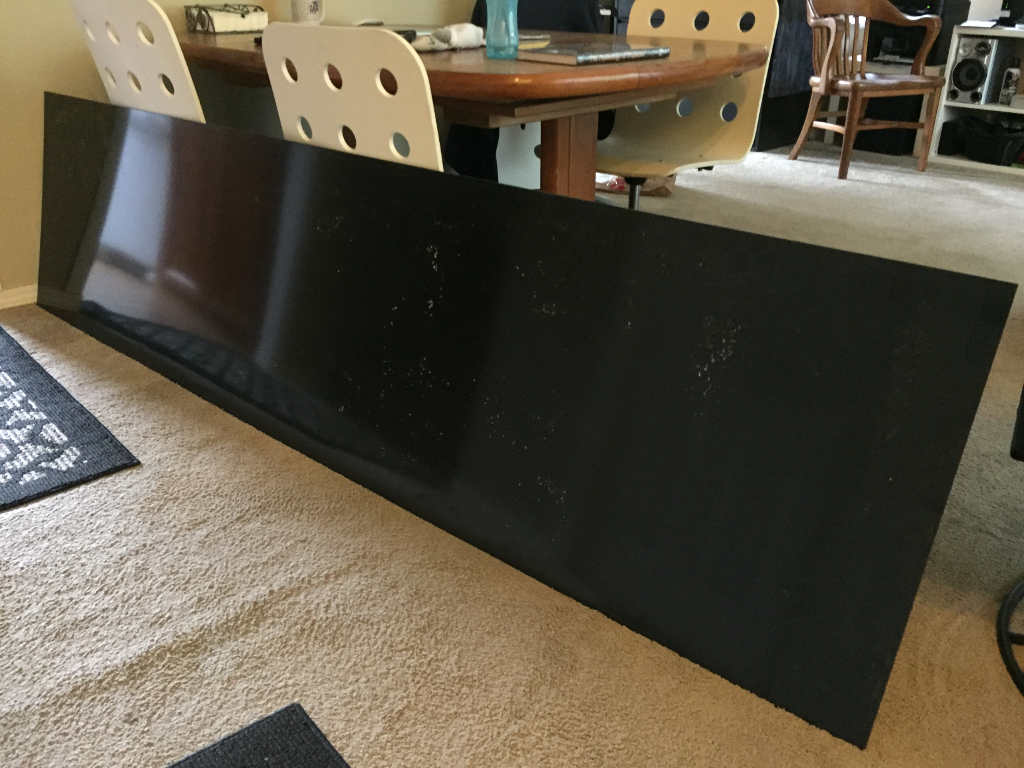
This past Saturday morning when I walked into our living room I couldn’t help noticing the large sheet of black ABS plastic that Caleb, my 19-year-old son, had acquired for his latest project.
Ever since Caleb was a toddler he has enjoyed creating things that would change and enhance his world. For the most part, he was just like every other young kid who loved playing with Lego and other toys but Caleb and his older brother Levi would migrate away from typical play and look for ways to improve their toys and their environment. Both my boys would use Lego and Kinex and other constructables (what I like to call toys that you can build things with) to make things that they could use for other purposes. Their desires quickly moved beyond using Lego and Kinex to using authentic resources to change their environment. For example, when my older son Levi was three he wanted to be able to pull his wagon with his bike and rather than just use a rope he wanted my help to rig up a hitch system which we created and he used and then passed onto his younger brother. Caleb was equally industrious and I have so many fond memories of heading down to the hardware store to gather the items my boys needed for their latest projects.
So when I saw the big piece of plastic I reminisced about Caleb’s passion for making things. I also thought about how my wife and I carefully nurtured and helped him and his brother develop their interests and created the environment in which they could fully develop their creative abilities and learn how to learn. If there was just one thing that I can point to that really made the difference it would have to be the use of authentic projects. While we didn’t deny our boys models, Lego, Knex and other constructables we also encouraged them to explore working on authentic projects. My boys were always working on something that was real and that would make an authentic difference in their world.
The bike hitch, bike ramps, countless other smaller projects, and the major fort project were just the starting point for exposing my boys to authentic learning. When I purchased and renovated a rental property the boys who were just 8 and 10 worked alongside me at every stage from cleaning up the junk in the yard to demolishing the basement rooms, to building new rooms and doing all the work that was necessary to bring the house into a state where it could be rented and then sold. Later that spring when the boys were still just 8 and 10 they planned out all the details of our month-long summer bike trip which included everything from getting the maps from the AMA, planning the route, to identifying what we could do along the trip to, where we would stay, and what we could do when we got to the interior of British Columbia. They put together a detailed binder that had all the information we would need. That first major biking holiday is still one of the most talked about trips that my boys will reminisce about. As professional DownHill Mountain bike racers and extreme athletes Levi and Caleb travel continuously so this early experience has served them well. The have spent the majority of their short lives working on authentic projects that not only enhance their lives but lives around them.
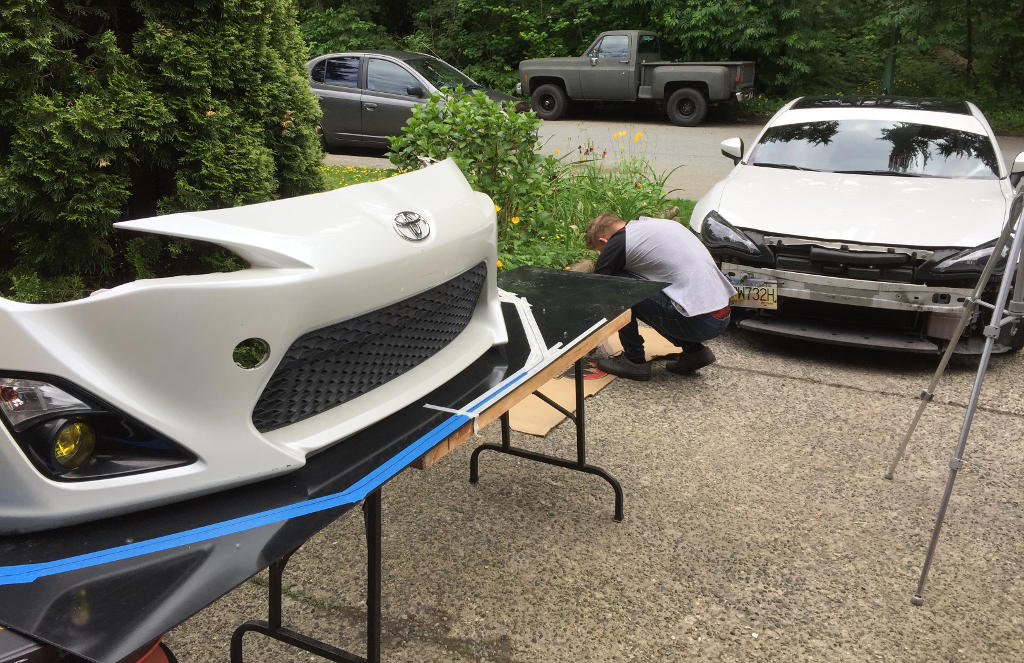
Authentic projects work because they not only give the learner choice and ownership over the world that they live in but they also give the learner the ability to find and use their voice and show the world what they have created. Caleb’s projects are getting very sophisticated and while the air splitter he created for his high-end sports car is not a project you would ask a novice to undertake Caleb is able to create a professional quality enhancement and add significant value to his car because he has lived a life filled with authentic projects.

The cognitive and analytic processes of prediction, modeling, experimentation, diagnosis, and problem-solving that Caleb experiences through his countless authentic projects has also contributed to his desire to take on in bigger and bigger challenges. I enjoy helping Caleb with his projects because his passion for learning and creation are contagious.
In our typical education rhetoric we talk about engagement, individualized instruction, and life-long learning but the reality of standardized testing or, if our learners are lucky, the occasional analysis of case-based studies offers our learners very little motivation for learning in the present, so how can we expect them to be excited about learning in the future. We can change this. But that means we have to give back control of the learning to the learner. We need to allow our learners to choose and work on authentic projects that will inspire their intrinsic passions for learning and help them grow their learner’s mindset. When we do this for our learners the possibilities of what they will be able to do are virtually limitless.

Additional thoughts on Authentic Learning:
- In Pursuit of the Better Way: The Learners Mindset
- Why Good Ideas Too Often Go Bad
- Mapping Your Learner’s Journey
- Ed Tech Projects Fail When the Focus is Technology rather than Learning
- Difference Between “Doing Projects” and “Project-Based Learning”
- Learning by playing, tinkering and making (The Learner’s Way blog of Nigel Coutts)


