Source: https://www.visualcapitalist.com/ranked-the-worlds-largest-economies-in-2026/
Creating Significant Learning Environments
My son Caleb and I have been rereading The Way We’re Working Isn’t Working: The Four Forgotten Needs That Energize Great Performance and we are both exploring how to apply the key principles of engagement management vs continuing to fail at attempting to manage time. I am writing this post in a 90-minute engagement cycle and will be shifting to a purposeful 20-minute break when my timer goes off and then focus on another type of energy I need to be productive. The key idea that Schartz points to is that energy, not time, is the fundamental currency of high performance which is at the heart of this process which was first established in a book co-written with Jim Loehr’s, The Power of Full Engagement: Managing Energy, Not Time, Is the Key to High Performance and Personal Renewal. I explored the ideas in this book back in 2010 and recently reread portions to remind myself of the 4 energy management principles that drive performance in my pursuit of finding a sustainable balance in my productivity.
To implement these principles effectively you have to begin with finding a balance between physical, emotional, mental, and spiritual energy. More specifically, you have to replenish one type of energy by either doing something to restore that energy and/or by switching to an expenditure of another type of energy. For example, after my 90-minute cognitive focus on writing this post, I will be shifting to building up my spiritual energy by taking in and meditating on a spiritually uplifting talk on YouTube. I will then shift my focus to building my physical capacity by going on a HIIT run. I listen to audiobooks on my runs and workouts so I can also build myself up mentally while challenging myself physically. Some time spent with my family in the afternoon will restore my emotional energy so that when I return to writing or creating I will have been replenished emotionally and mentally and can then approach more writing or creation with full engagement. Finding a balance in these types of energy use and replenishment is the key to my productivity and performance. I wish I could say that I have come to this understanding quickly and easily.
Unfortunately, this has not been the case, and my journey to engagement management prefaced by several decades of failing at time management. I have been looking for the key to time management since the early to mid-’80s when I first started trying to implement Blanchard’s One Minute Manager. After more than a decade of failing to make this work, I shifted to David Allen’s Getting Things Done (GTD) in 2006 and my Evernote still has the foundational structure of GTD for my main notebooks. I have also experimented with a wide assortment of GTD oriented tasks or ToDo list applications. Other than the GTD structure that I use to organize my Evernote notebooks about the only other GTD method I use is the GTD rule of doing something immediately if it will take 2 minutes or less. The challenge I have always found with GTD is that it takes so much time and energy to set it up properly and it also takes significant time and effort to implement consistently. I was never really able to use it completely or properly and I found that the time I spent trying to make GTD work could be better spent on actually doing what I needed to do.
As result in 2009, I turned to Brian Tracy’s Eat That Frog which is now in its third edition. Both GTD and Eat That Frog emphasize time management but Tracy better recognized that people have limited willpower or discipline to build and maintain a sophisticated GTD structure and methodology so he advocated that people do the most pressing task that they were not looking forward to first…hence the title Eat that Frog. Tracy also advocates for a prioritization structure not unlike the GTD structure be used to organize your other tasks. I have listened to and reread Eat That Frog multiple times and while I did manage to eat many frogs while attempting to use the Eat That Frog methodology I really didn’t get beyond this first idea. One of the other key insights I gained from Tracy was his emphasis on the notion of having limited stores of willpower and that the best way to preserve those stores was to set up a process that would become habits that would enable one to what they desired because of habituation and preserve the limited willpower stores for other things like eating that frog.
This led me to explore Charles Duhigg’s ideas in The Power of Habit: Why We Do What We Do in Life and Business in 2014. Duhigg argued that since more than 40% of what we do each day is a result of habitation it made sense to explore how this worked. He identified the habit loop which consists of a cue, a routine, and then a reward as the key to understanding how habits work and how to change them. Duhigg also argued that habits never really disappear so to change or replace a habit you have to first identify the habit loop and then change the habit or routine by isolating the cue and then choosing a new routine or behavior that will deliver a reward that you are craving. While this behaviorist approach does explain why we continue to do the things we do or don’t want to and it does offer a way to change habits, it was just too difficult to implement from a time management perspective.
Even when I looked into Stephen Guise arguments in Mini Habits: Smaller Habits, Bigger Results like putting your shoes and gym clothes by your bed so that the first thing you do when you wake up is put them on a go to the gym or go for a run, I was able to improve on my work out consistency but I wasn’t able to effectively apply these ideas to my time and productivity management. While exploring habits, mini habits, and willpower I turned to Kelly McGonigal’s The Willpower Instinct: How Self-Control Works, Why It Matters, and What You Can Do to Get More of It. Once again just knowing more about willpower and the mechanism behind habituation didn’t really give me the ability to make changes to my time management. Even though it makes sense that we have 3 kinds of willpower, that being able to differentiate between “I won’t” “I will” and “I want” power and the notion that we can train our biological willpower like a muscle, I just wasn’t able to put this into practice. McGonigal did point to the notion of finding a balance of eating well, exercising, meditating, getting enough sleep, and spending time with people who are positive influences as a way to build willpower. I started noticing this similar pattern of addressing or finding a balance in more holistic variables as a way to build willpower or energy.
I really appreciated McGonigal’s writing so when she put out her book Upside of Stress: Why Stress Is Good for You, and How to Get Good at It in early 2016 began my trip down the rabbit trail on exploring stress. McGonigal argues that stress is only harmful to your health if you believe it is, that happy lives include stress and that you can use stress to boost your performance. This notion of using the energy of stress to change the negative self talk into something positive and using that energy to make things happen reminded me of many of the key ideas from The Power of Full Engagement: Managing Energy, Not Time, Is the Key to High Performance and Personal Renewal.
I reread this book in 2017 and again in 2018 and for the past couple of years have been working at finding a balance expending and replenishing my physical, emotional, mental, and spiritual energy. I have taken a relatively holistic approach and have scheduled my writing time for first thing in the morning and have also been very consistent in my workouts, and my nutrition. I have always set aside time for my family and I do regularly address my spiritual needs through readings, prayer, and meeting with others who hold similar beliefs. In the past several years I have incorporated a 90-minute sleep cycle approach to match my body’s natural circadian rhythms and I have never slept better. Now, I am applying a similar approach to my waking hours and my ultradian rhythms thanks to the insights shared by Schartz in The Way We’re Working Isn’t Working: The Four Forgotten Needs That Energize Great Performance.
Schartz points to the work of the “father or sleep” Nathaniel Kleitman who discovered rapid eye movement (REM) and proposed that sleep included active brain processes. Kleitman also discovered that a Basic Rest Activity Cycle (BRAC) is present when people are awake and is part of our ultradian cycles. These cycles involve alternating 90 minutes periods of high-frequency brain activity followed by lower-frequency brain activity that lasts for about 20 minutes. The key to the highest levels of productivity is to engage in highly focused creativity or deliberate practice during this 90 minute period and then take a break by doing something physical, emotional, or spiritual in the 20 minute break period. Schartz also points to the work of authority on deliberate practice by Anders Ericsson who found that the most successful musicians or athletes engaged in an average of 4-4.5 hours a day of practice that was broken up with a few shorter breaks. It appears that these people have found their highest level of productivity in the natural rhythm in 3 cycles.
In the final analysis and synthesis, I have found that when I combine 90-minute cycles of intense focus with shorter cycles of exercise I am completely engaged and highly productive. I am also finding that if I can get 2-3 of these cycles in first thing in the morning I am much more productive than I have ever been before. I am not only more productive I can analyze, evaluate, and synthesize ideas more efficiently and can write or create more effectively. The power of full engagement is really finding a balance in the expenditure and replenishing of one’s physical, emotional, mental, and spiritual energy. It has taken me too many years to learn that time management really doesn’t work and there is no simple solution, quick fix, or just a matter of disciplining oneself to eat that frog. The key is to address all aspects of our humanity, find that balance and take into account all the factors that are necessary to be as complete and as productive as we were intended to be.
References
Allen, D. (2002). Getting things done: The art of stress-free productivity. Penguin Books.
Blanchard, K., & Johnson, S. (n.d.). The one minute manager. Berkley Publishing Group.
Brian, T. (2007). Eat that Frog!: 21 great ways to stop procrastinating and get more done in less time. Berrett-Koehler Publishers.
Duhigg, C. (2012). The power of habit: Why we do what we do in life and business (Vol. 34). Random House.
Ericsson, A., & Pool, R. (2016). Peak: Secrets from the new science of expertise. Eamon Dolan/Houghton Mifflin Harcourt.
Duhigg, C. (2016). Smarter faster better: The secrets of being productive. Random House.
Guise, S. (2013). Mini habits: Smaller habits, bigger results. Selective Entertainment LLC.
Loehr, J. E., & Schwartz, T. (2005). The power of full engagement: Managing energy, not time, is the key to high performance and personal renewal. Simon and Schuster.
McGonigal, K. (2011). The willpower instinct: How self-control works, why it matters, and what you can do to get more of it. Penguin.
McGonigal, K. (2016). The upside of stress: Why stress is good for you, and how to get good at it. Penguin.
Schwartz, T., Gomes, J., & McCarthy, C. (2010). The way we’re working isn’t working: The four forgotten needs that energize great performance. Simon and Schuster Audio.

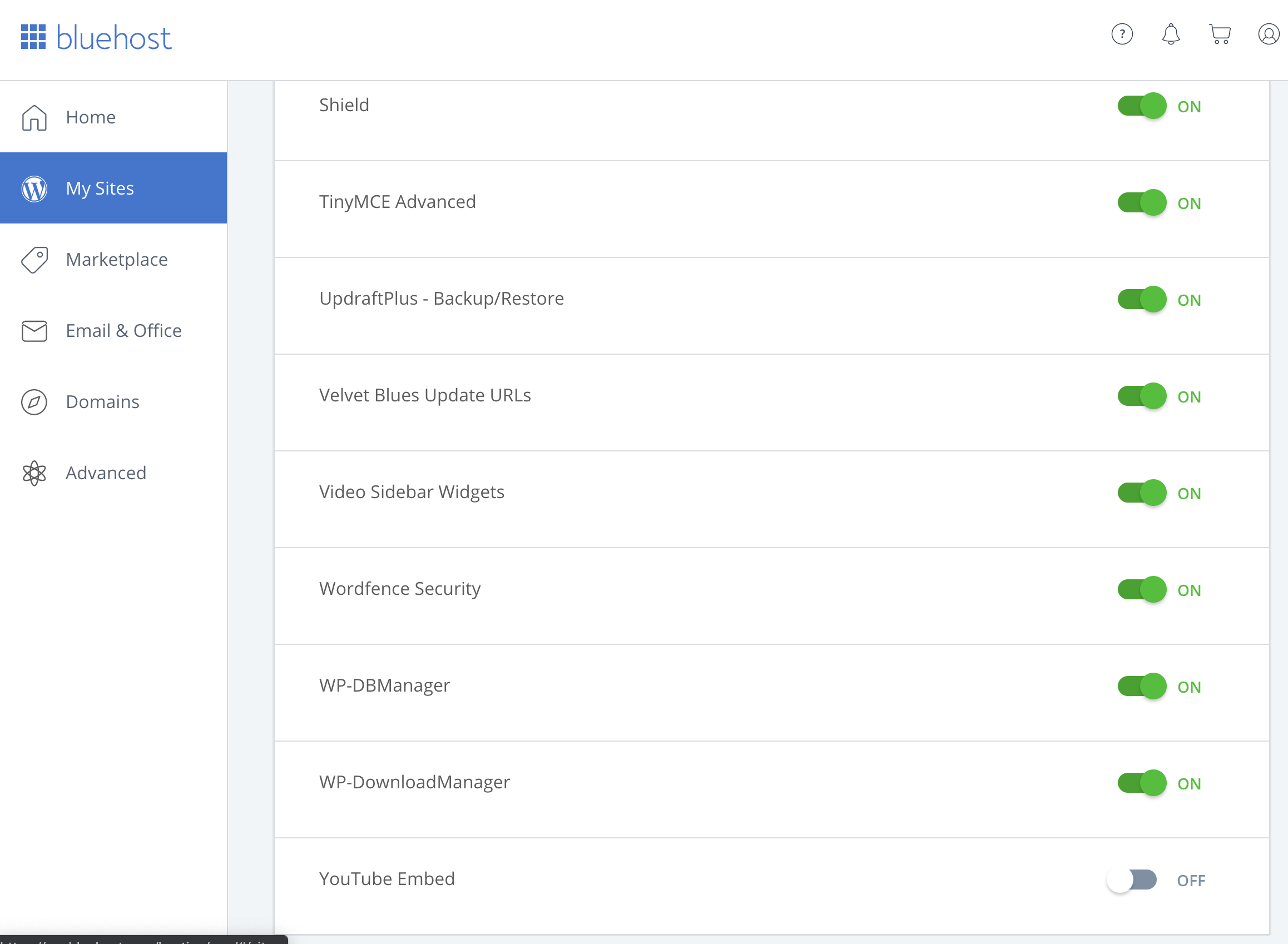
I keep my WordPress install updated and since it has been a very long time since a WP Plugin has caused an issue I simply did an “update all” and on about 4 or 5 plugins and walked away. I didn’t check to see if there were any issues because the backend interface and my control panel said all was fine. I didn’t actually take a look at my site in another browser. BIG MISTAKE. I woke up to a bunch of emails and messages indicating my site was down. Not something you want to deal with when you have a full day of pressing work scheduled. I couldn’t recall what plugins I had updated so I started the time-consuming process of turning them all off one at and time and testing. Fortunately, I have scaled down to only 22 plugins. Unfortunately, the very last plugin “Youtube Embed” was the culprit. I have uninstalled this plugin and have turned on all other plugins (one at a time with full testing) so my site is back up.
Lesson learned. NEVER update plugins and walk away. Do a full test. Also, update one plugin at a time.
This event has reminded me that I also need to update my site to HTTPS to get rid of the message “not secure” from the browser line. This is going to break my site and I am not looking forward to fixing this issue.
Have you every had a situation where you thought something would only take a few minutes to complete but ended up taking a couple of hours? To make sure this post doesn’t turn out this same way I will get to the point. This morning my co-instructor and I needed to send out the announcement to our new group of students. No problem…I have an announcement script in my trusty Evernote so I told my colleague this will just take a few minutes; I just needed to update the script to reflect the fact we are co-teaching, change the dates and then I can post it. Or so I thought.
Rather than explain in full detail the challenges that arose and how they were addressed I will summarize my experience in the following list:
By the time I went through the above process which included many other smaller steps too tedious to mention the few minutes to update the announcement message took just under two hours to complete. The authors of 4DX point to the day to day whirlwind of just getting your work done as one of the major factors that prevent significant change from taking place in most organizations. Most people are very busy just doing their work so adding anything new or looking to innovate is very challenging in the busy work that we live in. While this is true I also believe that we can add to that whirlwind by being reactive rather than being proactive. Let me explain. The steps above detail one reactive measure after another and if I would have been more proactive I could have eliminated or limited most of these steps and saved myself some time and frustration. Consider how I could have been more proactive:
I must acknowledge that even though being proactive will help you save some time you still need to actually spend the 2, 5, or 10 minutes here and there doing what needs to be done. You can save same some time but more importantly, you can save frustration and anxiety. Human’s don’t function very well in a heightened state of anxiety. Frustration and anxiety will cause adrenaline to flow and will turn on our flight or fight response which redirects our blood flow from our brains to our extremities. When things aren’t going well we don’t need blood being redirected from our brains to our limbs so this flight or fight state makes us even more unproductive. Ever noticed how the frustration just seems to build and it can take some time to calm down. This is just our physiology doing what it is supposed to do — get us ready to react and fight or take flight.
By being proactive we can not only save time but we can prevent moving into these states of growing frustration which we all know just kill our productivity. Being proactive will also mean that we can be much more purposeful and add to our work/website/ePortfolio on a consistent basis. The making of meaningful connections which are the essence of learning and growth are much more effective if we approach them incrementally. Creation, reflection, and revision and more reflection and revision require time… lots of time. If we are proactive we can leverage the hours we have and learn and grow more effectively.
More of my thoughts on being proactive:
The Paradox of Being Proactive
Why Create Significant Learning Environments
Sense of Urgency: Create It Now or React to It Later
How to Change Before You Have To
Pick Two – Innovation, Change or Stability
Practice Change by Living It
Learning something new is frustrating. It involves being dumb on the way to being smart. Once we get good enough (at our tools, at our work) it’s easier and easier to skip learning how to do the next thing, because, hey, those fifteen minutes are a hassle. (Godin, 2016)
I have been thinking about this Seth Godin quote ever since he posted The first fifteen minutes to his blog in January. For the most part I think he is accurate. All too often we are not willing to deal with the fifteen minutes of hassle to learn something new that can save us hundreds or even thousands of minutes down the road. I said for the most part because Godin’s fifteen minute rule can only be applied to the simplest of tasks, tools or processes. It also only applies if the task, tool, or process impacts you as an individual. Once the you bring in other people into the picture the time factor can increase significantly. Regardless of the complexity of the task or the added complexity of a collaborative effort the short time pain for long term gain are still worth the effort. Let me explain.
Students in the Lamar University Master of Digital Learning and Leading (DLL) study online and use digital books and resources. When they transition from one course to the next it has become common practice to share the reading list for the next course to give them the opportunity to stay up with the high volume of reading. We only use digital resources in the program and due to the nature of Digital Learning these resources are constantly being updated. Keeping and sharing static lists of these resources for each of the courses in the Master program has become a challenge. Updating a shared Google document doesn’t offer enough power and flexibility.
This is why we planning a move to Zotero reference management software. I have been using reference management software of one kind or another since the mid 1990’s and have been using the open source, cloud based Zotero since it was first developed in 2007. Therefore, I didn’t have to spend fifteen minutes to learn the software. However, I did have to spend much more then fifteen minutes because I had to explore and test:
Each of these steps took approximately fifteen minutes so Godin’s model does work if you multiply it by numbers of significant steps in the process. If you factor in the initial learning process I would have spent sixty minutes to get to the point where I could demonstrate to my colleagues that using Zotero would be the best way for us to share DLL resources.
But are the sixty minutes worth the effort. Godin argues:
The problem with evaluating the first fifteen minutes of frustration is that we easily forget about the 5,000 minutes of leverage that frustration earns us if we stick it out.
Once again Godin’s model is based on individual effort. When you factor in the six or seven full time faculty and dozen or so adjunct faculty who will use the Zotero system and the hundreds of students who will not only use Zotero to access the course reading lists, but will also share it with their students the impact can be much more significant then the 5,000 minutes of leverage that Godin points to.
Perhaps even more important than the time savings and leverage is the impact this can have on our future leaders. Our program is call Digital Learning and Leading so it is appropriate that faculty in the program model the digital leadership required to take the fifteen or sixty or more minutes of frustration in order to leverage the power of digital learning which will have an exponential effect. This is what leaders do and what leaders must model.
References
Godin. (2016, January 16). Seth’s Blog: The first fifteen minutes [Blog]. Retrieved from http://sethgodin.typepad.com/seths_blog/2016/01/the-first-fifteen-minutes.html


