Archives For Learning

When you listen to Sir Ken Robinson talk about starting a learning revolution and listen to many other educational reform speakers all encouraging teachers to improve our educational system the excitement will only last as long as you can then address the question of how. Educational researcher John Hattie who is also the Director of the Melbourne Educational Research Institute at the University of Melbourne has conducted a synthesis of more than 50,000 studies covering more than 80 million students to determine what factors contribute to most to improving student achievement. The results of this research and the answer to the how question are found in Hattie’s book Visible learning: A synthesis of over 800 meta-analyses relating to achievement.

Hattie points out in his Visible Learning books and in many of his talks that just as long as you aren’t doing anything to physically or mentally harm your students almost anything that you do will contribute to student achievement (2008, 2012). The key is to do the things the impact student achievement the most. What are those things?

In the following video Hattie addresses what the most important factors a teacher can address to improve student achievement:

Hattie argues examining, thinking and talking with other teachers about the learning environments that we have created and are creating and the impact that we can have on learners is the most important thing we can do to improve our learners achievement. I have always argued that if I can get educators to talk to other educators and consider what they are doing in their learning environment then the learner wins. Hattie and I are in good company with our recommendations that teachers start collaborating on how to improve the learning environment.

Theodore Sizer, the former Harvard Graduate School of Education Dean and Educational Reformer, argues in his book, The Red Pencil, that little has changed in education since his experiences in the information and test based classroom he endured in 1946. Sizer argues that teachers embrace a code of silence because they are continually subjected to the demands of politicians, administrators, academia, and parents who all claim to have the answer to education reform. Sizer explains that because everyone is a proclaimed expert and is telling teachers what to do when teachers go to their classroom they close the door and they do what they can and what they need to do in order to help students learn. Unfortunately, when they close the door they also agree to not add to the noise and enter into a code of silence where they won’t question or tell their teaching colleagues what to do as long as their colleagues won’t question or won’t tell them what to do. Sizer suggests that this code of silence is one of the main factors that explains why little has changed.

In addition to teachers working together to evaluate their impact as one of most significant factors in improving student achievement Hattie points to these other factors:

  • Moving from what students know towards explicit success criteria.
  • Errors an trust are welcomed as opportunities to learn.
  • Maximize feedback to teachers about their impact.
  • Getting the proportions of surface to deep correct.
  • The Goldilocks principle of challenge, and deliberate practice to attain these challenges.

By breaking the code of silence educators can start to work together to evaluate their impact and consider how the learning environments they create can improve their learners achievement.

References
Hattie, J. (2008). Visible learning: A synthesis of over 800 meta-analyses relating to achievement. Routledge.
Hattie, J. (2012). Visible learning for teachers: Maximizing impact on learning. Routledge.
Hattie, J. (2013) Why are so many of our teachers and schools so successful? (John Hattie at TEDxNorrkoping). Retrieved from https://youtu.be/rzwJXUieD0U
Sizer, T. R. (2005). The red pencil: Convictions from experience in education. Yale University Press.

As a constructivist educator, I believe that it is my responsibility to not only create a learning environment where the learner has choice, ownership, voice, and agency over their learning, it is also my responsibility to guide them through their personal development journey and help them take ownership of their learning. I like to use the notion or analogy of a journey because it allows me to point to common navigational tools in which most people are familiar and apply those ideas to the learning journey.

Google Map

When I think about going on a journey I immediately think about Google Maps which I use on a daily basis. Unless I have been to a destination several times, I will type in or speak in the destination name or address and then Google will immediately show me what they believe is the best path. I often preview a trip on my laptop so that I can manipulate my options and once I have the best route laid out I identify the key stages of the journey and transfer the map to my iPhone.

Experience has shown me that identifying the key landmarks and stages is a very important part of the travel process. Because I live in one of the most traffic congested cities in North America (Vancouver) it is not uncommon to have a traffic accident, construction, or an event forced me to change my route without warning so having previewed the key stages and landmarks enable me to make adjustments to my course with a lot less stress and anxiety then if I simply relied on Google’s step by step navigation. Both my younger son and I like to look at the big picture to identify the key stages and we can easily make adjustments to our travel much easier than my wife and older son who prefer to rely on Google’s step by step instructions and not have to think about the trip.

While the convenience of Google’s step by step instructions cannot be denied it does come at a cost. When you depend on Google to tell you where to go at every turn you actually aren’t learning the route. My older son is constantly having to rely on Google’s step by step instructions and when he isn’t using Google he is asking his brother or I where to turn and how to get to places that he would have learned how to navigate to if he would have taken ownership of the learning process and looked at the route, identified the key stages and fully engaged in understanding where he was going. It is not uncommon for my younger son to be able to take a variety of alternates to a destination without even having to refer to the map because he has learned how to navigate the city rather than just rely on Google to tell him where to go.

This dependence on step by step instructions or having someone or something tell us exactly what we need to do is paralleled in the educational setting. If our learners are not fully aware of where they are going and are not engaged in recognizing the stages or landmarks along the way, are they simply relying on step by step instruction to satisfy the assignment requirements without having to really think about the process then are they learning? I am in good company with people like John Dewey when I say that they are not learning. In Democracy and Education, Dewey argued learning or growth was the result of the quality of mental process not the production of right answers.

So how do we ensure that our learners are learning and growing and not simply regurgitating the right answers? We must go back to the starting point in this discussion and focus on creating significant learning environments where the learner has choice, ownership, voice, and agency over their learning.

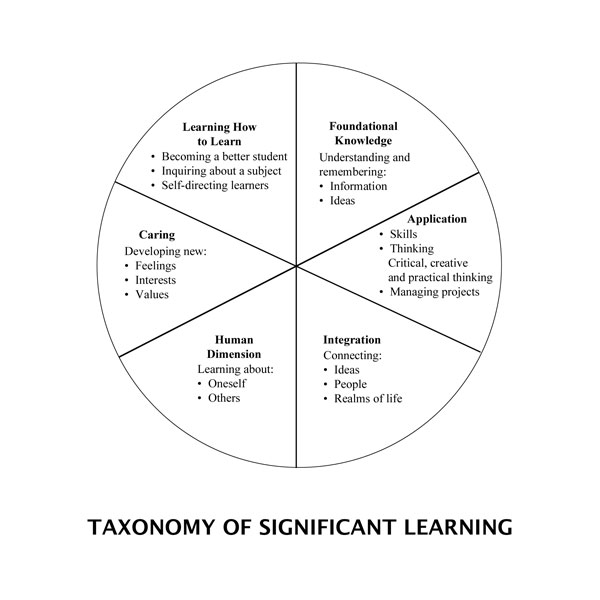
More specifically we do this by using the backward design principles within Dee Fink’s 3 Column table and his Taxonomy of Significant Learning.

The 3 Column table is essential a course map and when you add the notion of Jim Collin’s Big Hairy Audacious Goal (BHAG) you provide your learner their ultimate destination in their learning journey. This is why Fink encourages us to think in terms of who the learner will be or where the learner will be at the end of the course. This type of thinking is analogous to the final destination in our map/travel discussion above but the BHAG perspective adds the emotional factor that addresses why the learner will want to go there. Similarly, the learning outcomes are the stages or landmarks along the way. The activities section of the Finks model is where some of the more detailed instructions are that are necessary for the journey.

EDLD 5313 3 Column Table

At this point, some of you may be thinking that I am totally opposed to step by step instructions. I am not; there are times when the I am on the freeway in heavy traffic and I turn on the Google step by step instructions so that I don’t miss my exit or other times when I just can’t see the context of where I am going and it just makes more sense to follow Google’s direction. The key is that I don’t rely on the step by step but rather use it when it is most beneficial and I also use it within the context of knowing the bigger picture or where the map is leading me.

What about the assessment? To a certain extent, assessment can be compared to the speedometer, and other gauges in the car and other road signs that confirm that I am on the right track and that my car will get me to my destination safely. Unfortunately, this is where the analogy really breaks down because the notion of standardized testing really doesn’t fit into my map and journey example. Then again I would argue that standardized testing really doesn’t fit into our learning environments either…but this is a whole other discussion.

The 3 Column table is that bigger picture or map that I use to guide the learner to their learning destination (BHAG). The learning outcomes are those landmarks that I give them and encourage them to seek them as they go along in their learning journey. Well designed activities should focus on active learning, authentic projects and other learning processes that still address the bigger picture and encourage ownership of the learning. There are times when some step by step instructions/activities are necessary to scaffold a learner and to get them to the point in the journey where they take back the control of the learning process. The key is to remember that it is the learner’s journey and if you adhere to any constructivist thinking then we must acknowledge that we are only the guides on the side.

References

Collins, J. C., & Porras, J. 1994. Built to Last: successful habits of visionary companies. New York: HarperBusiness.

Dewey, J. (2004). Democracy and education. Courier Corporation.

Fink, L. D. (2013). Creating significant learning experiences: An integrated approach to designing college courses. John Wiley & Sons.

BHAGThe notion of a Big Hairy Audacious Goal (BHAG) was first introduced by Jim Collins back in 1994 in the book Built to Last: Successful Habits of Visionary Companies. Collins and many others since have used the notion of a BHAG to help define a visionary type goal that is more strategic and emotionally compelling rather then being simply tactical.

While you don’t have explicitly to use the term BHAG in presenting your course goal you should use the focus of the BHAG in your design and development to ensure that your goal is strategic and emotionally compelling enough to speak to where you students will be after the course. The goal should focus more on who the students will be or become as a result of the course and not just focus on what they will be able to do.

Whenever you are using a backward design model and are working within an outcomes based education (OBE) framework a clear focus on who you want the learner to become at the end of the course will help you to clearly articulate the course outcomes—which should focus on what the learner needs to do to get achieve the BHAG.

A big enough but still achievable BHAG will also address a fundamental motivator that you need to consider when designing a learning environment—the why. As Simon Sinek argues, people aren’t interested in what they need to do as much as they are interested in why they need to do it. Addressing the why also address the fact that we are much more emotionally than rationally motivated and that the head won’t go where the heart hasn’t been.

References

BHAG [Online image]. Retrieved June 13, 2016 from http://www.printaudit.com/premier/wp-content/uploads/2015/03/BHAG.jpg

Collins, J. C., & Porras, J. 1994. Built to Last: successful habits of visionary companies. New York: HarperBusiness.

Sinek, S. (2009). Start with why: How great leaders inspire everyone to take action. Penguin.

Learning something new is frustrating. It involves being dumb on the way to being smart. Once we get good enough (at our tools, at our work) it’s easier and easier to skip learning how to do the next thing, because, hey, those fifteen minutes are a hassle. (Godin, 2016)

I have been thinking about this Seth Godin quote ever since he posted The first fifteen minutes to his blog in January. For the most part I think he is accurate. All too often we are not willing to deal with the fifteen minutes of hassle to learn something new that can save us hundreds or even thousands of minutes down the road. I said for the most part because Godin’s fifteen minute rule can only be applied to the simplest of tasks, tools or processes. It also only applies if the task, tool, or process impacts you as an individual. Once the you bring in other people into the picture the time factor can increase significantly. Regardless of the complexity of the task or the added complexity of a collaborative effort the short time pain for long term gain are still worth the effort. Let me explain.

Students in the Lamar University Master of Digital Learning and Leading (DLL) study online and use digital books and resources. When they transition from one course to the next it has become common practice to share the reading list for the next course to give them the opportunity to stay up with the high volume of reading. We only use digital resources in the program and due to the nature of Digital Learning these resources are constantly being updated. Keeping and sharing static lists of these resources for each of the courses in the Master program has become a challenge. Updating a shared Google document doesn’t offer enough power and flexibility.

This is why we planning a move to Zotero reference management software. I have been using reference management software of one kind or another since the mid 1990’s and have been using the open source, cloud based Zotero since it was first developed in 2007. Therefore, I didn’t have to spend fifteen minutes to learn the software. However, I did have to spend much more then fifteen minutes because I had to explore and test:

  • The best way to set up Zotero Groups which included determining the correct group and user permissions and access model,
  • How to add new users and how to invite and share access to the system;
  • How to instruct the group administrators and new users how access and use the online system.

Each of these steps took approximately fifteen minutes so Godin’s model does work if you multiply it by numbers of significant steps in the process. If you factor in the initial learning process I would have spent sixty minutes to get to the point where I could demonstrate to my colleagues that using Zotero would be the best way for us to share DLL resources.

But are the sixty minutes worth the effort. Godin argues:

The problem with evaluating the first fifteen minutes of frustration is that we easily forget about the 5,000 minutes of leverage that frustration earns us if we stick it out.

Once again Godin’s model is based on individual effort. When you factor in the six or seven full time faculty and dozen or so adjunct faculty who will use the Zotero system and the hundreds of students who will not only use Zotero to access the course reading lists, but will also share it with their students the impact can be much more significant then the 5,000 minutes of leverage that Godin points to.

Perhaps even more important than the time savings and leverage is the impact this can have on our future leaders. Our program is call Digital Learning and Leading so it is appropriate that faculty in the program model the digital leadership required to take the fifteen or sixty or more minutes of frustration in order to leverage the power of digital learning which will have an exponential effect. This is what leaders do and what leaders must model.

References

Godin. (2016, January 16). Seth’s Blog: The first fifteen minutes [Blog]. Retrieved from http://sethgodin.typepad.com/seths_blog/2016/01/the-first-fifteen-minutes.html