Archives For Learning

LMS-Providers-Market-Share-by-Year1
Source: http://listedtech.com/lms-providers-market-share-implementation-year/

Keep in mind that Blackboard (BB) growth has been through acquisitions. This has proven to be an effective strategy for BB because changing from one LMS to another is one of the most challenging IT task an institution can take on. The chart above points to % of LMS implementation and shows just how quickly Canvas has grown and continues to grow.

The chart below reveals the total market share and provides a better perspective the dominant players in this space. While BB is still the market leader their growth has almost stopped and ask Moodle and Canvas continue to grow it will more than likely be at the expense of BB market share.
LMS-Providers-Market-Share-by-Year
Source: http://listedtech.com/lms-providers-market-share-implementation-year/

If I were D2L I would be very concerned about Canvas and Moodle because D2L no longer is a compelling alternative to BB. Having worked with all these LMS at a variety of institutions I am not surprised to see Canvas grow. It really does provide a genuine alternative to the traditional LMSs BB, Moodle and D2L.

During last summer’s Exponential Youth Camp (XYC) pilot at Singularity University 14 of the world’s brightest teenagers were asked to redesign the future of education. They recommended:
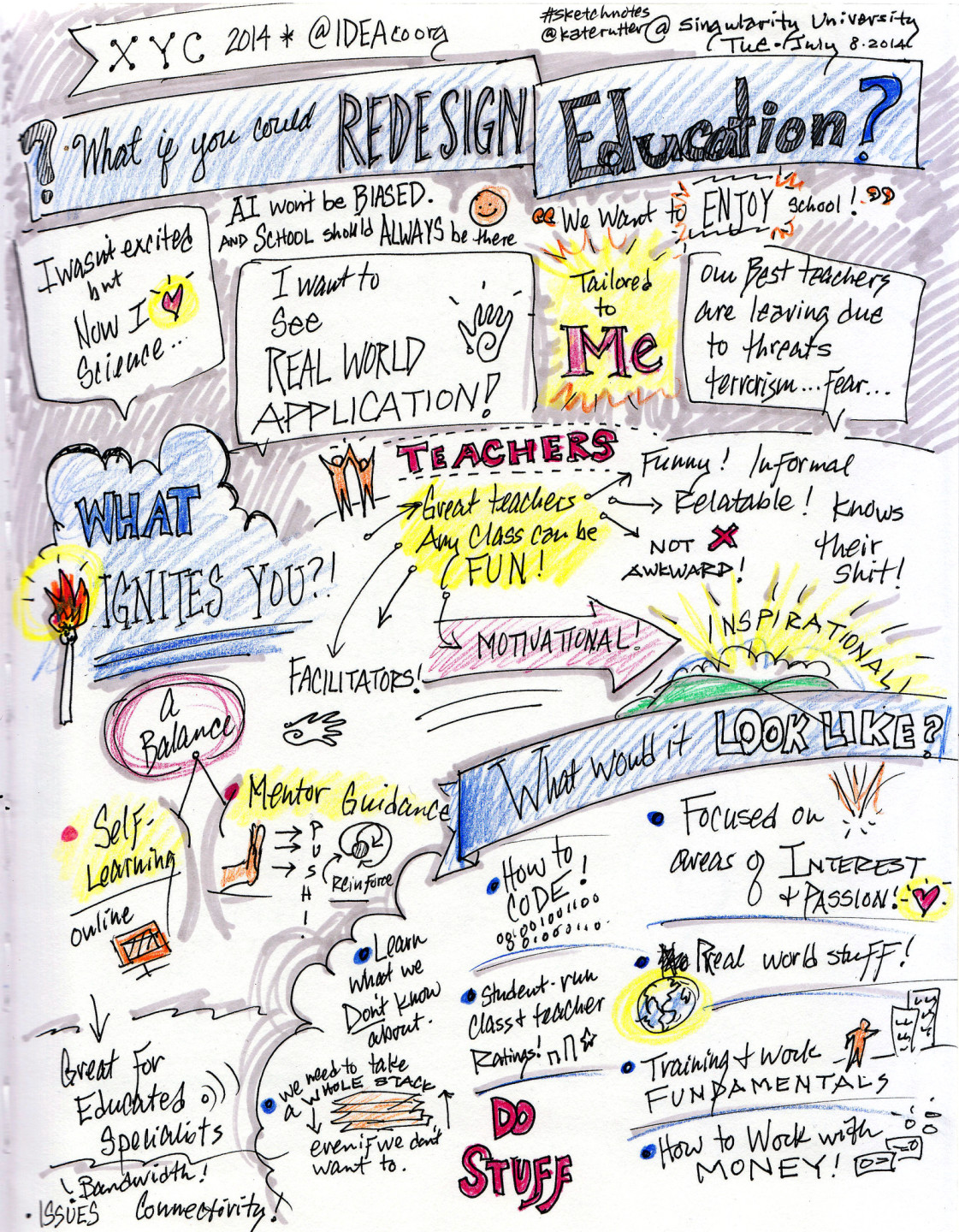
Redesign Education

  1. Make it about ME – Personalization is necessary to compete in today’s intricately specialized world.
  2. Let’s DO things – Across the board, the teens wanted opportunities to demonstrate knowledge through real-world application, not scantrons.
  3. Don’t ditch me in an online course – students simply desired guidance in navigating the material.
  4. Be my coach – Students still want great teachers.
  5. Teach me relevant skills – opportunities to build more practical skills like teamwork, problem solving and conflict resolution
  6. Foster a growth mindset – education should make people confident in their ability to learn anything.

Read the full article…

Feedback-Boost-Student-Results-With
Source: http://www.evidencebasedteaching.org.au/the-value-of-feedback-infographic/

ED IT Predictions

Image credit: http://www.ubertas.co.uk/blog/5-it-predictions-you-need-to-know-about

Tis the start of the season for predictions. At the recent EDUCAUSE conference in Indianapolis in October a panel of leaders came up with a list of 10 IT issues that will be important to address in 2016. The following is a comparisons of the 2016 list with 2015 as one can see many of the issues are despite having different formal labels are very similar:

2015 Optimizing technology in teaching and learning and 2016 Optimizing educational technology


Top 10 Higher Ed IT Issues Comparison
2015 2016
1. Evolving staffing models 1. Information security
2. Optimizing technology in teaching and learning 2. Optimizing educational technology
3. Funding IT strategically 3. Student success technologies
4. Improving student outcomes 4. IT workforce
5. Demonstrating IT’s value 5. Institutional data management
6. Increasing capacity for change 6. IT funding models
7. Providing user support 7. Business intelligence and analytics
8. Developing security policies for the institution 8. Enterprise application integrations
9. Developing enterprise IT architecture 9. IT organizational development
10. Balancing information security and openness 10. E-learning and online education

Elearning has been a top priority on many lists since the late 1990 so perhaps this year Educational IT will finally get this priority sorted out.

Read the full article…

For a learning theorist and Professor there are few things more invigorating than working with a group of highly motivated learners. My long time colleague and friend Dr. Craig Montgomerie often asks me to join his online Athabasca University class MDDE 610: Survey of Current Educational Technology Applications to provide his students the opportunity engage with a professional like myself who has extensive experience in promoting the use of Educational Technology.

In the MDDE webinar for November 3, 2015 titled Leading learning and technological change we focused on the most difficult challenges in any organizational change — dealing with an organization’s culture and implementing strategies that require a cultural shift. Through examining a case study of the ACU Connected Mobile Learning Initiative we explored how addressing the following four key principles increase your chances of success significantly:

  1. Start with Why
  2. Identify and engage key influencers
  3. Install an effective execution strategy
  4. Enlist and empower self-differentiated leaders

We also analyzed how ignoring even one of these principles can contribute to failure and how these principles are currently being used in the BCIT School of Health Sciences Future of Learning initiative.

Webinar slide deck – MDDE 610 Nov 2015.pdf

The following resources were mentioned or briefly discussed in the webinar and can be used to gain a deeper understanding:

The Head Won’t Go Where the Heart Hasn’t Been
This post stresses that:
If you really want to bring about change in people then you need to appeal their hearts and not to their heads. The sharing of more information or engaging in more rational discourse on its own doesn’t appear to help people to make significant change but an appeal to values, attitudes, and feelings first can motivate people toward making changes.

People who like this stuff…like this stuff
Includes a short annotation and links the books Start with Why (Simon Sinek), Influencer, Four Disciplines of Execution (4DX) and Freidmen’s Failure of Nerve.

Connected The Movie by the ACU Connected Initiative
Link to the ACU Connected mobile movie that started and provided the fundamental Why or vision for Mobile Learning at ACU.

Additional resources on Change and Innovation: