
Source: elearninginfographics.com/youtube-increases-classroom-pass-rates-infographic/
Creating Significant Learning Environments


I regularly monitor a variety of sources that report on advances in learning technologies and I try to compare the real progression in educational technology to the hype that is offered through the local, regional and national press. When I read the Globe and Mail article What universities are doing to create a more exciting learning experience I had mixed emotions.
On the one hand it is exciting to see that institutions like Wilfrid Laurier University, McMaster University, Queen’s University and many others in Canada are finally implementing some well researched and established best practices in learning spaces. On the other hand referring to brightly painted and decorated rooms, round tables equipped for laptops, video conferencing and integrated projector controls; whiteboards mounted on the walls; portable collaborative stations; flexible room configurations and well designed informal learning spaces as turning “everything upside down” or as “hugely disruptive” is frustrating because these claims are excessive and do not accurately reflect the fact that innovative use of learning spaces has been happening for the past fifteen plus years.
If you consider the Open Classroom/School movement that started in the late 70’s we have over forty years of research in the use of flexible learning spaces to draw upon. Rather than go that far back all we need to do is refer to the seminal and authoritative work Learning Spaces that was edited by the President of EDUCAUSE Diana G. Oblinger. Learning Spaces offers thirteen chapters of best practices and principles followed by another thirty chapters of case studies. Back in 2006 at Lethbridge College our Learning Spaces & Classroom Standards committee used this book as one of several foundational works for how the College should create active and dynamic learning spaces that used technology to enhance learning. If you put this discussion on Learning Spaces into the context of Gartner’s Hype Cycle of Innovation you should recognize that we are well into the Plateau of Productivity.
I really do not intend to be critical of the wonderful improvements that are happening to the learning spaces discussed in the article; we should applaud these institutions for finally implemented well established ideas. I am just calling into question the hype and using the terms turning “everything upside down” or as “hugely disruptive” to describe or refer to these activities. Disruptive is the latest trendy term that too many people are attaching to too many things. Dan Maycock points to research of the top 1000 companies in his post The Ugly Truth About Disruption & Innovation that too many managers believed that:
everyone thought being disruptive was something that happened all at once and only took one brilliant idea so they spent money on white board and clear glass conference rooms believing they were planting the seeds for disruption because everyone felt more innovative due to a trip to Ikea and a TED seminar on disruption.
Maycock argues that focusing on the disruption or the disruptive technology is wrong and that companies should focus what is that they really do and make sure they are doing that well. He offers the following question as an example of what happens when you have the wrong focus:
How many railroad companies went out of business, when planes and trucks came into the picture, because they said they were focused on building better trains vs building better ways to transport?
Higher education can learn from these corporate examples and rather than look to learning spaces or technology as the magic bullet or quick fix we need to focus on what is most important…learning.
Perhaps the most redeeming part of the Globe and Mail article was the very end where Prof. Brockett used the learning space to change his teaching strategy which resulted in the following:
“They are working a great deal harder and so am I,” he says. “The result is that they are happy and learning and I am happy because I can see the learning.”
Its not about the technology or the space, its about the learning.

It is very easy to adapt Seth Godin’s post Google it! to the learning context because it is an instructor’s primary responsibility to make us care enough to look up the facts for ourselves. Godin argues:
“The only reason people don’t look it up is that they don’t care, not that they’re unable. So, your job is to get them to care enough.””
In the age of Google it is foolish to recite facts, deliver content or try to explain something that is better explained by Youtube. In the information age an instructor is even more important than ever before. Because of their knowledge and experience they can show the learner how to discern what information is valuable, create significant learning environments that facilitate active and engaging learning and show the learner why they should care enough to look the facts up themselves. Inspiring the learner to want to look it up themselves is key equipping them to learn how to learn.
Are you inspiring your learners to care enough to Google it?
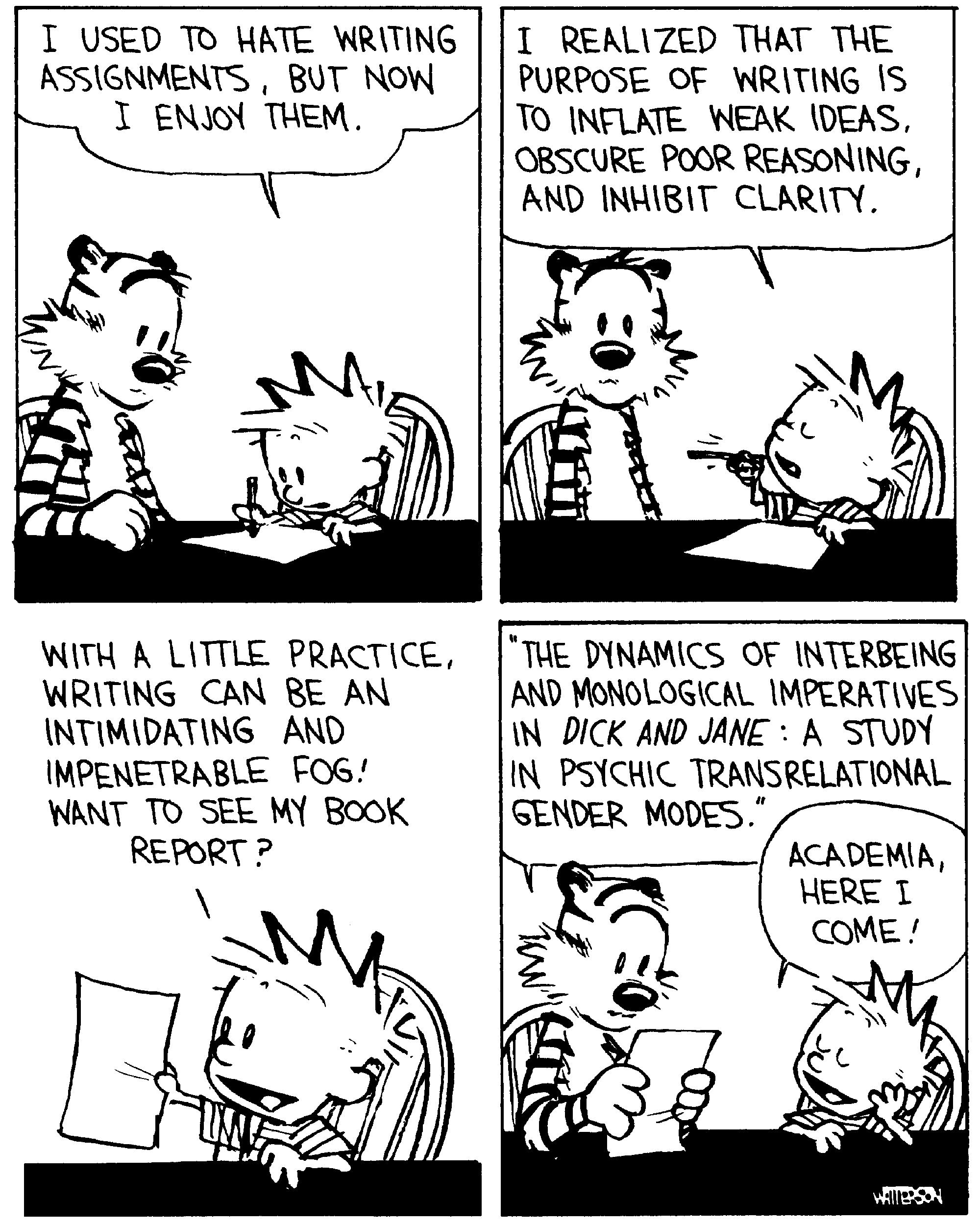
Source: Bill Watterson, Calvin and Hobbes: Homicidal Psycho Jungle Cat
In Why Academics Stink at Writing Steven Pinker, professor of psychology at Harvard University and chair of the usage panel of the American Heritage Dictionary points to Watterson’s Calvin to provide a summary for why academics stink at writing:
“…the purpose of writing is to inflate weak ideas, obscure poor reasoning, and inhibit clarity. With a little practice, writing can be an intimidating and impenetrable fog!”
In addition to this wonderful humour Pinker offers the following explanations for why so many academics write so poorly:
“lifeless noun by adding a suffix like –ance, –ment, or –ation. Instead of affirming an idea, you effect its affirmation; rather than postponing something, you implement a postponement.”
Pinker expands on all these ideas throughout his long article but his final reason for shoddy academic writing is:
“There are few incentives for writing well.”
Since few graduate programs teach writing, few academic journals stipulate clarity as a submission criteria and few reviewers and editor enforce it there is little professional motivation to engage in self improvement.
That is until now…
In this blog post The sophistication of truth Seth Godin argues that these common forms of complexity are the sophistication of fear.
“Long words when short ones will do. Fancy clothes to keep the riffraff out and to give us a costume to hide behind. Most of all, the sneer of, “you don’t understand” or, “you don’t know the people I know…”
“It’s complicated,” we say, even when it isn’t.
We invent these facades because they provide safety. Safety from the unknown, from being questioned, from being called out as a fraud. These facades lead to bad writing, lousy communication and a refuge from the things we fear.”
He encourages us to be fearless and reminds us that our work doesn’t have to be obtuse to be important or brave. I agree with Godin since I have spent that last 20+ years in academia I too have fallen into the traps of
“scientific sophistication, hoping to bamboozle [my] audiences with highfalutin gobbledygook.”
To be fearless Godin suggest that we need to start with:
“This is, “here it is, I made this, I know you can understand it, does it work for you?”
Perhaps the easiest way to do this is to stop writing in the conventional way and simply state what we need to state in the simplest terms. I subscribe to and read Godin’s posts on a daily basis because they are short, simple and to the point.
Or when it is appropriate we need to stop writing all together and use other forms of communication. The following video is a the best example of this sophistication in simplicity:
Do you prattle on with words when a video, infographic, illustation or other form of media is the right tool to use?


