
Source: MindShift
Creating Significant Learning Environments
We design information systems, smart buildings, ecological friendly communities, learning spaces and so many aspect of our society but we unfortunately do not apply this holistic approach to designing learning environments. Apple has always designed excellent hardware but with their iPhone, iPad and the whole IOS ecosystem they gone a step further and have designed a mobile communication or networking environment that just works. If we apply a similar purposeful design to our learning environments we also can create a significant learning environment that just works. Whether we are purposeful in its design or we just allow the circumstances to dictate its development education at all levels are providing learning environments. Rather than allow the environment to come together on its own and respond reactively to the learning dynamics that arise I suggest that educators become more proactive and create significant learning environments.
Therefore it is exciting to see an emphasis on purposeful design in the list of resources on Design Thinking for educators. Design thinking consists of four key elements:
Defining the Problem, Creating and Considering Multiple Options, Refining Selected Directions, and Executing the Best Plan of Action. (InformEd, 2013)
Several of the resources listed are links to a either the IDEO group or related sites that have been influenced by the working and writings of Tom Kelly and Tim Brown, who are two of the foundational thinkers behind design thinking.


New Council to Develop Standards, Best Practices for Online Learning – Wired Campus – The Chronicle of Higher Education via kwout
When I first read this article my first reaction was to post a comment suggesting that there are many well established standards of quality for online education. So when I scrolled through all the comments it was clear that almost everyone who commented had the same idea. Except for the sarcasm the first commentator Steve Foerster really captures the essence of what I was planning to say:
You’d think that online education were some new thing no one had ever heard of before. Why this and not one of the existing organizations focused in this area? I wonder sometimes whether anyone out there is better at reinventing the wheel than higher education administrators. They seem to be masters of leaping to the front of whatever parade they see and shouting “Follow me!”
I also have to agree with DrDave8563 who stated:
…Except instead of leaping to the front of this parade, they are leaping somewhere into the middle of the last third of the parade shouting “Follow me!” This parade has been going on since the Bulletin Board days – it’s hardly something new. There is a great deal of history and data about online education that already exists in both for-profit and not-for-profit realms.
There are many educators like myself who have been teaching online since the early 90’s and we have all seen a healthy complement of standards developed from organization like the Sloan Consortium, Quality Matters or any one of the many Universities who have been involved in online learning since its inception. So when I read the following statement by Hunter R. Rawlings III, the president of the Association of American Universities I have to sadly admit just how out of touch some of our academic leaders can be:
I think too many people are trying to deliver final judgment on the quality of online education, on the value of online education. It is just much too early in my mind to give any kind of final judgment. Let’s give this some time, and some real scrutiny.
We know what constitutes effective learning and exceptional learning designs. The technology plays a secondary role to effective learning design and whether the courses happens fully online, in a blended format or fully face2face we KNOW what good constitutes good education. I have always been hesitant to pile on and take shots at academic administrators because I have spent time in senior leadership so I understand the challenges. However, I have to admit that this is one time when a group of administrators are publicly demonstrating just how out of touch they are with the reality of the learning environment and the research. As one of my peers was so apt to point out with their comment this is an example of the
“blind leading the sighted”
On a positive note, I expect this group of academic heavy hitters to leverage their positions and influence and produce a report that will satisfy the online learner critics.

(Credit: Constantine Pankin via Shutterstock)
I clipped the blog post by Brandon Busteed, Executive Director of Gallup Education The School Cliff: Student Engagement Drops With Each School Year earlier this year and added it to my Evernote “.Write” repository hoping to one day deal with this topic in a significant way. When I read the story I immediately agreed with Busteed’s assertion that a overzealous focus on standardized testing and the lack of experiential and project-based learning as probable causes of this drop in student engagement. But it wasn’t until this fall that I experienced, in a very personal way, how standardized testing and the supporting curriculum negatively impacted my older son’s engagement and attitude toward school. As the following data indicates this breakdown in engagement is rampant.
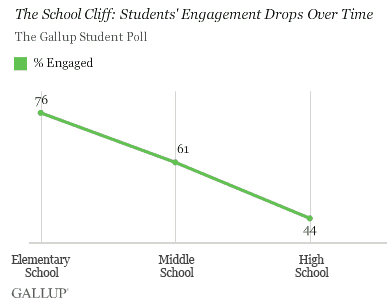
Source: Gallap.com
The Gallup Student Poll which surveyed nearly 500,000 students in grades five through 12 from more than 1,700 public schools in 37 states in 2012 revealed the sobering fact that the longer students stay in school, the less engaged they become. The survey asked students to indicate their level of agreement with statements such as: “My teachers make me feel my schoolwork is important,” and “At this school, I have the opportunity to do what I do best every day.”
From my anecdotal experience with my son Levi I would also have to add that standardized tests add a level of frustration and futility to the learning experience. We moved to North Vancouver to enable our boys to pursue their goals of professional downhill mountain bike racing. To ensure that they boys can commit enough time to riding and training and to allow for the flexibility the sport demands both of our boys are being home educated. They are engaged in math and science courses online and since the boy’s mother and I have a background in the humanities we are working with the boys on English, Social and History and are preparing the boys to challenge the Alberta Education departmental exams.
The Social 30 curriculum focus is on understanding the role that ideologies play in shaping identity. When I reviewed the text and supporting material I was excited to be able to explore some very significant life questions and issues with my son. I saw our working through this course as a way to further explore my son’s emerging identity and challenge him to think much deeper and more critically in his daily life. We have read through the first 5 chapters of the material, watched many videos and documentaries, worked through many review questions, discussed many of the historical issues that have emerged from the ideologies of individualism and collectivism and are starting to explore the impact of these fundamental perspectives on our modern society. Everything was going well and it was clear that Levi was not just understanding the material he was able to apply what he learned to an analysis of the world around him.
Since we are going to be challenging the course and Levi’s entire grade will be dependent upon this one exam we started working through some of the practice and sample exams from the previous years and soon realized that all the work on higher order thinking skills of analysis, application, synthesis were for naught because the exams were structured for recognition and regurgitation. Most of the multiple choice questions had at least 3 seemingly correct answers and the right answer was the one that repeated a phrase directly from the text. Even the supposed analysis questions required responses that were worded as close to the text as possible.
All our work at understanding and application didn’t prepare either Levi or I to do well on these exams–I worked through the exams as well and did only slightly better than Levi. We quickly realized that the best way to do well on the exams was to repeatedly go through the practice exams to get used to the way that the questions were structured and to be able to recognize the rightest answers. The exams were testing for information recognition and NOT understanding. I fully understand why teachers have to teach toward the test. Standardized testing forces this unfortunate practice.
Levi and I are still working toward understand but we have now added another component to our studies–test writing practice. Unfortunately that takes almost as much time as learning for understanding so our time on this subject has nearly doubled. For boys who are very serious about their commitment to being extreme athletes time is something that is very valuable and it is so frustrating that we have to WASTE so much of it on preparing for this exam.
My attitude toward teachers who teach to the test has completely changed. I regrettably understand why they have to do this–because I am having to do this. Last year in parent teacher interviews two of Levi’s teachers openly stated that in order to prepare Levi and his peers for the departmental exams and for university they had to teach to the test. The small charter school that Levi attending last year in Alberta boasted some of the highest high school achievement standards in the province and I now better understand how they got this ranking and what they had to do to get it. This is a systemic problem. A problem that we all know could easily be fixed if we moved away from an environment based on standardized testing to an active educational environment of active learning, critical and analytical thinking, collaboration and meaningful projects.
But teachers can’t make that move until the politicians and the ministries of education have the courage to move away from a culture of assessment to a culture of learning–this foolish notion that you can “fatten a pig by continuously weighing it”. Unfortunately, Alberta is moving toward more standardize testing in K-12 so these problems will persist.
I don’t see any significant and immeidate changes on the horizon that will improve the circumstances for my two boys but the results of the Equinox Summit – Learning 2030 indicate that learning in the future will be significantly different. Earlier this year the Waterloo Global Science Initiative hosted the Equinox Summit – Learning 2030 that was directed by Graham Brown-Martin, the founder of Learning Without Frontiers (LWF) a disruptive think tank focused on new ideas for learning and teaching practice, brought together 40 education thought leaders that worked together propose flexible, context and culturally sensitive solutions that would act as a foundation to define the global education systems in 2030. The group developed a Communique that proposes a radically different structure for learning in 2030, one in which traditional concepts of classes, courses, timetables, and grades are replaced by more flexible, creative
and student-directed forms of learning. As one can see from the points below the Summit proposed a system that emphasizes assessment that is nothing like the standardized testing that we are so stymied by today:
I am hoping that these fundamentals are realized much sooner than 2030, because we need this type of a learning system TODAY. I am also hoping that there is the political will and academic leadership that will help bring this system about. In the mean time it is the responsibility of all educators to envision this type of a system for the future to work toward making it a reality today.

I take Dewey’s admonition very seriously because in my role as a Instructional Designer I believe that it is my responsibility to ensure that we are creating the most effective learning environments for our students; environments that will prepare them for a future that we are unable to predict and that equips them with the necessary tools to address problems that don’t yet exist.
How do we do this?
By applying instructional design to blended and fully online learning we are able to help faculty create significant learning environments. Rather than allow the learning environment to come together inadvertently and respond reactively to the learning dynamics that arise I believe that effective instructional design allows us to be proactive and purposeful and think through and utilize all the components needed to create significant learning environment that inspire, foster and facilitate deeper learning.
This notion of a holistic design is not new. Just look at your iPhone, iPad or any other Apple device–Apple’s main selling point is design. They design the entire user experience and environment. When you buy into the IOS or OSX you also buy into Apples ecosystem– and for the most part it just works. But it is not just Apple that has good design.
We design information systems, smart buildings, ecological friendly communities; so many aspect of our society are purposefully designed but we unfortunately are not purposeful enough in applying this holistic approach to designing learning environments. Yes, there are wonderful examples of exceptionally designed learning environments but these are the exception and not the norm.
The purposeful design of learning must start with the learner. The learner or student-centred focus becomes the measuring stick. We must ask questions like–how will this course or learning management system (CMS/LMS) support the learner, how will this curriculum support the needs of the learner, how will this pedagogy enhance learning, and wlll our formative and summative assessment help the learner?
Purposeful and effective instructional design means that we ensure that the learning goals or outcomes are clearly identified and we use those goals to continually ensure that the course activities and assessments are weighed against those outcomes. We start with the learning and the ultimate goal of changing students lives.
But to do this in the 21st century we have to use 21st century tools.
Educational technology is NOT a learning outcome but a tool that enhances and empowers the learning outcome. We live in a digitally connected world – ubiquitous access – all the time and everywhere. This means
This move into digitally connected world means we have actually moved away from the print information age into the digital information age but it is taking a long time for academia to make these adjustments. In the print information age the problem is getting access to information. In contrast in the digital information age the problems is assessing information. Millennial students get this shift to a digitally connected world and thrive in this fully connected multimedia environment. They expect to earn anywhere anytime – all the time and everywhere. They also need and demand flexibility. These are some of the most important situational factors that we have to take into account when we design our learning environments.
It is through effective instructional design that places a priority on student centred and outcome-based principles first and then uses technology as a tool to create a significant learning environment that we will be able to truly prepare our learners for the future.
I have to admit that I am an idealist and I do see the enormous potential that we have to radically improve learning through blended and online learning.
BUT the last couple of decades of teaching in a blended and online format and through helping many other faculty put their courses online I have also become a pragmatist. Just having faculty enter into the discussion of setting up a blended or fully online learning environment is still a huge win because once they go done this path and they recognize the potential of blended and online learning and consider the whole learning environment they will never be satisfied with the notion of just delivering content.
By having faculty think about the whole learning environment, which we can help them design and enhance through technology, the learner ultimate wins–and that is a good thing.


