[youtube]opXKmwg8VQM[/youtube]
I was looking through the ISTE NETS Implementation site and while I get excited about these initiatives and look forward to seeing a move toward student centered learning realized in education I am reminded just how much of a challenge it will be to make this happen. When I watch video clips like “Progressive Education in the 40s” and consider the work of icons like Dewey, Kirpatrick, Gagne, Bruner and many more who all advocated forms of teaching and learning that we only see small glimpses of, I am motivated to stay the course and do my part to ensure that the work they started is carried on. We can create active, engaging and dynamic learning environments that focus on real world activites that will encourge critical and analytical thinking but this will take a great deal of work.
We are not there yet but there are many who are working to make this happen. The Partnership for 21St Century Skills are the the latest group to advocate and promote change in education. This group advocates for the integration of skills such as critical thinking, problem solving and communication into the teaching of core academic subjects such as mathematics, reading, science and history. The primary focus of ISTE NETS and the Partnership for 21st Century Skills is primary education but there is work happening in higher education which parallels the same priorities.
ACU’s new Core is designed primarily to help learners to think. Classroom activity will not focus on the professor as presenter and the learner as the audience, but on the learner as an engaged participant with faculty as guides. Professors will assist learners in examining, critiquing and assessing information, solving problems, and making decisions in order to prepare ACU grads for the 21st Century.
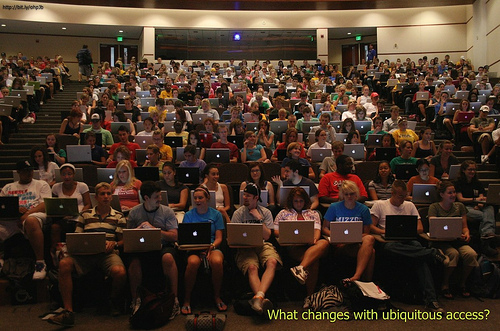
You can’t mention ACU without talking about ACU Connected. ACU is the first university to announce distribution of Apple iPhones and iPod touches to all incoming freshman, allowing ACU to explore a new vision for mobile learning. Looking at how to use mobile learning to engage the learner forces instructors and the institution as a whole to revisit the teaching and learning environment and consider learning from a non traditional perspective. The focus on mobile learning at ACU should be very transformative. Unlike what has happened with online learning, where the traditional classroom has simply been digitized and content is delivered online, mobile learning should forces a significant change in the way learning will work because mobile devices work best with connection and engagement.