Archives For EDLD 5305

Unfortunately, technology like the Citation Machine or other citation generation tools aren’t going to help you with the proper APA formatting of your citations and references unless you understand the fundamental APA rules and are able to use the official APA Publication Manual or at minimum use the Purdue OWL site to check and confirm the accuracy of what these tools generate. Yes, this is a bit of a paradox because these tools are intended to help you save time in citing your references. But if you don’t understand the basic rules or are not willing to spend some time to confirm that what these tools generate then you will run the risk of having significant errors. I also found that they can take more time to use then if you manually formatted the reference.

Lets consider the following reference example from the son of citation machine:

Livingston, J. A. (1997). Metacognition: An Overview. Retrieved from http://gse.buffalo.edu/fas/shuell/cep564/Metacog.htm

While this is very close to being correct it isn’t because the title is not formatted properly. The correct format according to APA is “Metacognition: An overview” – the letter “O” should not be capitalized. Small error but still an error.

Follow along the process of using one of these citation tools. There are a wide variety of citation tools that can help you generate this reference but I will deal with one of the more popular tools – Citation machine or Son of Citation Machine

When I go to the Citation Machine site I input the URL for this reference and this is what I get:

Metacognition: An Overview
http://gse.buffalo.edu/fas/shuell/cep564/Metacog.htm

The site prompted me to additional information like the author and dates and then it generated:

Livingston, J. A. (1997). Metacognition: An Overview. Retrieved November 30, 2016, from http://gse.buffalo.edu/fas/shuell/cep564/Metacog.htm

Unfortunately, the title format is wrong. Only the first word in the title should be capitalized. The second word “A” after the colon is also capitalized but the word “Overview” should not be capitalized.

Manually formatted based on the Purdue OWL site – https://owl.english.purdue.edu/owl/resource/560/10/

I used the Non-periodical Web Document or Report section since this is isn’t a blog post which recommended this format:

Author, A. A., & Author, B. B. (Date of publication). Title of document. Retrieved from http://Web address

Lets consider another example – a Youtube video:

Not Suited for School But Suited For Learning – https://youtu.be/clv2yr_UhDU

After setting the APA setting and selecting the Film tab the citation machine then asks me to fill in the following details:
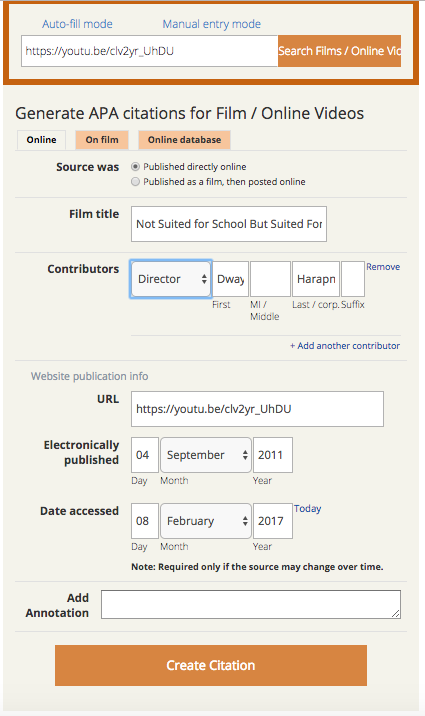
Youtube Director

The first time I ran the citation machine I left it on Producer as the default and it generated a partial reference.

Youtube director result

I had to go back and fill in all the details again and select Writer in order for it to generate a complete reference.
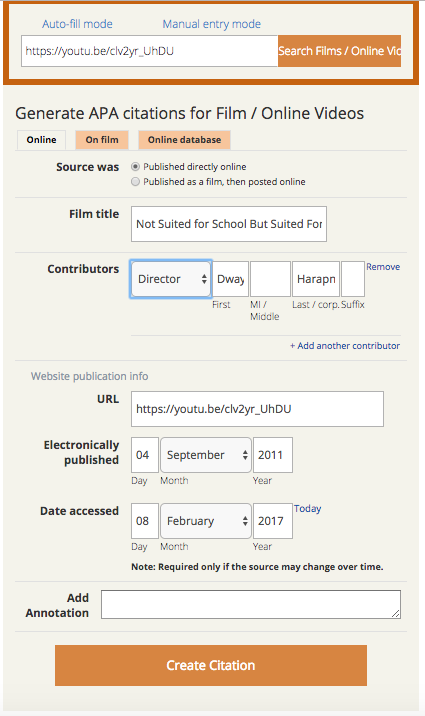
Youtube write

Once I had the right role selected the citation machine generated:

Youtube write result

But this is still wrong. APA doesn’t require a role designation so you don’t need (Writer) in the reference and more significantly only the first letter in the title should be capitalized.

The correct reference is:

Harapnuik, D. (2011, September 4). Not suited for school but suited for learning [Video file]. Retrieved from https://youtu.be/clv2yr_UhDU

The problem with these types of tools is that they require you to fill in the blanks and if you just copy and past the title in from the Youtube page chances are the title capitalization required by APA won’t be met. Having to go back and forth as many times as I did to get a more accurate reference was also not very efficient. The formatting instructions on the Reference List: Electronic Sources (Web Publications) page of the Purdue OWL site points to an example that is easy enough to follow:

J Dean. (2008, May 7). When the self emerges: Is that me in the mirror? [Web log comment]. Retrieved from http://www.spring.org.uk/the1sttransport

Just need to remember to replace the Web log comment with Youtube and you will be good to go.

As much as I would like to hope these citation tools are useful they really aren’t and you still need to go to the APA Publication Manual, Purdue OWL site, or other style guide to check and see if the reference is actually correct – so why not just save yourself the time and start with the style guides.

If you really want to save some time on creating your Reference list for a larger literature review then I recommend that you bite the bullet and purchase the APA Style Guide and also use Zotero to house your references. The key to using Zotero effectively is to input the date into Zotero correctly and check it according to the APA style-guide. There are some quick tricks to getting content into Zotero that I will deal with in another post–but even with these tricks you still need to manually check the reference to make sure it adheres to APA formatting.

While I do recommend using the Purdue OWL site it really only covers the fundamentals and if you need to really dig down into the details of figuring out when to use the et al. or other unique APA features then you really do need to refer to the official APA Publication Manual.

My boys are competitive Down Hill Mountain bike racers and they recently raced in several events at Whistler Crankworx. This meant that they had several practices, qualifiers, and final races that ran very close together and had to incorporate protein and energy bars into their nutritional plans to get them through their hectic schedule over the week of racing. High quality protein and complex carbohydrates packed into a portable bar are not just a convenience for my sons, they are a necessity if they wish to stay fully fuelled and competitive. Slipping a couple of these small energy packed bars into a jersey or shorts pocket means my boys can quickly and easily maintain their nutritional needs for the hectic training and/or racing session.

A quality protein and energy bar has little or no sugar, uses natural ingredients, and has a balance of protein and complex carbohydrate to help an athlete maintain their energy when they are unable to access whole foods. Bars that are nutritionally high quality often don’t taste the greatest because the manufacturers stay true to the purpose of helping to fuel a competitive athlete. Unfortunately, as protein and energy bars get more and more popular quality bars are getting harder and harder to find because too many manufacturers are willing to move away from the fundamental purpose of the bars and focus primarily on the taste of the bars at the expense of the nutritional quality.

When you focus on the taste and not the nutritional needs of an athlete you end up with something that sounds like it would be a good thing, but when you look at the details you find it’s not the case. The list of ingredients on the following popular protein and energy bar reveals that taste and not nutrition is their priority:
Power Bar Ingredients

Evaporated cane juice syrup and corn maltodextrin are the first and third listed ingredients which also indicates their quantities. While neither of these ingredients are listed as sugar they are essentially the same as sugar hiding behind a more natural name. The more diligent athlete who is aware of the sugar synonyms won’t be tricked by the manufacturer and will look for a better bar, but for the average person who isn’t as informed this fake protein and energy bar is really not much better then a typical candy bar. At least in the candy bar the manufacturers don’t try to hide the actual ingredients behind more natural sounding names:
chocolate bar ingrediants

What makes this really serious is that the majority of protein and energy bars are really not much better or different then candy bars when you look at the first three ingredients:

Protein bar – Evaporated cane juice syrup oat bran, corn maltodextrin and soy protein isolate
Candy bar – Sugar, peanuts, and corn syrup

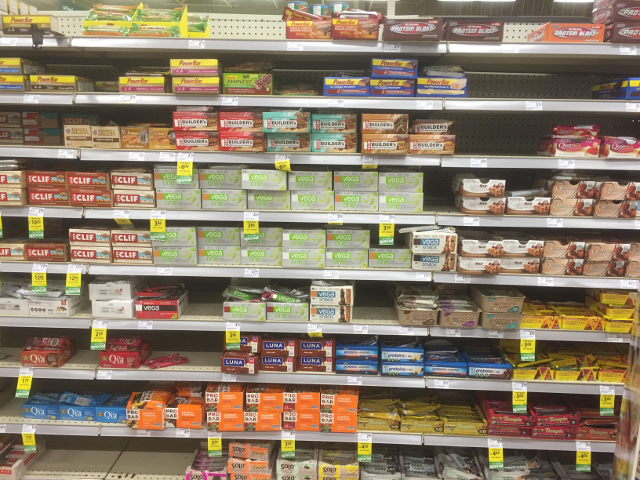
Yes the protein bar does have a few better ingredients, it does have soy isolate protein powder, but for the most part it is just a candy bar with added protein. This is very alarming and in the display pictured below there are a couple of dozen different types of bars and there were only two that were actually healthy enough to be used by a competitive athlete:
Protein Bars on Shelf

How does such a good idea, a portable highly nutritious bar that a competitive athlete can use to stay energized, go from good to bad. Simply shift the primary purpose from a portable highly nutritious bar used by competitive athletes for fuel to a good tasting convenience snack used by anyone. Most competitive athletes are willing to deal with the lack of flavour and even a chalky texture in their bars because they know that it isn’t about the taste it is about the fuel that they need to stay competitive.

This shift in purpose from fuel to taste has as a dramatic effect on an individuals results as a shift from a focus on learning to technology has on the learner.

We can run into a similar problem in education when we shift our focus from the learning to the technology. In his post How to Fake a 21st Century Classroom Terry Heick satirically posits how to:

“fake 21st century thinking and learning environment to make the right kind of impression with the right people, and give the appearance of forward-thinking.”

Useful ideas like Project-Based learning, 1 to 1, and blended learning can all too easily loose their benefit when we shift the focus from learning and just do projects, just focus on the devices, and just focus on the content delivery part of the blended learning. Heick points to ten good learning ideas that can easily go bad for the learner if we shift our focus from the learning to the technology or to what appears to be a trendy 21st Century activity. His post How to Fake a 21st Century Classroom Terry Heick is worth the read but I must caution you that you may be bothered or convicted by a few convenient or fake activities that you may have fallen into. I know I am taking a hard look at several of my activities as a result of reading his post.

As educators, our responsibility is to know better, to know that you can’t fake Project-Based learning by doing make work or fake projects. You have to give the learner the control, ownership and voice over an authentic project that will make some sort of difference in the learner’s personal life or community. You can’t just fake 1 to 1 by making students do digital worksheets on their iPads. You have to give the learner the opportunity to use their devices for creation, collaboration and communication and enable them to learn all the time and everywhere with everyone. You can’t just fake blended learning by focusing on the content. The emphasis on creation, collaboration and communication in your blended learning environment will also enable your learners to go much deeper then they would if you were to focus on the delivery of content.

As educators we should know better but just like the average person who is swayed by the appearance, convenience and taste of the fake protein bars we too often can be swayed by wanting to give the right kind of impression and the appearance of forward-thinking.

We can also be swayed by the fact that we may be faking it until we make it; meaning that we may move toward our learning goals by implementing changes incrementally and may use that worksheet on the iPad as a transition activity until we can focus on more genuine activities. This is understandable and as long as the transition happens this will be fine. But just like the fake protein bars that will work when you don’t have anything else available, temporary or transition use of technology can also work, but also like the fake protein bars long term use would not be heathy for the athlete or the learner.

These past several weeks my two boys, Levi and Caleb, have spent most of their days riding Silver Star and Whistler Bike Park, Whistler Aerodome and other DownHill and DirtJump locations in British Columbia. This type of riding is not only extremely hard on the human body (i.e. Levi’s concussion and recent shoulder injury and Caleb’s ongoing aching hands, too many bruises, scrapes and scratches to mentions) it may even be harder on the bikes. As result there is extensive daily maintenance and the all too often broken component that needs to be replaced as a result of bad hit, wipe out our simply the harsh terrain.

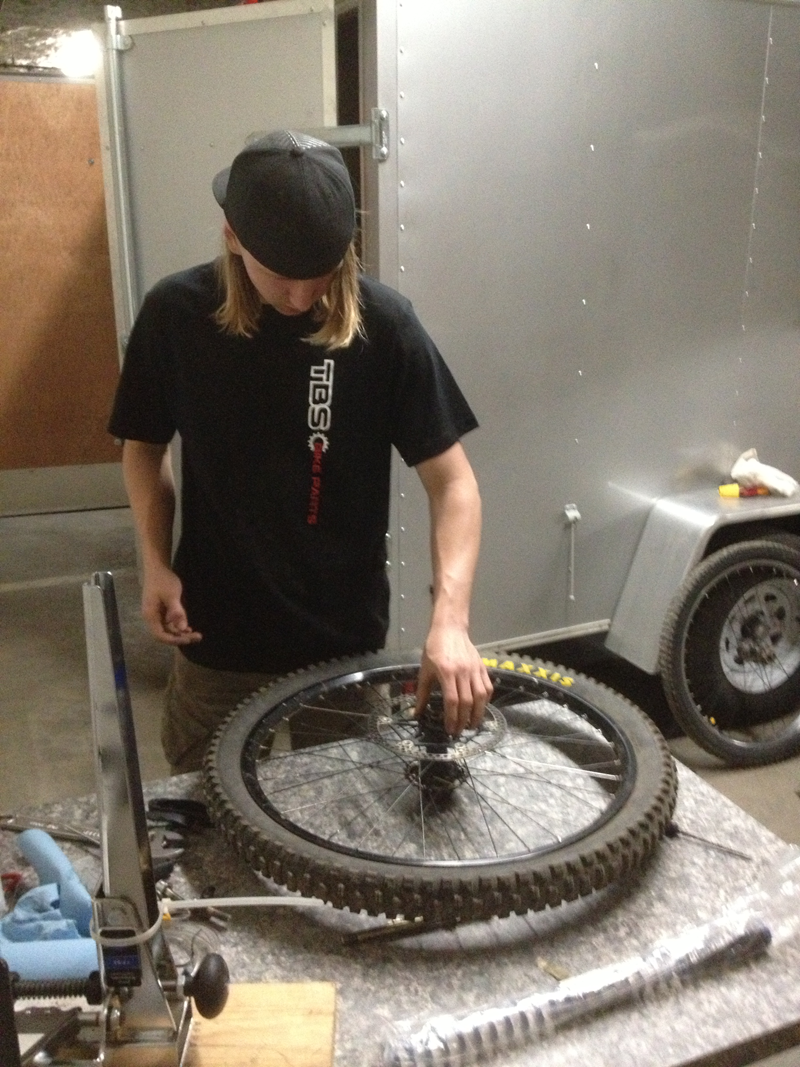
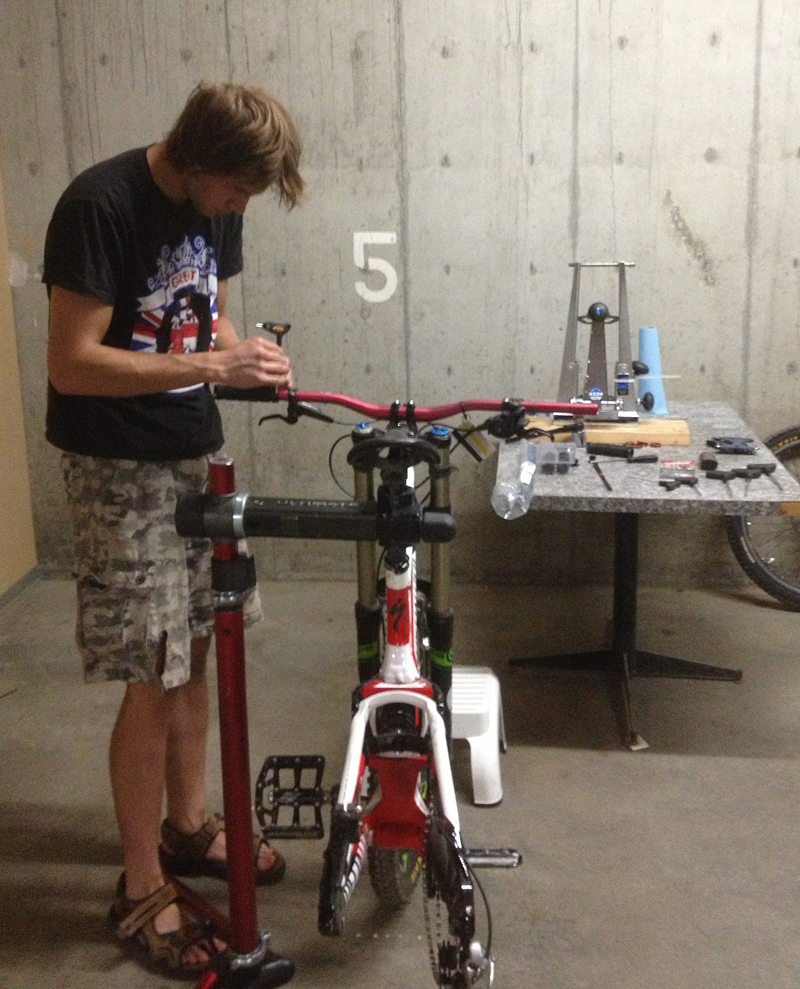
Up until this summer I had been supervising and directing this daily maintenance. Taking on a new position at BCIT means that I am not going to be able to ride with my boys on a daily basis and help them with their bike maintenance and repairs. That is why a recent Saturday morning at Silver Star confirmed that the gift of intrinsic motivation that I have been giving my boys for several years has not only finally been fully received, it has blossomed into the wonderful sight displayed in these pictures.

caleb wheelrepair

Cluster Removal

levi bikerepair

Lockon Grip Fastening

Two typical teenage boys (17 and 15) are not only cleaning, lubing and adjusting their high end DH bikes, they are spending sometimes up to 2-3 hours a day doing full repairs and preventative maintenance which ranges from replacing spokes, truing and tensioning wheels to changing fork oil, brake bleeds, replacing suspension bearings and every other aspect of maintaining and repairing their very expensive bikes. Most importantly they are doing it on their own without having to be told or directed. The gift of intrinsic motivation has finally been received.

While the title and initial focus of this blog post suggests that you can give someone intrinsic motivation I must concede the fact that you cannot give anyone intrinsic motivation. This type of motivation comes from within. You can however create the environment and influence the circumstances in which intrinsic motivation will not only emerge but will grow into a driving force.

I believe that we can help foster the growth and establishment of intrinsic motivation if we consider and foster the following five key contributing factors.

Modelling
James Dobson has repeatedly stated that “Values are not taught to our children; they are caught by them.” I suggest that intrinsic motivation is similar to values in that is not taught to our children but has to be caught by them. Ever since my boys first started riding their bikes they have also learned how to repair and maintain them–it is just something that I/we have always done. In addition to maintaining bikes I maintain our vehicles, our home and just about anything that we own. The years of rotating tires, changing oil, fixing the dishwasher, renovating and updating our homes and everything else that the boys were involved in helping their mom and dad do on a daily basis contributed to showing the boys how they could “catch” the intrinsic motivation required to work through the mundane tasks that are part of everyday life.

Expectations
Effective modelling will also convey or demonstrate what expectations, standards and criteria need to be met. Knowing what is expected and fulfilling those expectations is extremely important for children and teenagers because it will help them to develop responsibility and accountability. As adults our work is judged and often connected to our income so developing the ability to meet or exceed expectations for our children is not only very important, their future careers may also depend on this ability.

One of the biggest challenges with expectations is being realistic. The performance standard for an 10-12 year old child will not be the same as a 15-17 year old teenager or an adult. The desired end quality should not be compromised but the path to getting to that quality will depend on the age and skill level of your children so be patient. Unrealistic expectations are the source of too many disappointed fathers and children so remember when your 12 year old son or daughter is striving to meet their father’s expectations remember that they are just a 12 year old boy or girl. Similarly there is a point when challenging your 17 year old son or daughter to step up and perform as adult is crucial to their development.

Trust
The key to trust is letting go and letting your children do the task, make their own mistakes and learn from the situation. All too often we want to swoop in and direct and correct and interfere with the learning process. Or worse we think that it would be more time effective and less stressful to do the task ourselves or worse still outsource the job. When we trust our children to make breakfast, repair the doorknob, fix the flat tire or, in the case of my boys, build their own bikes from scratch we are telling them that we believe in them and that we value their effort and contribution. A father’s and mother’s trust is a major contributor to your child’s identity and to their intrinsic motivation. Knowing that someone else trusts and believes in them helps them to trust and believe in themselves. This instills confidence which is a fundamental contributor to personal motivation.

Ownership
Little boys and girls want to be like their mom and dad and have their own tool belts, hammers, appliances, bikes, cars and so many other things. This is one principle that I wish I would have fully grasped and understood sooner. When Caleb and Levi searched out and selected all the necessary components and built their own DH bikes up from a raw frame it really changed the way they approached maintaining their equipment. They now have a vested interest. They understand the work involved in putting the bike together and what it would take to replace or repair those components. More importantly, my boys now not only want to maintain their bikes they do so on their own and even appreciate preventative maintenance because they know the work that went into building up their bikes.

Consequences
Broken spokes are like deer; if you see one you inevitably will see another. A bad landing, a rock or root can cause a broken spoke and cut into prime riding time. Unfortunately, a poorly tensioned wheel will be more susceptible to damage than a well maintained wheel. There is often nothing better than natural consequences to motivate a young man to take the extra time necessary to properly tension his wheels to limit the downtime that can ruin an otherwise wonderful riding day. The idiom “an ounce of prevention is worth a pound of cure” is never fully appreciated until one is personally responsible for implementing that pound of cure. Letting your children suffer the consequences (as long as they aren’t life threatening) will be much more valuable to them in the long run than your intervening.

The lesson learned in the garage and on the mountain slopes, bike parks and dirt jump parks of BC have played a significant role in my sons’ acceptance of the gift of intrinsic motivation. As an intentional father it is my responsibility to create an environment at home, on the road and anywhere we are at where the above listed contributing factors will help my boys to grow into responsible men. Helping them with the gift of intrinsic motivation is just one part of this ongoing process.

Related Intentional Father Posts:

Becoming an Intentional Father
Catching the Openness to Change