Archives For Innovation

The Association of American Colleges and Universities (AAC&U) survey “It Takes More Than a Major: Employer Priorities for College Learning and Student Success,” reveals that most employers don’t think colleges are doing a very good job of preparing students for work. In response to the survey results, 160 employers and 107 college presidents agreed to sign a compact and work toward helping the public:

understand the importance of a “21st-century liberal-arts education,” comprising broad and adaptive learning, personal and social responsibility, and intellectual skills.

While I admire this initiative I am somewhat skeptical of its impact. Why? It was only 6 years ago that AAC&U conducted a similar survey that revealed similar findings. In the 2008 report How Should Colleges Assess and Improve Student Learning?) Peter D. Hart Research Associates revealed the following 6 Key Findings:

  1. When it comes to preparedness for success at the entry-level, one-third of business executives think that a significant proportion of recent college graduates do not have the requisite skills and knowledge.
  2. When asked to evaluate recent college graduates’ preparedness in 12 areas, employers give them the highest marks for teamwork, ethical judgment, and intercultural skills, and the lowest scores for global knowledge, self-direction, and writing.
  3. Most employers indicate that college transcripts are not particularly useful in helping evaluate job applicants’ potential to succeed at their company.
  4. Few employers believe that multiple-choice tests of general content knowledge are very effective in ensuring student achievement. Instead, employers have the most confidence in assessments that demonstrate graduates’ ability to apply their college learning to complex, real-world challenges, as well as projects or tests that integrate problem-solving, writing, and analytical reasoning skills.
  5. Employers deem both multiple-choice tests of general content knowledge and institutional assessments that show how colleges compare in advancing critical-thinking skills of limited value for evaluating applicants’ potential for success in the workplace. They anticipate that faculty-assessed internships, community-based projects, and senior projects would be the most useful in gauging graduates’ readiness for the workplace.
  6. When asked to advise colleges on how to develop their methods for assessing students’ learning, employers rank multiple-choice tests of students’ general content knowledge and institutional scores for colleges as conspicuously low priorities.

This report focused on assessment and learning and offered some very specific and practical recommendations that, if followed, should have resulted in a different findings in the latest AAC&U survey. Why hasn’t higher education made any progress in this area over the past 6 years? Theodore Sizer, the former Harvard Graduate School of Education Dean and Educational Reformer, argues in his book, The Red Pencil, that little has changed in education since his experiences in the information and test based classroom he endured in 1946. Why does higher education perpetually find itself in a state of paralysais by analysis?

We need to heed the advice often attributed to Albert Einstein. Although he never actually offered the following quote this notion of challenging conventional thought is still useful:

Insanity is doing the same thing over and over again and expecting different results.

We can stop this insanity only if we stop hiring so many traditional risk adverse leaders and faculty. As I detailed in my post Pick Two – Innovation, Change or Stability we need to search out individuals who are outside-of-the-box thinkers with entrepreneurial spirits and unconventional career paths if we really want to bring about the changes we so desperately need in education.

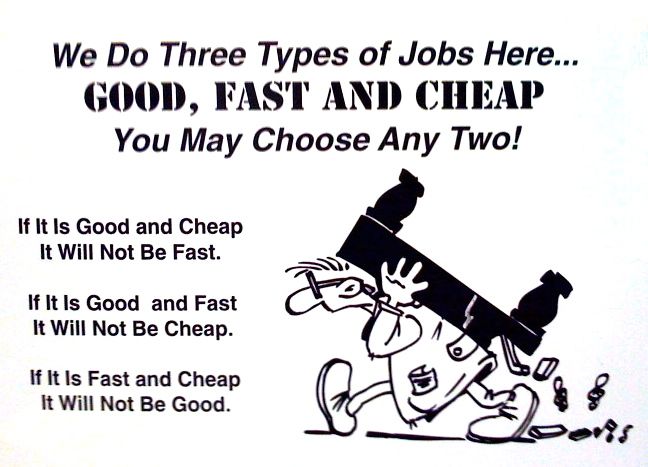
Good fast cheap work

I first heard this phrase when I was in my teens working as a lot boy/mechanic’s helper at a car dealership. A former race mechanic was explaining to a customer that there are always trade offs when it comes to performance and one has to choose what is most important. He told the customer to “pick two… good, fast or cheap.” Since that time I have heard this constraint triad referenced in IT, Educational Technology, Instructional Design, Web Design and many other projects. The challenge is that all three constraints of a project are interrelated and it is impossible to realize all three. One of the contraints or properties will always suffer.

Personal experience with many projects confirms that if you want something that is good and cheap then it won’t be fast… if you want something that is good and fast… then it won’t be cheap and if you want something fast and cheap… then it won’t be good. I have yet to find an situation where this principle doesn’t apply and more recently I have seen an expansion of this constraint triad apply to another area – the glacial pace of change in Education.

Consider the following constraint triad for Education:

“Pick any two—innovation, change or stability”

To ensure that we don’t get caught up in semantics I will use the following definitions sourced from dictionary.com:

  • Change: to transform or convert or make something different from what it is or from what it would be if left alone.
  • Innovation: the introduction of new things or methods.
  • Stability: the state of being stable or the status quo.

If you want innovation and change in Education then you won’t have stability. If you want innovation and stability then you won’t have change and if you want change and stability then you won’t have innovation. This is NOT a new idea. Clayton Christensen the author of the concept of disruptive innovation points to the challenges that Education faces in the book Disrupting Class which focuses on K-12 Education and the book Innovative University which deals with Higher Education. Christensen points to years of research that confirms that true innovation is disruptive because it introduces something new and upsets or disrupts the status quo. He also uses the term of sustaining innovation that explains that a product or service can improve over time but this type of innovation has no real transformative effect because it doesn’t introduce something new or significantly different.

Therefore, when you examine the stated positions of the leadership and faculty in Education you will note that while they may be willing to talk about innovation in Strategic Plans, Vision and Mission statements, Academic Plans or even list innovation as part of their organization’s Core Values, their actions reveal a preference for stability. Once again I am not the first author to point to this inconsistency. In the article Innovation in Higher Education? HAH! Ann Kirschner Dean of William E. Macaulay Honors College at the City University of New York argues that College leaders need to move beyond talking about transformation to actually transforming Higher Education before it’s too late. If you have any doubt about the lack of innovation and proactive change in Education please refer to the dozens of articles, blog posts and books that I have reviewed or summarized in the Change category on this blog.

Since stability is so important to many of the leaders and faculty in Education it comes at the expense of innovation. When you pick stability and innovation you do so at the expense of change and at best you may get sustaining innovation which really is just a slight improvement on the status quo – blackboards to whiteboard, overheads to PowerPoint, large lecture halls to MOOCs and so on. When you pick stability and change you loose out on innovation all together. Unfortunately, educational reformers dating back to the likes of John Dewey and earlier (see post Progressive Education – Are We There Yet) have been pointing to the need for innovation in our educational system.

Perhaps if we challenged the leaders and faculty in Education to “pick any two—innovation, change or stability” then we would at least be able to account for why things change so slowly…or better yet may be able to motivate educational leadership and faculty to face the reality that if they really want innovation then they can’t have the levels of stability that are they are so accustomed. The renowned educational reformer Ken Robinson argues that we don’t need evolution in Education we need a learning revolution. Where do we start?

Stop hiring so many traditional risk adverse leaders and faculty. I have sat on many selection committees where the majority of the group is simply looking for the “safe bet”. Rather than embrace an individual’s potential, entrepreneurial spirit and unconventional career path or out of the box thinking most selection committee members will look for a stable work history, a traditional promotional path and other safe factors. We need to heed the advice often attributed to Albert Einstein. Although he never actually offered the following quote this notion of challenging conventional thought is still useful:

Insanity is doing the same thing over and over again and expecting different results.

It is impossible to become an innovative or entrepreneurial organization by continually hiring traditional and conventional people. Educational organizations need to hire innovators and entrepreneurs and once they do, let them do the work that they were hired to perform. This takes courage. Innovative, entrepreneurial and out of the box thinkers push the limits, ask uncomfortable questions, offer unique solutions and make some people feel uncomfortable. But this is good. Educational institutions should be learning organizations and learning must be at their core. Learning is a messy, uncomfortable endeavour and innovation and change is just part of the learning process–shouldn’t it be part of organizational culture?

Does your organization genuinely embrace innovation and change? Or is stability and the status quo the top priority?

Josh Constine from Tech Crunch ponders the impact:

… if Facebook could minimize the voice minutes these users have to buy by offering VoIP that’s free beyond the cost of data usage? Suddenly Facebook goes from a nice way to connect with friends to a critical communication service that saves them money.

Anything that has the potential of breaking the monopolistic control of the carriers here in Canada not only has my voie it is something that I will use and promote.

On another note, this is another reason why Android is the platform that will see significant innovative gains in unique areas. There are simply more Android users who don’t want to spend the money that they typical IOS user is willing to spend so the necessity to create a more cost effective solution is much more pressing for Android open source community then it is for the Apple and its walled garden IOS.

I do need to note, Apple’s walled garden IOS is still currently the best mobile infrastructure and it is still the phone I recommend to most average users but the grass is really starting to look greener on the other side of the wall.

Read the full post…

Samsung vs Apple

Dwayne Harapnuik —  March 5, 2013 — 2 Comments

Despite being and iPhone user since 2008 I have decided that my next phone will be the Google Nexus 4. While I still really enjoy the iPhone and switched from Windows to Mac back in 2006 I believe the open Android platform will provide even greater opportunities for innovation. The iPhone interface is still the same as it was when it was introduced and many productivity apps that are available like app switchers provide functionality that is native to the Android OS. Unfortunately, much of the really unique functionality is only available if one jailbreaks the phone. I have repeatedly stated that I don’t care who makes the device and that I am committed to using the most innovative smartphone that is available.

Right now that phone is the Google Nexus 4 because only the Nexus 4 has, and will continue to have, the most recent version of Android. While Samsung makes great hardware, they don’t update the OS quickly enough for my liking. Furthermore, I find that Samsung’s added software features they include in their implementation of Android simply wastes battery life (at least this is the case with my Galaxy Tab 10.1) and decreases the device efficiency. Since I have been preparing to make the big switch I have been noticing more and more data that shows that I am not the only one who sees that Apple is loosing its lead in many different respects.

Samsung vs Apple Infographic

Source: MBAOnline

Miguel Nicolelis, a top neuroscientist at Duke University, says:

computers will never replicate the human brain and that the technological Singularity is “a bunch of hot air….
The brain is not computable and no engineering can reproduce it.

Nicholelis suggests that our soul or our consciousness cannot be replicated in silicon because it is the result of unpredictable, non-linear interactions amongst billions of cells. No computer system is capable of replicating this type of unpredictability. At best humans will be able to control machines through implants which will become an extension of the brain.

Read the full article…