Archives For 21st century learning

My boys are competitive Down Hill Mountain bike racers and they recently raced in several events at Whistler Crankworx. This meant that they had several practices, qualifiers, and final races that ran very close together and had to incorporate protein and energy bars into their nutritional plans to get them through their hectic schedule over the week of racing. High quality protein and complex carbohydrates packed into a portable bar are not just a convenience for my sons, they are a necessity if they wish to stay fully fuelled and competitive. Slipping a couple of these small energy packed bars into a jersey or shorts pocket means my boys can quickly and easily maintain their nutritional needs for the hectic training and/or racing session.

A quality protein and energy bar has little or no sugar, uses natural ingredients, and has a balance of protein and complex carbohydrate to help an athlete maintain their energy when they are unable to access whole foods. Bars that are nutritionally high quality often don’t taste the greatest because the manufacturers stay true to the purpose of helping to fuel a competitive athlete. Unfortunately, as protein and energy bars get more and more popular quality bars are getting harder and harder to find because too many manufacturers are willing to move away from the fundamental purpose of the bars and focus primarily on the taste of the bars at the expense of the nutritional quality.

When you focus on the taste and not the nutritional needs of an athlete you end up with something that sounds like it would be a good thing, but when you look at the details you find it’s not the case. The list of ingredients on the following popular protein and energy bar reveals that taste and not nutrition is their priority:
Power Bar Ingredients

Evaporated cane juice syrup and corn maltodextrin are the first and third listed ingredients which also indicates their quantities. While neither of these ingredients are listed as sugar they are essentially the same as sugar hiding behind a more natural name. The more diligent athlete who is aware of the sugar synonyms won’t be tricked by the manufacturer and will look for a better bar, but for the average person who isn’t as informed this fake protein and energy bar is really not much better then a typical candy bar. At least in the candy bar the manufacturers don’t try to hide the actual ingredients behind more natural sounding names:

chocolate bar ingrediants

What makes this really serious is that the majority of protein and energy bars are really not much better or different then candy bars when you look at the first three ingredients:

Protein bar – Evaporated cane juice syrup oat bran, corn maltodextrin and soy protein isolate
Candy bar – Sugar, peanuts, and corn syrup

Yes the protein bar does have a few better ingredients, it does have soy isolate protein powder, but for the most part it is just a candy bar with added protein. This is very alarming and in the display pictured below there are a couple of dozen different types of bars and there were only two that were actually healthy enough to be used by a competitive athlete:

Protein Bars on Shelf

How does such a good idea, a portable highly nutritious bar that a competitive athlete can use to stay energized, go from good to bad. Simply shift the primary purpose from a portable highly nutritious bar used by competitive athletes for fuel to a good tasting convenience snack used by anyone. Most competitive athletes are willing to deal with the lack of flavour and even a chalky texture in their bars because they know that it isn’t about the taste it is about the fuel that they need to stay competitive.

This shift in purpose from fuel to taste has as a dramatic effect on an individuals results as a shift from a focus on learning to technology has on the learner.

We can run into a similar problem in education when we shift our focus from the learning to the technology. In his post How to Fake a 21st Century Classroom Terry Heick satirically posits how to:

“fake 21st century thinking and learning environment to make the right kind of impression with the right people, and give the appearance of forward-thinking.”

Useful ideas like Project-Based learning, 1 to 1, and blended learning can all too easily loose their benefit when we shift the focus from learning and just do projects, just focus on the devices, and just focus on the content delivery part of the blended learning. Heick points to ten good learning ideas that can easily go bad for the learner if we shift our focus from the learning to the technology or to what appears to be a trendy 21st Century activity. His post How to Fake a 21st Century Classroom Terry Heick is worth the read but I must caution you that you may be bothered or convicted by a few convenient or fake activities that you may have fallen into. I know I am taking a hard look at several of my activities as a result of reading his post.

As educators, our responsibility is to know better, to know that you can’t fake Project-Based learning by doing make work or fake projects. You have to give the learner the control, ownership and voice over an authentic project that will make some sort of difference in the learner’s personal life or community. You can’t just fake 1 to 1 by making students do digital worksheets on their iPads. You have to give the learner the opportunity to use their devices for creation, collaboration and communication and enable them to learn all the time and everywhere with everyone. You can’t just fake blended learning by focusing on the content. The emphasis on creation, collaboration and communication in your blended learning environment will also enable your learners to go much deeper then they would if you were to focus on the delivery of content.

As educators we should know better but just like the average person who is swayed by the appearance, convenience and taste of the fake protein bars we too often can be swayed by wanting to give the right kind of impression and the appearance of forward-thinking.

We can also be swayed by the fact that we may be faking it until we make it; meaning that we may move toward our learning goals by implementing changes incrementally and may use that worksheet on the iPad as a transition activity until we can focus on more genuine activities. This is understandable and as long as the transition happens this will be fine. But just like the fake protein bars that will work when you don’t have anything else available, temporary or transition use of technology can also work, but also like the fake protein bars long term use would not be heathy for the athlete or the learner.

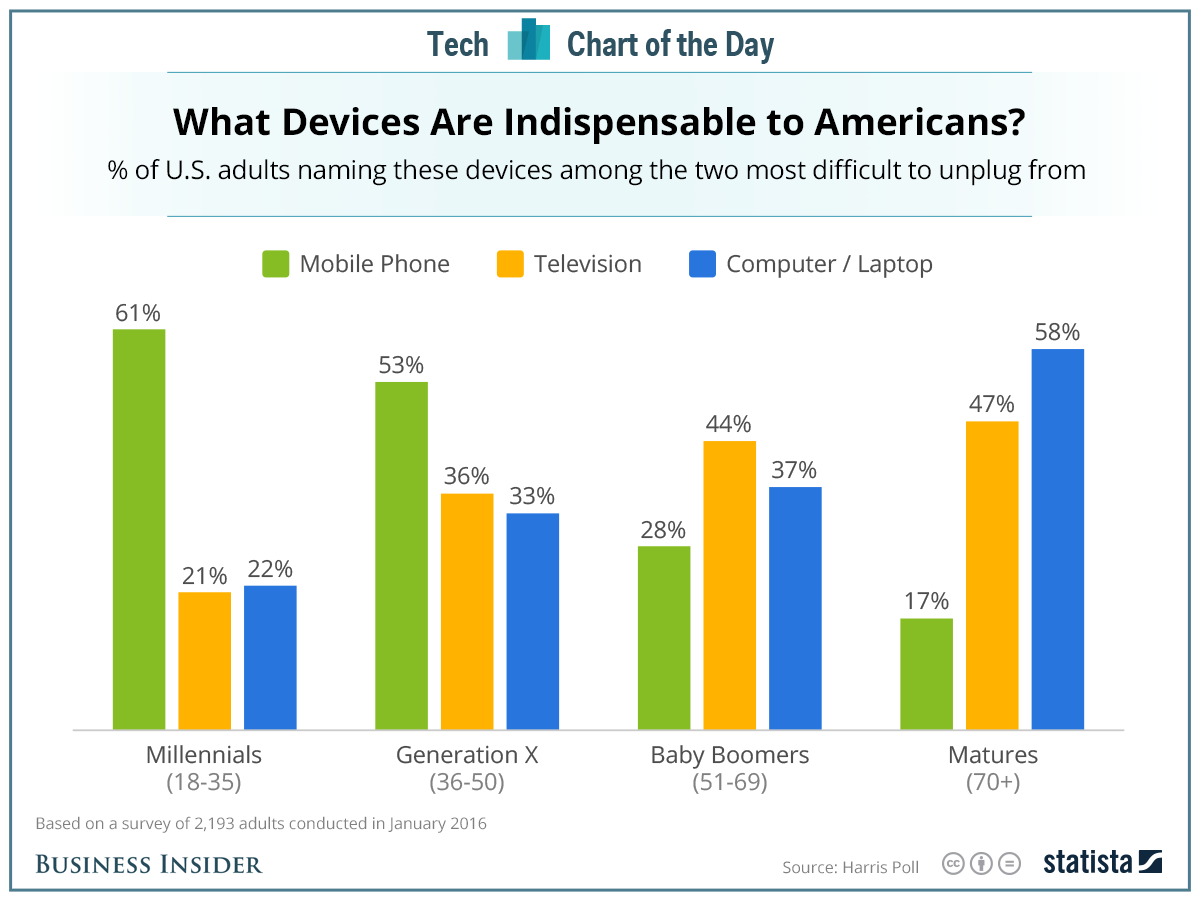
devices_used by age group

Source: www.businessinsider.com/young-americans-cant-live-without-their-mobile-phones-2016-3

If Millennials and Generation X can’t live without their phones then shouldn’t we be using this as one of the primary tools for learning. I have two Millennial sons and it only takes a few minutes to see how useful their mobile phones are. There are very few aspects of their lives where they don’t rely on their phones. My boys are athletes and log their riding, nutrition and mosts aspects of their training. They both use Google forms to input their riding logs and depending on who is driving back from a training session one of the boys is using their mobile phones to update their riding logs. They do realize that it is more efficient to use their laptops or even their tablets for touch typing but he advantage of using the phone is that you don’t have to wait and can get the log out of way immediately.

Immediacy plays a very important role in their lives so relying on their mobile device helps them to deal with most issues as they come up. The notion of waiting to get back to their laptops isn’t something they are willing to do so when they are considering recording or writing anything their first thought is to use the phone. If they don’t have a good app to help then they search one out.

Even though I fit into the Baby Boomer category my device preferences are more in line with Millennials and Generation X so I can appreciate Millennials and Generation X reliance on their devices. However, when I design learning environments I have to admit that I am assuming that my students will be using a laptop or tablet to access the digital aspects of the course.

But is this a safe assumption? The more time I spend with people who truly appreciate the power of mobile devices the more I realize just how much can be done with a tablet or even a mobile phone. I used to think that other than writing a novel you can do most forms of digital creation on your mobile device. However, when I see just how much my son types into his riding log I am starting to realize that a mobile phone can also be used as writing device.

This forces me to ask… Are we really being reasonable when we ban the use of mobile devices in our classrooms? The knee jerk reaction is to point to the fact that students will use the device to text each other and engage in all forms of communication. Once again if you watch a group of Millennials you will see that while they are constantly texting each other they are also finding youtube videos, images and even articles that will add to the conversation. In addition to texting each other, it is not uncommon for these collaborators to pass their phone onto their neighbours so that they can share in the information. They aren’t isolating themselves, they using their mobile devices to enhance their collaboration and their learning.

Isn’t this what we want 21st Century or Digital Learners to do… to use technology to enhance their learning. Let’s think long and hard the next time we are inclined to ask our students to turn off their devices. In doing so we may be asking them to turn off their learning.


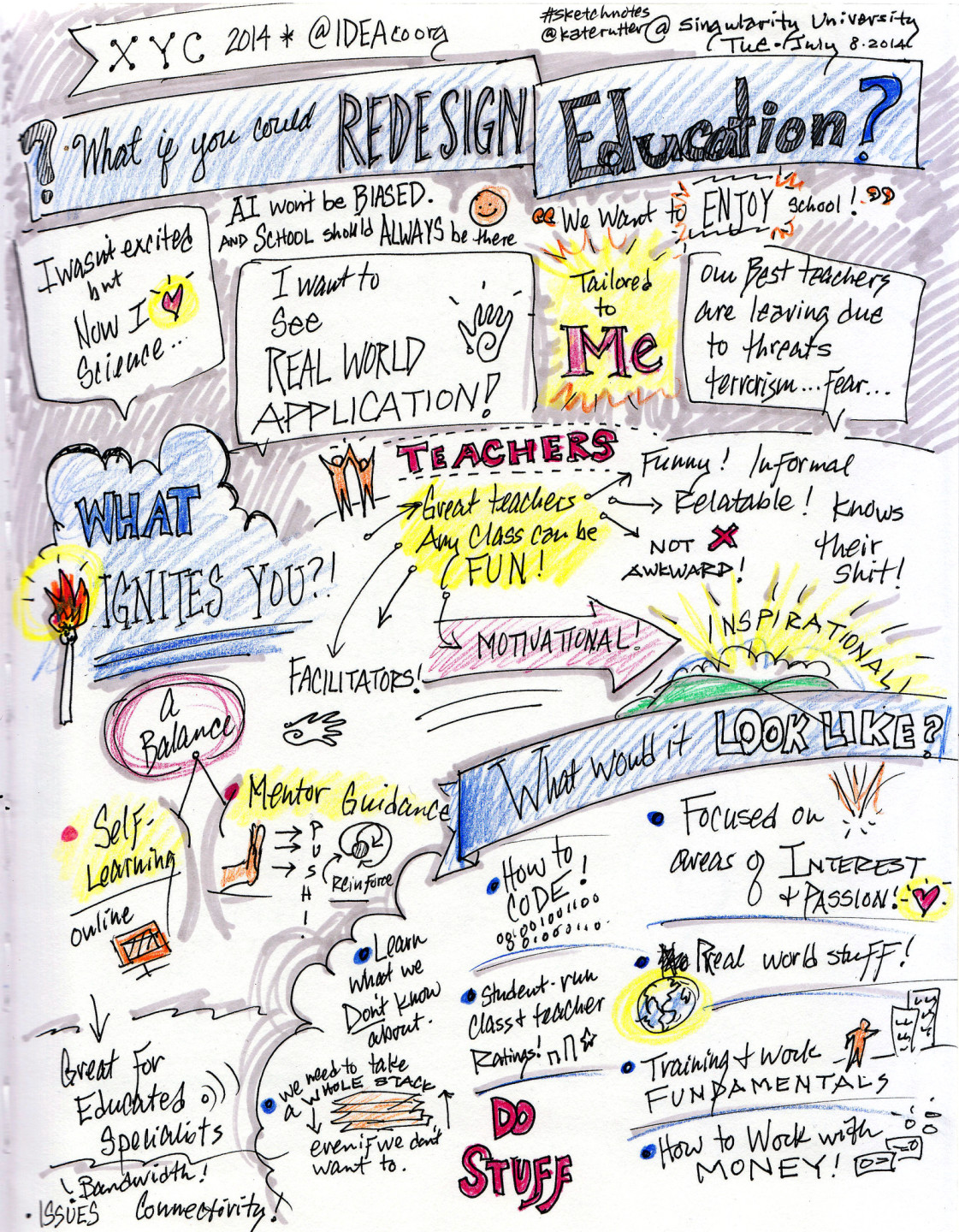
During last summer’s Exponential Youth Camp (XYC) pilot at Singularity University 14 of the world’s brightest teenagers were asked to redesign the future of education. They recommended:

Redesign Education

  1. Make it about ME – Personalization is necessary to compete in today’s intricately specialized world.
  2. Let’s DO things – Across the board, the teens wanted opportunities to demonstrate knowledge through real-world application, not scantrons.
  3. Don’t ditch me in an online course – students simply desired guidance in navigating the material.
  4. Be my coach – Students still want great teachers.
  5. Teach me relevant skills – opportunities to build more practical skills like teamwork, problem solving and conflict resolution
  6. Foster a growth mindset – education should make people confident in their ability to learn anything.

Read the full article…

ED IT Predictions

Image credit: http://www.ubertas.co.uk/blog/5-it-predictions-you-need-to-know-about

Tis the start of the season for predictions. At the recent EDUCAUSE conference in Indianapolis in October a panel of leaders came up with a list of 10 IT issues that will be important to address in 2016. The following is a comparisons of the 2016 list with 2015 as one can see many of the issues are despite having different formal labels are very similar:

2015 Optimizing technology in teaching and learning and 2016 Optimizing educational technology


Top 10 Higher Ed IT Issues Comparison
2015 2016
1. Evolving staffing models 1. Information security
2. Optimizing technology in teaching and learning 2. Optimizing educational technology
3. Funding IT strategically 3. Student success technologies
4. Improving student outcomes 4. IT workforce
5. Demonstrating IT’s value 5. Institutional data management
6. Increasing capacity for change 6. IT funding models
7. Providing user support 7. Business intelligence and analytics
8. Developing security policies for the institution 8. Enterprise application integrations
9. Developing enterprise IT architecture 9. IT organizational development
10. Balancing information security and openness 10. E-learning and online education

Elearning has been a top priority on many lists since the late 1990 so perhaps this year Educational IT will finally get this priority sorted out.

Read the full article…

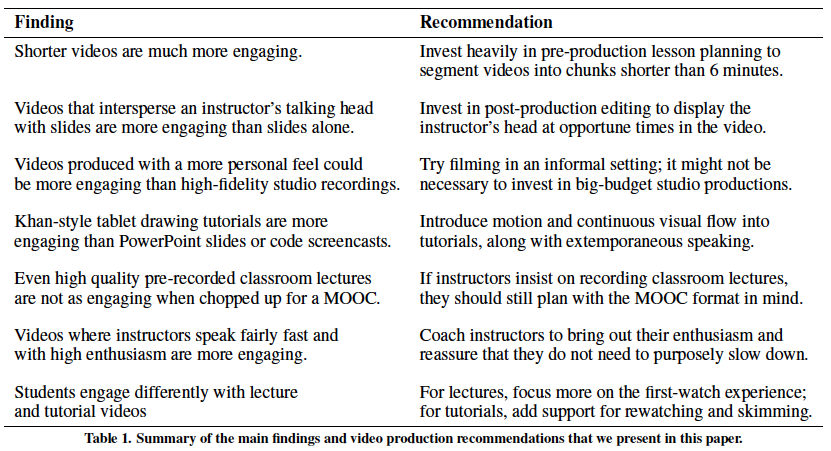
Researchers Philip J. Guo from University of Rochester, Juho Kim from MIT and Rob Rubin from edX collaborated on quantitative research project to study how video production decisions affect student engagement in online educational videos. They used data from 6.9 million video watching sessions across four courses on the edX MOOC platform to measure how long students watched each video and whether they attempted to answer post-video assessment problems.

They found that shorter videos, informal talking-head videos, and Khan-style tablet drawings are much more engaging. They also found that highly produced pre-recorded classroom lectures did not engage students.

The following table provides a summary of the researchers findings and their recommendations:
Video Engagement Summary

We really shouldn’t be surprised by the results. When we are looking to learn something or solve a problem an authentic simply produced and presented message wins out over the highly polished and drawn out information dump. The marketing and social media world has recognized that there is an ideal length for everything online and that every piece of content should be as long as it takes to convey the message and no longer (See Internet is a Zoo Infographic).

Now that we have the hard data to support this notion academia too can start moving in the right direction when it comes to effectively using media to engage the learner.

Read the full article…

References:

Guo, P. J., Kim, J., & Rubin, R. (2014, March). How video production affects student engagement: An empirical study of mooc videos. In Proceedings of the first ACM conference on Learning@ scale conference (pp. 41-50). ACM.