This past weekend I wrapped up the second part of the PIDP 3210 Curriculum Development Course and one often wonders how did the course really go. The following note from one learners in the course suggests that at least one of the my students benefited from the experience:
Just a quick note… I’m teaching our 5-day course this week … and, I wanted to share this with you …
I went into class yesterday with what I can only describe as a ‘spark’. It seemed odd; but, today, the same … I started today’s activities with that feeling of the spark. This weekend’s course’s materials aside, the learning environment you created is, I believe, responsible for this spark in me, and now in my class. I’m thinking that I needed it somehow, or I probably wouldn’t have felt it … who knows; it’s a mystery, eh. 🙂 . And, thanks for this.
Are you tolerating a problem in the world around you and not doing something about it? I see so many opportunities to improve learning environments and get quite frustrated when I miss the chance to make a difference. But I also see, read and hear about situations where opportunities to make a difference are missed.
I recall a blog post from a renowned educator who is a considered a leading thinker and writer about the intersection of social online learning networks and education. This educator was driving his 14-year-old son to school when the son remembers a homework assignment he forgot to do for biology class. The following is their exchange:
“Something big?” I ask, fearing the worst.
“Nah,” he says with a shrug. “Just a handout and some questions. It doesn’t matter.”
This educator reflected on the fact that he could not remember any work that his son and daughter had done the past year that actually did matter in the world; work that had a purpose outside the classroom.
For the remainder of the post he reflected on his experience in traveling the world and viewing “work that matters” that has significance beyond the classroom walls. He effectively argued that when learners create authentic solutions to real world problems it not only benefited those who’s problems were being solved the work benefited the learner.
While I was excited and agree that authentic learning or “work that matters” is important I was also concerned that he didn’t provide any suggestions on how he would attempt to address the problem his children were having with hand outs with questions that didn’t matter. Perhaps he has, but the post left me wondering.
We each have our own spheres of influence. If we see a situation that needs improvement the first thing we need to ask is…
I always look forward to an opportunity to explore what we can do as educators to enhance the learning environment. The following are a list of videos, links to blogs/articles and related resources that were used in a workshop for the Emergency Nursing instructors are BCIT. It is always a privilege to spend time exploring learning and achievement with such a group of dedicated educators.
Not Suited for School But Suited For Learning
Generation Tomorrow – Eddie Obeng, Zeitgeist Europe 2013
Time Travellers in the 21st Century
John Seely Brown On Education
Seely Brown suggest that we focus on the following three key factors to bring our learning into the 21st Century:
Knowledge/information – Pull from the Internet.
Skills – Pickup with mentoring.
Disposition – Foster the idea that learning can be an adventure.
How to Change People Who Don’t Want to Change | The Behavioral Science Guys
The BS Guys recommend that:
When you are trying to influence people who need motivation don’t give them more information….Use questions to help them explore motivations they may already have.
The Head Won’t Go Where the Heart Hasn’t Been
If you really want to bring about change in people then you need to appeal their hearts and not to their heads. The sharing of more information or engaging in more rational discourse on its own doesn’t appear to help people to make significant change but an appeal to values, attitudes, and feelings first can motivate people toward making changes.
Fixed Vs Growth Mindset = Print Vs Digital Information Age
If we really want to take advantage of all the opportunities that the digital information age offers, we need to move away from fixed mindset to growth mindset thinking.
John Hattie: Visible Learning Pt1. Disasters and below average methods.
Hattie argues:
“short of physical and psychological abuse, almost anything you do in the classroom will positively impact student achievement…key is to figure out what promotes achievement…”
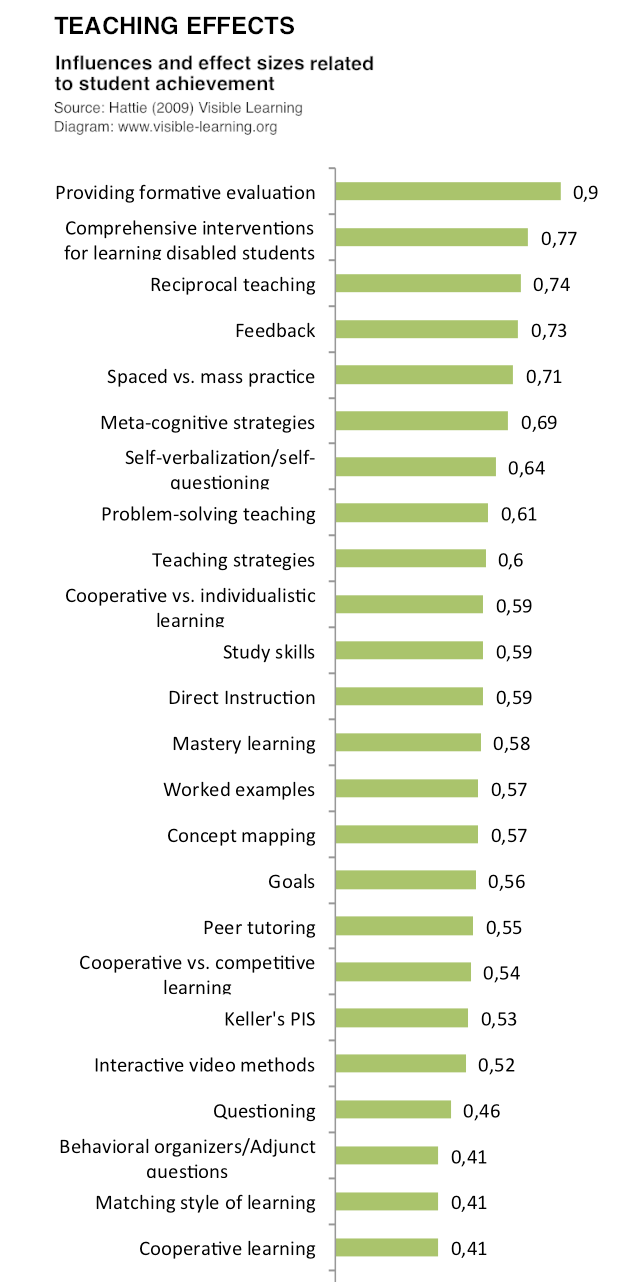
John Hattie, Visible Learning. Pt 2: effective methods.
Teaching effects that really make a difference – above .40
Positive Feedback: The PIPS Model
PIPS Model to providing effective feedback
P – Praise something specific
I – Improve – suggest ways
P – Positive overall praise
S – Supply an uplifting comment