Where is Canada? Why aren’t we on the list?
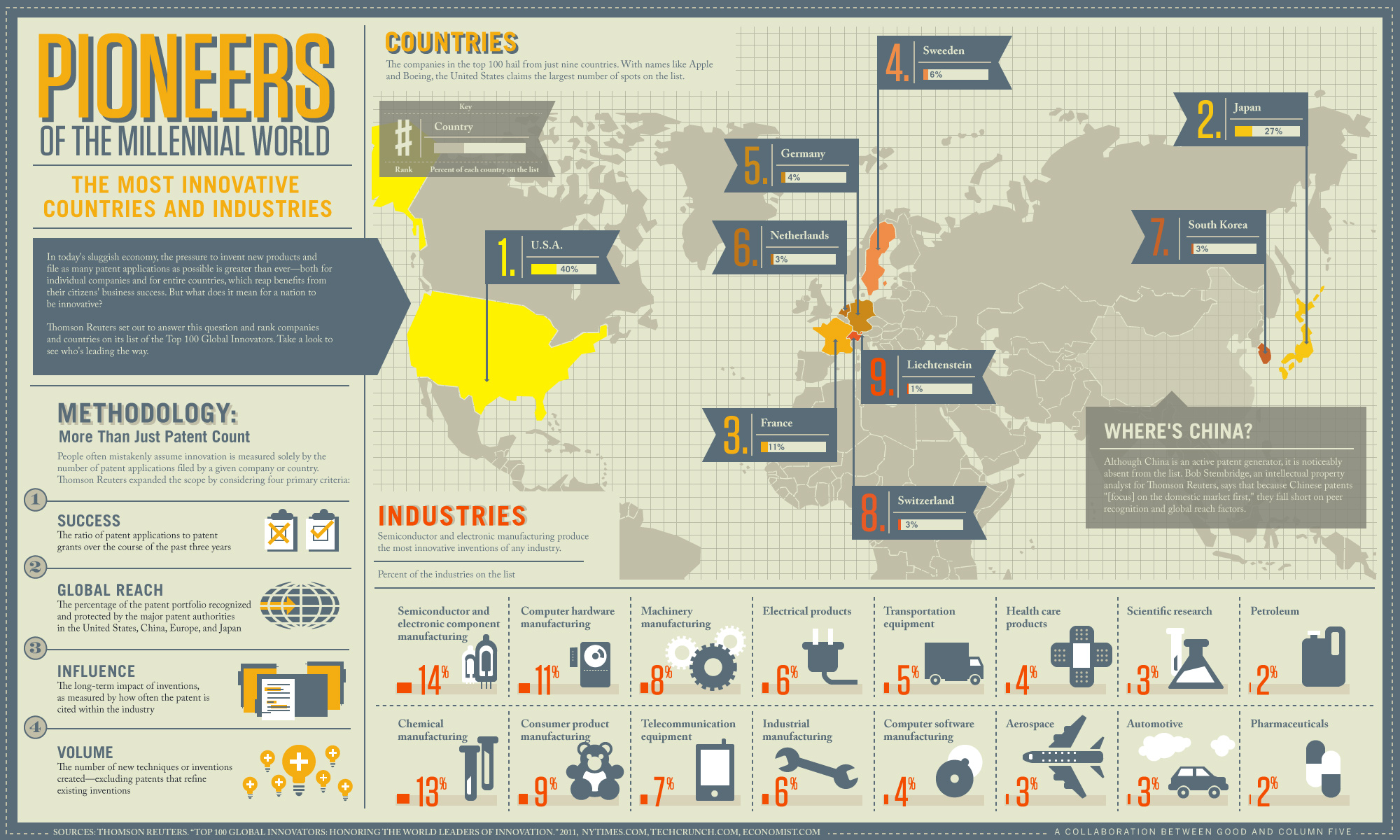
Source: magazine.good.is/infographics/infographic-the-world-s-leading-innovators
Creating Significant Learning Environments
Where is Canada? Why aren’t we on the list?
Source: magazine.good.is/infographics/infographic-the-world-s-leading-innovators


In the TechRepublic post Chromebooks leapfrog iPads in US education market for first time, here’s why Conner Forrest points out that Chromebooks got to 20% marketshare of the education market worldwide and nearly 50% share in the US education market.
Why is Google taking control of the market share?
Cost aside, Google Chromebooks provide a much simpler and easier to use ecosystem for students, teachers and administrators than the iPad.
This could be a huge blow to Apple because the education market has been one of Apple’s keys to success. With their continued inability to grow their iCloud service into anything that remotely offers the power of Google Docs/Apps for education I don’t see them regaining the Educational market share in the US and would expect to see their world wide Educational share decline as well.
I think that this is also an example of Google beating Apple at is own game – simplicity. Over the years people (myself included) have been willing to spend the premium dollar on the iPhone, iPads and other Apple products in general because they are so simple to use. The iPhone, iPad and other Apple devices work so well together that they required minimal management. Once you learn all of Apple’s idiosyncrasies you are up and running.
Google’s products have matured to the point were they are equally simple to use and with the added infrastructure of Google Classroom and Google Apps for Education Google offers a management simplicity that Apple has not been able to match.
As much as I enjoy using my MacBook Air, my iPad or my iPhone I can only tolerate iTunes and iTunesU and other Apple management tools. The wonderful option is using the best of both worlds. For the most part I use Apple hardware but for almost everything else Google is my first choice.
It will be interesting to see how this continues to develop. Are you Google or Apple purist or are you a hybrid user?
I generally do not comment on infographics because I believe a good infographic needs no additional explanation. The reason I am adding this comment is that I need to make a connection between the most promising industries for the future and education. Many people prefer not to refer to education as a business but the data suggest that it is not only a business it is one that promises significant growth in the future.

Source: magazine.good.is/infographics/infographic-what-are-the-most-lucrative-industries
I am not one to long for the “good ole days” because I believe that there has never been a better time to be a learner, to be an entrepreneur, or to be alive in general. You can fill in the “to be” section of that statement with so many things. Now, I need to qualify a few points. I am referring to living in the west and in particular Canada but despite the unconscionable social injustices we see throughout the world and in particular the third world there has never been a better time to be alive. Don’t take my word for this–just refer to Hans Rosling amazing Ted Talk The best stats you have ever seen.
The opportunities for a learner today have never been better. Virtually all the worlds information is available in the palm our hands on our mobile devices. We can learn all the time and everywhere. Social networking enables a learner to move out of isolation and to connect to so many others who are striving to learn about similar, related or dissimilar things. These learning communities are so crucial for the advancement of ideas. Steven Johnson in the RSA talk Where good ideas come from points to the European Coffee Houses in the Age of the Enlightenment and the Parisian Salons of Modernism as places were ideas “bumped” into each other and significant advances in society were born. Johnson also argues that these virtually connected communities will further advancement today because “chance favours the connected mind. ”
The connected world of the Internet has also put significant pressure on our traditional educational institutions. At all levels we are starting to see a shift toward more student centric form of education. We see many teachers experimenting with online, blended and technology enhanced learning because they have starting to recognize that the problem of the deliver of content has been solved by technology. It has never been a better time to be a teacher. Teachers now have the opportunity to focus on helping students to go much deeper and discern what can be done with all the information.
We truly live in an amazing time and it has never been a better time to be a learner. Are you embracing all the opportunities that the 21st Century has to offer?


