The Association of American Colleges and Universities (AAC&U) survey “It Takes More Than a Major: Employer Priorities for College Learning and Student Success,” reveals that most employers don’t think colleges are doing a very good job of preparing students for work. In response to the survey results, 160 employers and 107 college presidents agreed to sign a compact and work toward helping the public:

understand the importance of a “21st-century liberal-arts education,” comprising broad and adaptive learning, personal and social responsibility, and intellectual skills.

While I admire this initiative I am somewhat skeptical of its impact. Why? It was only 6 years ago that AAC&U conducted a similar survey that revealed similar findings. In the 2008 report How Should Colleges Assess and Improve Student Learning?) Peter D. Hart Research Associates revealed the following 6 Key Findings:

  1. When it comes to preparedness for success at the entry-level, one-third of business executives think that a significant proportion of recent college graduates do not have the requisite skills and knowledge.
  2. When asked to evaluate recent college graduates’ preparedness in 12 areas, employers give them the highest marks for teamwork, ethical judgment, and intercultural skills, and the lowest scores for global knowledge, self-direction, and writing.
  3. Most employers indicate that college transcripts are not particularly useful in helping evaluate job applicants’ potential to succeed at their company.
  4. Few employers believe that multiple-choice tests of general content knowledge are very effective in ensuring student achievement. Instead, employers have the most confidence in assessments that demonstrate graduates’ ability to apply their college learning to complex, real-world challenges, as well as projects or tests that integrate problem-solving, writing, and analytical reasoning skills.
  5. Employers deem both multiple-choice tests of general content knowledge and institutional assessments that show how colleges compare in advancing critical-thinking skills of limited value for evaluating applicants’ potential for success in the workplace. They anticipate that faculty-assessed internships, community-based projects, and senior projects would be the most useful in gauging graduates’ readiness for the workplace.
  6. When asked to advise colleges on how to develop their methods for assessing students’ learning, employers rank multiple-choice tests of students’ general content knowledge and institutional scores for colleges as conspicuously low priorities.

This report focused on assessment and learning and offered some very specific and practical recommendations that, if followed, should have resulted in a different findings in the latest AAC&U survey. Why hasn’t higher education made any progress in this area over the past 6 years? Theodore Sizer, the former Harvard Graduate School of Education Dean and Educational Reformer, argues in his book, The Red Pencil, that little has changed in education since his experiences in the information and test based classroom he endured in 1946. Why does higher education perpetually find itself in a state of paralysais by analysis?

We need to heed the advice often attributed to Albert Einstein. Although he never actually offered the following quote this notion of challenging conventional thought is still useful:

Insanity is doing the same thing over and over again and expecting different results.

We can stop this insanity only if we stop hiring so many traditional risk adverse leaders and faculty. As I detailed in my post Pick Two – Innovation, Change or Stability we need to search out individuals who are outside-of-the-box thinkers with entrepreneurial spirits and unconventional career paths if we really want to bring about the changes we so desperately need in education.


Mining your iphone

Source: 911Metallurgist

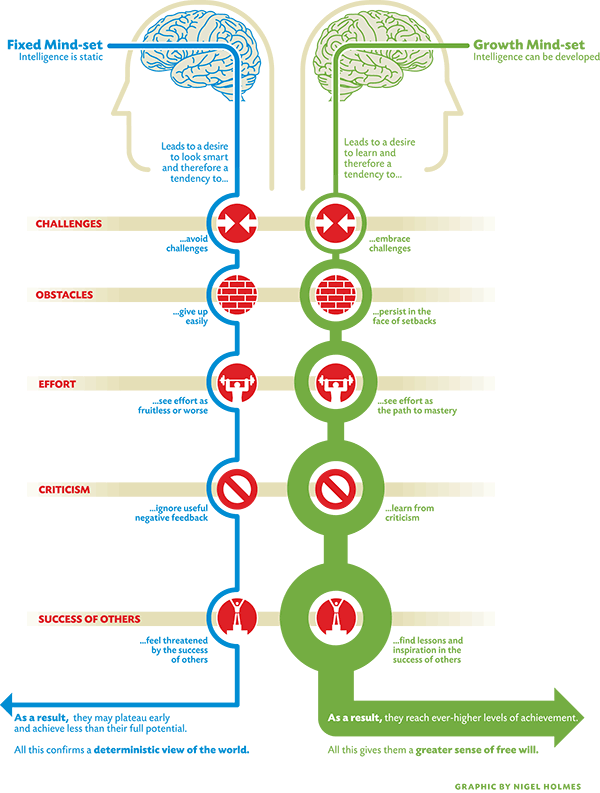
dweck mindset

If we really want to take advantage of all the opportunities that the digital information age offers, we need to move away from fixed mindset to growth mindset thinking. Carol Dweck, Professor of Psychology at Stanford University, the author of Mindset: The New Psychology of Success (Random House, 2006) and the article Even Geniuses Work Hard posits that if students with a Fixed Mindset believe that intelligence is an inborn trait and is essentially fixed they:

  • Tend to view looking smart above all else;
  • May sacrifice important opportunities to learn—even those that are important to their future academic success—if those opportunities require them to risk performing poorly or admitting deficiencies;
  • Believe that if you have ability, everything should come naturally;
  • Tell us that when they have to work hard, they feel dumb;
  • Believe that setbacks call their intelligence into question, they become discouraged or defensive when they don’t succeed right away;
  • May quickly withdraw their effort, blame others, lie about their scores, or consider cheating.

In contrast Dweck explains that students with a Growth Mindset believe that they can develop their intelligence over time and subsequently will:

  • View challenging work as an opportunity to learn and grow;
  • Meet difficult problems, ones they could not solve yet, with great relish;
  • Say things like “I love a challenge,” “Mistakes are our friends,” and “I was hoping this would be informative!”
  • Value effort; they realize that even geniuses have to work hard to develop their abilities and make their contributions;
  • More likely to respond to initial obstacles by remaining involved, trying new strategies, and using all the resources at their disposal for learning.

The fixed mindset, or as it is more often referred to as innate intelligence, was the widely accepted theory of cognitive development until 60’s when UC Berkley professor Mark Rosenzweig replicable studies made the case for the environmental impact on brain development and plasticity. It is now widely accepted that the brain remains plastic and adapts to our constantly changing environment which is foundational to Dweck’s argument for the growth mindset.

This notion of adapting to a constantly changing environment is also important when we consider our move from a static print information age to the dynamic digital information age.

The emphases of the print information age and print culture include:

  • development of systems of cataloging and retrieval
  • emphasis on memorization
  • information as primary, analysis as secondary
  • centralization of instructional space
  • learning as hierarchical, “objective,” and categorized
  • standardization paramount

Therefore, the greatest challenge of the print information age is finding existing or fixed information. A learning environment that is based on the print culture will emphasize memorization and regurgitation of standardized information.

In contrast the emphasis of the digital information age and digital culture include:

  • systems of communication & interconnection
  • emphasis on participation
  • analysis, critique & “remixing” as primary
  • information as a “commodity”
  • centralization of creation & production
  • emphasis on community & social interaction

The greatest challenge of the digital information age will be assessing Information and making meaningful connections between existing information and new information that is developed. A learning environment that is based on digital culture will emphasize, creation, communication, and participation as primary and hold information simply as a commodity or a product of interconnected human endeavours.

Considering that we have moved into and have been in the digital information age for at least the past two decades we need to consider our roles as educators and look long and hard at the changes we need to make to our learning systems. The following questions are central to how I will be responding to how I see my role as an educator in the 21st Century:

  • If I imagine my primary job as a teacher is to serve information, am I helping solve the current informational problem or make it worse?
  • And given the vast complexity of the informational network, if I insist on my centrality, does that establish or harm my credibility as a teacher?
  • If assessing information – and the wisdom & experience that requires – is the central challenge of the current informational age, are teachers more or less necessary?

Helping learners assess the vast amounts of information that is available and giving them necessary skills and abilities that they need to make meaningful and useful connections is more important than it has ever been. Learning is an active and dynamic process in which learners construct new ideas or concepts based upon their current/past knowledge. The making of meaningful connections in the digital information age is key to the learning and knowing. 

We need to move from fixed mindset thinking and the passive educational environment of main lecture points, rubrics, individual competition and standardized testing to growth mindset thinking of active learning, dynamic interactivity, critical and analytical thinking, collaboration and meaningful projects.

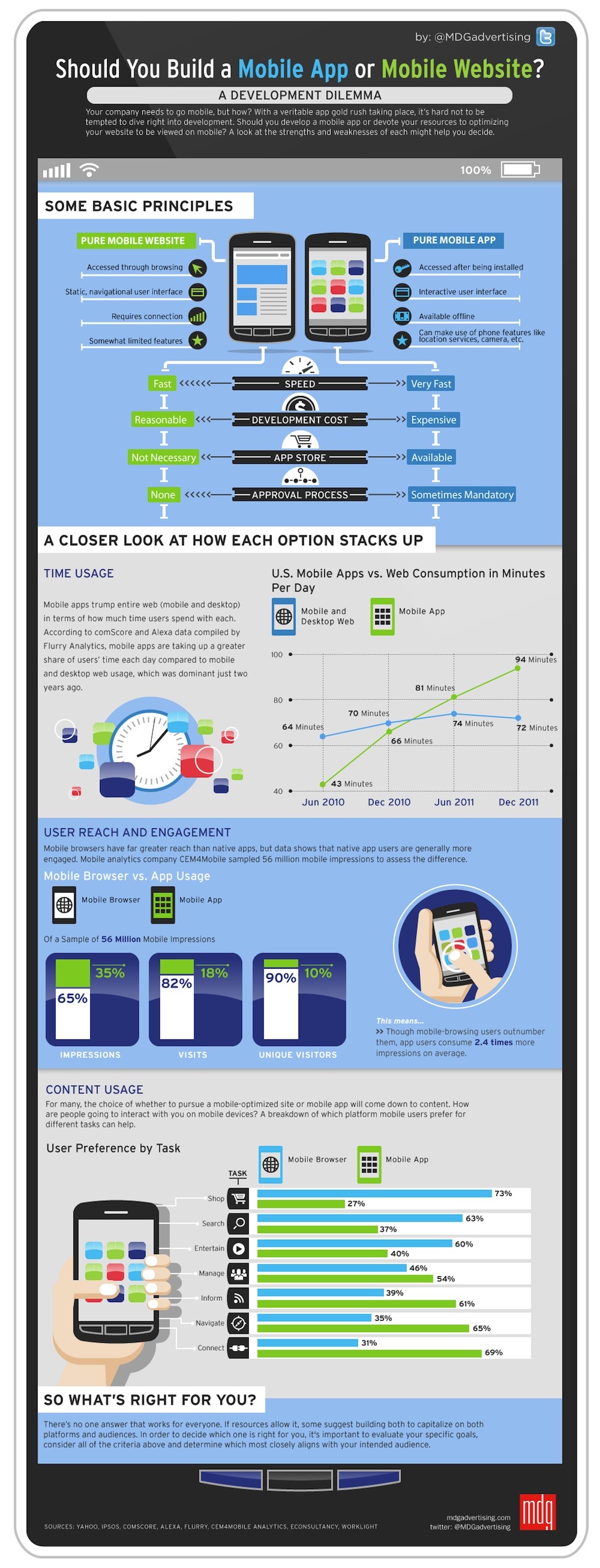
mobileapp or mobilewebsite

There are advantages and disadvantages to both. This inforgraphic should help you determine whether a mobile app or website will be best for your specific needs.

Source: bestdesigntuts.com