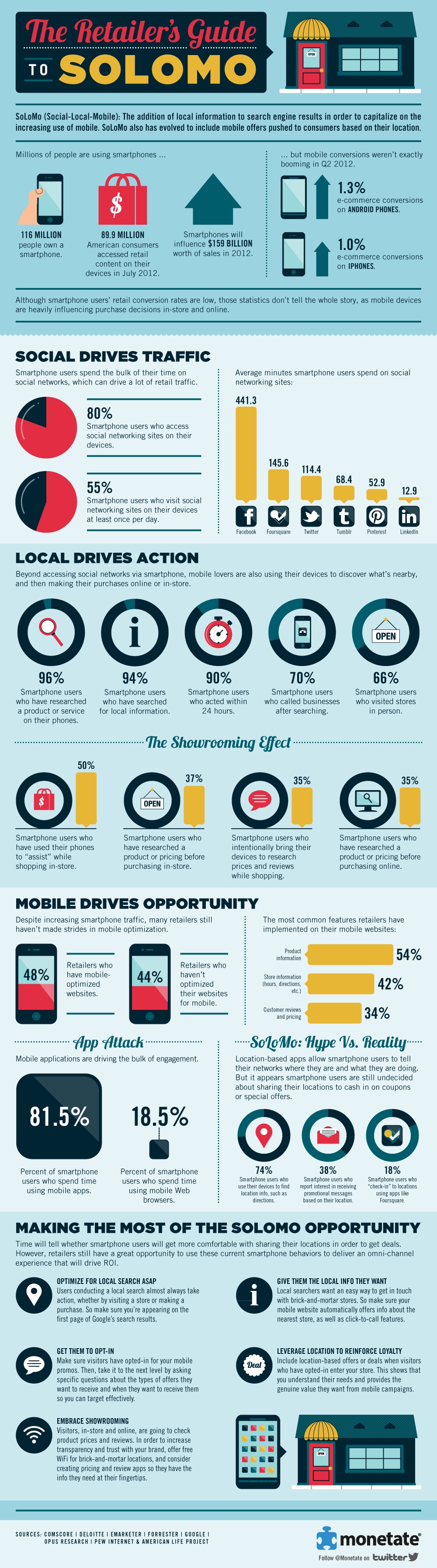
Original Source: Marketing Pilgrim: SoLoMo Infograph Shows Impact of Mobile and Social on Locale
I find it interesting that the general use of the Internet has evolved to the place where we have moved passsed the desktop and onto mobile devices which we carry with us everywhere and use all the time for almost everything we do.
All the while academics are still debating the merits of the use of the Internet in the form of online learning, digital texts and the like in higher education.
This makes we wonder who Alvin Toffler is really referring to in the following quote:

It is currently a two horse race between the IOS and Android. Samsung must be mentioned as a major player in this space considering it is the developer of the Galaxy S2, S3 and Google’s own Nexus device not to mention all the other models of smartphones is has offered. Apple and Android own the smartphone and it will be interesting to see how much of an impact Windows 8, Microsoft Surface and the Nokia phones will make on these numbers. There is also the long shot that RIM may revive some interest in its platform in 2013 but most people believe RIM will be a niche play at best.
It is always fascinating to see just how much an impact the smartphone has had in such a short period.

When you combine the smartphone growth With the explosive growth of the iPad, mobile access to the web is now the new norm. Perhaps the most exciting part about this for learners is that access to the world’s information is truly available all the time and from everywhere. Even more exiting is the fact that we has just started to see development in this space. One can only imagine where we will be in the next 3-5 years.
PLEASE NOTE: There are several videos on Youtube that highlight the parable of the five monkeys and while this experiment is NOT based on actual research the principles extracted from the fable are still useful.
Most people or organizations who use this parable point to Harry Harlow the American psychologist best known for his maternal-separation and social isolation experiments on rhesus monkeys as the source for but the parable can more than likely attributed to the work of Gordon R. Stephenson:
“Stephenson (1967) trained adult male and female rhesus monkeys to avoid manipulating an object and then placed individual naïve animals in a cage with a trained individual of the same age and sex and the object in question. In one case, a trained male actually pulled his naïve partner away from the previously punished manipulandum during their period of interaction, whereas the other two trained males exhibited what were described as “threat facial expressions while in a fear posture” when a naïve animal approached the manipulandum. When placed alone in the cage with the novel object, naïve males that had been paired with trained males showed greatly reduced manipulation of the training object in comparison with controls. Unfortunately, training and testing were not carried out using a discrimination procedure so the nature of the transmitted information cannot be determined, but the data are of considerable interest.”
Sources:
Stephenson, G. R. (1967). Cultural acquisition of a specific learned response among rhesus monkeys. In: Starek, D., Schneider, R., and Kuhn, H. J. (eds.), Progress in Primatology, Stuttgart: Fischer, pp. 279-288.
Mentioned in: Galef, B. G., Jr. (1976). Social Transmission of Acquired Behavior: A Discussion of Tradition and Social Learning in Vertebrates. In: Rosenblatt, J.S., Hinde, R.A., Shaw, E. and Beer, C. (eds.), Advances in the study of behavior, Vol. 6, New York: Academic Press, pp. 87-88:
The following statement needs repeating:
One of the most comprehensive studies into media sharing and consumption habits in the United States and Germany reveals that file-sharers buy 30% more music than their non-sharing counterparts. The result confirms that file-sharers are actually the music industry’s best customers…
This is direct contrast to what the Recording Industry Association of America (RIAA) claims:
The more music people pirate, the less they buy…
What does this have to do with learning? A great deal when you consider that the best way to determine who is right is to see what the data says. According to the Copy Culture report by the American Assembly, a non-partisan public policy forum affiliated with Columbia University, people who pirate music files purchase 30% more than those who don’t.
This isn’t the first study, nor the last, that will reveal this fact. When will we start making decisions and implementing policy based on the facts?
For the additional information read the American Assembly posts:
Unauthorized File Sharing: Is It Wrong?
Where do Music Collections Come From?
Wh