William Gibson, the science fiction author who coined the term cyberspace and is credited with influencing cyberculture offered the following prediction about computers back in 1993:
In the future, computers will mutate beyond recognition. Computers won’t be intimidating, wire-festooned, high-rise bit-factories swallowing your entire desk. They will tuck under your arm, into your valise, into your kid’s backpack. After that, they’ll fit onto your face, plug into your ear. And after that – they’ll simply melt. They’ll become fabric. What does a computer really need? Not glass boxes – it needs thread – power wiring, glass fiber-optic, cellular antennas, microcircuitry. These are woven things. Fabric and air and electrons and light. Magic handkerchiefs with instant global access. You’ll wear them around your neck. You’ll make tents from them if you want. They will be everywhere, throwaway. Like denim. Like paper. Like a child’s kite. This is coming a lot faster than anyone realizes. Gibson, 1993)
Since 1993 we have seen computer size shrink drastically as computing power has increased signficantly. For example the iPhone of today is many times more powerful than the computers of 1993 and it is something that we can slip into our pockets. We are also seeing computing woven into all aspects of our physical and social spaces and it is truly happening much faster than anyone realizes, so Gibson’s predictions are relatively accurate.
Gibson is also very accurate in his prediction regarding the Internet and its rapid growth:
Every machine you see here will be trucked out and buried in a landfill, and never spoken of again, within a dozen years … The values are what matters. The values are the only things that last, the only things that *can* last. Hack the hardware, not the Constitution. Hold on tight to what matters, and just hack the rest. I used to think that cyberspace was 50 years away. What I thought was 50 years away, was only 10 years away. And what I thought was 10 years away – it was already here. I just wasn’t aware of it yet. (Gibson, 1993)
Gibson’s recommendation to focus on values and not the technology are words that should be headed. Focusing on what we use technology to do to improve our lives, education and society in general should be the priority.
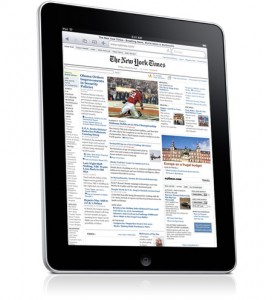
I have started down this path of reflection to help me focus on what is really valuable in the release of the iPad. It is also a response to the countless articles and blog posts that I have read in the past few days predicting the demise of the the Kindle and other ereaders to the grandiose headline in the UK Telegraph Is Apple using the iPad to take over the world? An example of the incorrect focus on the technology rather than what it can do to improve our society is highlighted in the following quote from the article:
As Richard Holway, of analysts TechMarketView, says: “Get on any train in five years’ time, and people will be reading the newspaper (downloaded at home or automatically when they walk through Waterloo Station on the way home), books, watching TV, playing games (quite possibly with fellow passengers!) or whatever on their iPads.”
In five years we should have a very different and much more powerful device than the iPad and while there is a good chance it will be an Apple device there are no guarantees. While I am certain that this new device will enable the user to read any content or amuse themselves individually or socially while traveling this perspective limits the potential of technology to improve our lives. We owe it ourselves to look and think beyond limited consumptive desires.