Checklists, progress bars, completion status checks, competency or activity focused rubrics and other related tools or methods that help a student to check a completed activity off a list may be useful in competency-based education but these activity monitors do not have a place or role in outcome-based education. They are simply not needed in outcome-based education because the focus of the learning environment and experience is not on completing an activity, rather, the focus is on the outcome which drives the context of learning. I do have to qualify that for outcomes-based education to be truly effective the use of authentic or “real world” learning opportunities are required to create the context for the learning outcome. If the learner is working toward a real-world solution, building or creating an authentic or real-world project, or even researching, analyzing, and synthesizing a plan for a real project, the context of these authentic opportunities drives the learning and the work. Working on authentic projects requires that the learner goes much deeper than simply checking an activity off a list. The trial and error and failing forward that is part of this process does not lend itself to checklists.
In the following video, we explain the difference between competency-based education and outcome-based education. It is important to note that one isn’t necessarily better than the other. They play different roles in the educational process and are used in different contexts and for different purposes. If you are measuring skills, abilities, information transfer, or a variety of other variables through a test, quiz, or even a traditional report or basic essay then you are doing competency-based education. Unfortunately, our educational system misuses the term “outcome” to refer to goals and objects which are central to competency-based education.
As you will have surmised from the video much of our educational system or what we focus on in education is competency-based. It is easy to measure, easy to check off the list, and easy to standardize. In contrast, because real-world problems and projects can be difficult to measure and are difficult to standardize, outcome-based instruction is all too often relegated to special programs, graduate programs, or elite institutions. Outcome-based education has been advocated by the likes of Dewey, Piaget, Brunner, Papert, and many other constructivists and cognitivist learning theorists. The educational historian David Labaree argues that we use the rhetoric of Dewey when we talk about deeper learning, critical and analytical thinking but we have the reality of Thorndyke who is the founder of our behaviorist and competency-based information transfer model of education which is still used today. Because there is an underlying desire to use real-world projects and many of our institutions frame their instruction toward job readiness there is a misconception that they are engaged in outcomes-based education.
This is especially the case in the trades and most other “hands-on”, or job readiness or credentialing programs. The students are being prepared to work in an office, dental clinic, a laboratory, a clinic, the construction site, and the “real world” work for which they need to be prepared, is viewed as the outcome; hence the misconception of outcome-based education. In virtually all of these programs, the “real world” task is broken down into smaller competencies and the student is taught and tested on each of these competencies as they go through their training. Many of these disciplines have a local, regional or federal credentialing exam that the student must pass to be authorized to work in that industry. Where there are no governmental exams there are often associations or other governing bodies formed to ensure standardization who manage the testing and credentialing within the industry.
I stated earlier that competency-based education has its place and we have a system of education that has evolved to fit this need. The designing a curriculum (DACUM) approach and the use of goals and objectives are useful instructional design tools that help to guide the process of breaking down larger goals into smaller objectives which can be easily measured. Due to its prevalence, which is attributed more so to the ease of standardization and measurement than pedagogical efficacy, most students have primarily had a competency-based education experience. This is how school works for most people. The outcome-based education all too often is relegated to special projects or special programs or to higher levels of education, but it doesn’t have to be. We can incorporate many of the benefits of outcome-based education even in a predominantly competency-based education culture if we simply change our focus.
By changing our focus we can bring the benefits of outcome-based education to our learning environments. Introductory level courses, test preparation, and credentialing courses, and other standardized focused instruction can be addressed with competency-based education. Higher-level courses within a program or where preparation for real-life, not just the test is the priority, is where outcome-based education and authentic learning opportunities can be implemented. Several words of caution. Preparing students for real-life not just the test takes more work on your part as the instructor and on the student’s part. It also requires that the control of the learning shift from the instructor to the learner. Since most students have had a steady diet of competency-based education in primary and secondary school and for the most part in higher education, many will not be prepared to take control of their own learning. The research is very clear that even though they will do better active and dynamic learning and have significantly higher grades they will not like it (see Harvard Study). In the following video we explore the consequences of this shift in control over the learning.
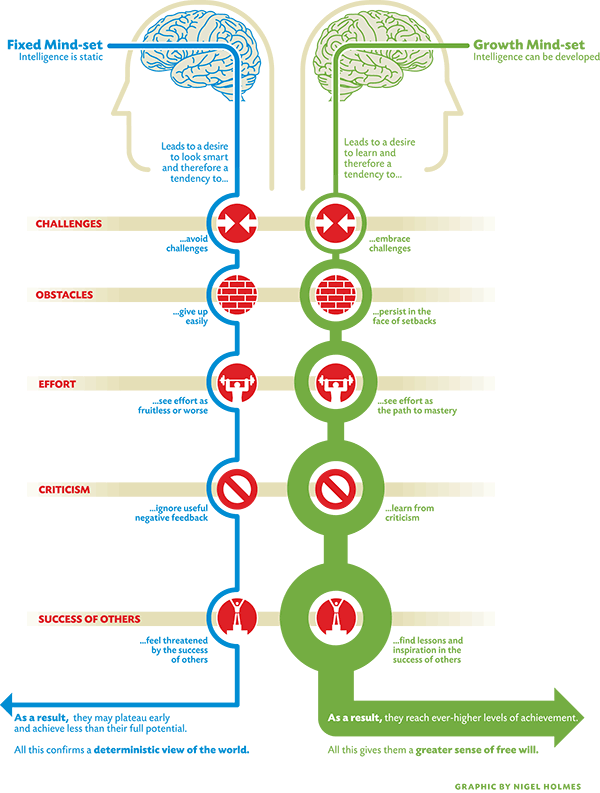
If you create a significant learning environment that gives your learner choice, ownership, and voice through authentic learning opportunities (CSLE+COVA) you will enable them to go much deeper into learning and help them revitalize their learner’s mindset.
This has been a long explanation for why I don’t use checklists, progress bars, completion status checks, competency or activity focused rubrics and other related tools or methods that help a student to check a completed activity off a list. These tools play a role in competency-based education where you simply have to check a completed skill or activity off a list. Those activity monitoring tools don’t have a place in outcomes-based education because the focus isn’t the incremental skill or activity, it is the bigger project…and what they will do with that project. All the skills and activities that the learner acquires as they go along are theirs and once they own them they become part of their learning process.
My focus is outcome-based learning and my goal is to help prepare my learners for life, not just a test. I am willing to push the boundaries of cognitive dissonance and challenge my students to take control of their learning in ways which before, they may not have done.
References
Bruner, J. S. (1966). Toward a theory of instruction. New York: W. W. Norton & Company, Inc.
Dewey, J. (1916). Democracy and education: An introduction to philosophy of education. New York, NY: Macmillan.
Ginsburg, H., & Opper, S. (1969). Piaget’s theology of intellectual development: An introduction. Englewood Cliffs, NJ: Prentice-Hall.
Labaree, D. F. (2005). Progressivism, schools, and schools of education: An American romance. Paedagogica Historica, 41(1&2), 275-288. Retrieved from https://eric.ed.gov/?id=EJ748632
Papert, S. (1993). The children’s machine: Rethinking school in the age of the computer. New York, NY: Basic Books.
Papert, S. (1997). Why school reform is impossible (with commentary on O’Shea’s and Koschmann’s reviews of “The children’s machine”). The Journal of the Learning Sciences, 6(4), 417–427.
Piaget, J. (1964). Development and learning. In R.E. Ripple & V.N. Rockcastle (Eds.), Piaget Rediscovered: A Report on the Conference of Cognitive Studies and Curriculum Development (pp. 7–20). Ithaca, NY: Cornell University.