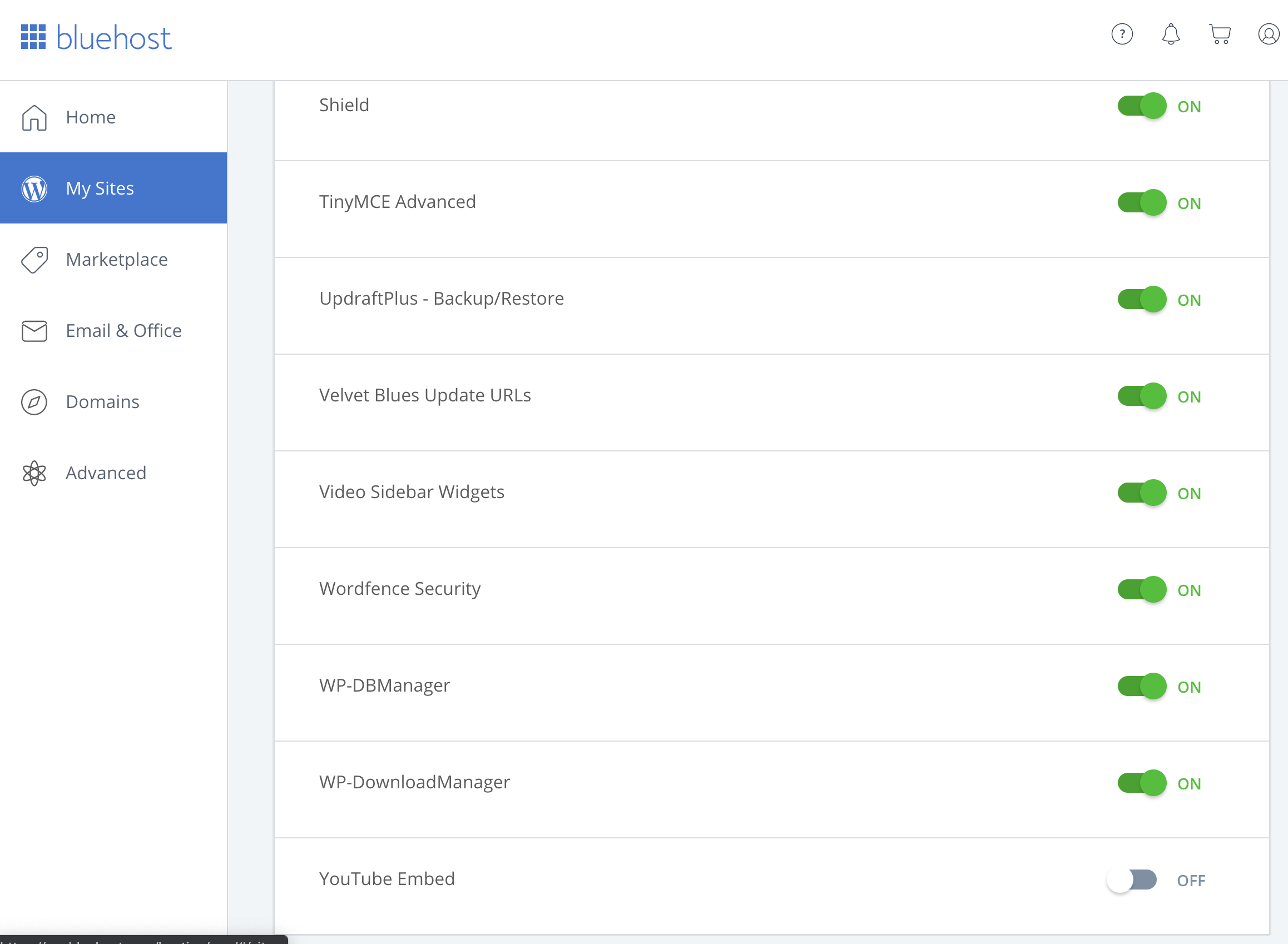
I keep my WordPress install updated and since it has been a very long time since a WP Plugin has caused an issue I simply did an “update all” and on about 4 or 5 plugins and walked away. I didn’t check to see if there were any issues because the backend interface and my control panel said all was fine. I didn’t actually take a look at my site in another browser. BIG MISTAKE. I woke up to a bunch of emails and messages indicating my site was down. Not something you want to deal with when you have a full day of pressing work scheduled. I couldn’t recall what plugins I had updated so I started the time-consuming process of turning them all off one at and time and testing. Fortunately, I have scaled down to only 22 plugins. Unfortunately, the very last plugin “Youtube Embed” was the culprit. I have uninstalled this plugin and have turned on all other plugins (one at a time with full testing) so my site is back up.

Lesson learned. NEVER update plugins and walk away. Do a full test. Also, update one plugin at a time.

This event has reminded me that I also need to update my site to HTTPS to get rid of the message “not secure” from the browser line. This is going to break my site and I am not looking forward to fixing this issue.

Original Source: https://www.visualcapitalist.com/life-return-to-normal-covid-19/

I find these sorts of surveys and infographics and the related data fascinating. The full post has some additional data that is interesting. Makes you wonder…..?

Checklists, progress bars, completion status checks, competency or activity focused rubrics and other related tools or methods that help a student to check a completed activity off a list may be useful in competency-based education but these activity monitors do not have a place or role in outcome-based education. They are simply not needed in outcome-based education because the focus of the learning environment and experience is not on completing an activity, rather, the focus is on the outcome which drives the context of learning. I do have to qualify that for outcomes-based education to be truly effective the use of authentic or “real world” learning opportunities are required to create the context for the learning outcome. If the learner is working toward a real-world solution, building or creating an authentic or real-world project, or even researching, analyzing, and synthesizing a plan for a real project, the context of these authentic opportunities drives the learning and the work. Working on authentic projects requires that the learner goes much deeper than simply checking an activity off a list. The trial and error and failing forward that is part of this process does not lend itself to checklists.

In the following video, we explain the difference between competency-based education and outcome-based education. It is important to note that one isn’t necessarily better than the other. They play different roles in the educational process and are used in different contexts and for different purposes. If you are measuring skills, abilities, information transfer, or a variety of other variables through a test, quiz, or even a traditional report or basic essay then you are doing competency-based education. Unfortunately, our educational system misuses the term “outcome” to refer to goals and objects which are central to competency-based education.

As you will have surmised from the video much of our educational system or what we focus on in education is competency-based. It is easy to measure, easy to check off the list, and easy to standardize. In contrast, because real-world problems and projects can be difficult to measure and are difficult to standardize, outcome-based instruction is all too often relegated to special programs, graduate programs, or elite institutions. Outcome-based education has been advocated by the likes of Dewey, Piaget, Brunner, Papert, and many other constructivists and cognitivist learning theorists. The educational historian David Labaree argues that we use the rhetoric of Dewey when we talk about deeper learning, critical and analytical thinking but we have the reality of Thorndyke who is the founder of our behaviorist and competency-based information transfer model of education which is still used today. Because there is an underlying desire to use real-world projects and many of our institutions frame their instruction toward job readiness there is a misconception that they are engaged in outcomes-based education.

This is especially the case in the trades and most other “hands-on”, or job readiness or credentialing programs. The students are being prepared to work in an office, dental clinic, a laboratory, a clinic, the construction site, and the “real world” work for which they need to be prepared, is viewed as the outcome; hence the misconception of outcome-based education. In virtually all of these programs, the “real world” task is broken down into smaller competencies and the student is taught and tested on each of these competencies as they go through their training. Many of these disciplines have a local, regional or federal credentialing exam that the student must pass to be authorized to work in that industry. Where there are no governmental exams there are often associations or other governing bodies formed to ensure standardization who manage the testing and credentialing within the industry.

I stated earlier that competency-based education has its place and we have a system of education that has evolved to fit this need. The designing a curriculum (DACUM) approach and the use of goals and objectives are useful instructional design tools that help to guide the process of breaking down larger goals into smaller objectives which can be easily measured. Due to its prevalence, which is attributed more so to the ease of standardization and measurement than pedagogical efficacy, most students have primarily had a competency-based education experience. This is how school works for most people. The outcome-based education all too often is relegated to special projects or special programs or to higher levels of education, but it doesn’t have to be. We can incorporate many of the benefits of outcome-based education even in a predominantly competency-based education culture if we simply change our focus.

By changing our focus we can bring the benefits of outcome-based education to our learning environments. Introductory level courses, test preparation, and credentialing courses, and other standardized focused instruction can be addressed with competency-based education. Higher-level courses within a program or where preparation for real-life, not just the test is the priority, is where outcome-based education and authentic learning opportunities can be implemented. Several words of caution. Preparing students for real-life not just the test takes more work on your part as the instructor and on the student’s part. It also requires that the control of the learning shift from the instructor to the learner. Since most students have had a steady diet of competency-based education in primary and secondary school and for the most part in higher education, many will not be prepared to take control of their own learning. The research is very clear that even though they will do better active and dynamic learning and have significantly higher grades they will not like it (see Harvard Study). In the following video we explore the consequences of this shift in control over the learning.

If you create a significant learning environment that gives your learner choice, ownership, and voice through authentic learning opportunities (CSLE+COVA) you will enable them to go much deeper into learning and help them revitalize their learner’s mindset.

This has been a long explanation for why I don’t use checklists, progress bars, completion status checks, competency or activity focused rubrics and other related tools or methods that help a student to check a completed activity off a list. These tools play a role in competency-based education where you simply have to check a completed skill or activity off a list. Those activity monitoring tools don’t have a place in outcomes-based education because the focus isn’t the incremental skill or activity, it is the bigger project…and what they will do with that project. All the skills and activities that the learner acquires as they go along are theirs and once they own them they become part of their learning process.

My focus is outcome-based learning and my goal is to help prepare my learners for life, not just a test. I am willing to push the boundaries of cognitive dissonance and challenge my students to take control of their learning in ways which before, they may not have done.

References

Bruner, J. S. (1966). Toward a theory of instruction. New York: W. W. Norton & Company, Inc.

Dewey, J. (1916). Democracy and education: An introduction to philosophy of education. New York, NY: Macmillan.

Ginsburg, H., & Opper, S. (1969). Piaget’s theology of intellectual development: An introduction. Englewood Cliffs, NJ: Prentice-Hall.

Labaree, D. F. (2005). Progressivism, schools, and schools of education: An American romance. Paedagogica Historica, 41(1&2), 275-288. Retrieved from https://eric.ed.gov/?id=EJ748632

Papert, S. (1993). The children’s machine: Rethinking school in the age of the computer. New York, NY: Basic Books.

Papert, S. (1997). Why school reform is impossible (with commentary on O’Shea’s and Koschmann’s reviews of “The children’s machine”). The Journal of the Learning Sciences, 6(4), 417–427.

Piaget, J. (1964). Development and learning. In R.E. Ripple & V.N. Rockcastle (Eds.), Piaget Rediscovered: A Report on the Conference of Cognitive Studies and Curriculum Development (pp. 7–20). Ithaca, NY: Cornell University.


Original Source: https://www.visualcapitalist.com/how-many-people-die-each-day/

COVID-19 deaths can be hard to interpret without context. This graphic shows how many people die each day globally, by cause.

If you are using your synchronous communication time with your students to deliver content please STOP. There is a better way to use this valuable time. When you meet with your learners online in real-time, which is what synchronous communication is, you should be using this time to build your learning community NOT deliver content. Yes, you will be sharing information but you can do so in a positive way that will be engaging and will foster collaboration. Because of amazing technologies like Zoom, Skype, WebEx, Collaborate, Blue Jeans so so many more, you can get close to the level of engagement that you can have in your face2face sessions. At least you can if you use something like the BOPPPS model.

Rather than try to explain the BOPPPS model I will show you what it is and how it works with an actual recording of a Synchronous Collaboration session followed by a breakdown of how I used BOPPPS model components to keep my session participants engaged.

Power Video Synchronous Collaboration Session 1

Power Video Synchronous Collaboration Session 2
In addition to having a slightly larger group, in this second session also I sorted out the video issue I had in the first session. But with the video sorted out the Dave Hax How to Fold a Shirt is copyrighted to I had to trim out that content. The full video can be viewed below.

Power of Video Slides

How I used the BOPPPS Model in the Power of Video Session

BOPPPS Power of Video Slides

BOPPPS Model Details

BOPPPS structure

Bridge-in (B)

  • The bridge-in is partly for capturing a learner’s attention.
  • Lao Tzu said, “You can no more teach without a willing learner than a merchant can sell without a willing buyer.”
  • Aside from simply gaining attention, a bridge-in should ideally get students to want to learn.

Bridge-in (B) Techniques

  • Tell a personal story
  • Bring in a relevant newspaper article, website, video, device…
  • State an interesting statistic
  • Create doubt
  • Create curiosity
  • State a current problem

In the session main keynote slide the Can a Picture Say More than a Thousand Words? image and then the folding the shirt were all part of the Bridge In for my session. I used images, story and a problem followed up by a video to create an effective and powerful bridge. Just consider how you felt when you watch this folding the shirt video.

Learning Outcome (O)

It is always important to state or paraphrase the learning outcome – Use new media resources like video, audio, and images to enhance the learning environment.

Pre-Assessment (P)

  • This step is intended to find out what your students already know. Why do this?
  • What can you do with students who know a lot of the content?
  • The questions you ask can be the same as you would do for the bridge-in. If so, what can you do?
  • Use open-ended rather than close-ended questions in this step. Why?
  • Brainstorming can also work.

I asked the following question as part of my Pre-Assessment:

What is the most popular search engine for North American’s 18 years and younger?

YouTube

The answer was surprising for most participants because most people do not think of Youtube as a search engine and yet that is how it is used by most people. The answer to:

What is the second most popular search engine in North American?

should have been less of a surprise but most participants still thought about traditional search engines.

The key with the Pre-Assessment stage of BOPPPS to get a sense of where your audience is at and just how far you need to take them.

Participatory (P)

Active or participatory learning leads to “deep” learning; learning that lasts.“Surface” learning tends not to last.

Personal interaction with the content leads to personal/deep meaning.

Interaction can be between you and students or between students.

What are some activities you can do within a lesson so that you do NOT have a traditional “talk-only” lecture?

The participatory section started with a discussion about how powerful combining video with graphics and text to create and effective:

How-To

A series of slides were presented that led to additional discussions which are key to the participatory process.

Brake Bleed

Steps

The focus on the Participatory section is to get to the outcome which is:

Using new media resources like video, audio, and images to enhance the learning environment.

To ensure that the outcome was realized a short Post-Assessment participation section is facilitated and used to ensure that the key elements of the outcome have been addressed.

Post-Assessment (P)

  • Assess whether your students achieved the outcome.
  • Be sure you assess the outcome at the right level.
  • If you teach with media and/or real objects, you probably have to test with them.
  • What are some ways you can conduct a post-assessment? For example, ask for“muddiest” point.
  • Give time to answer your question(s).

One of the best ways to stimulate effective discussion is to ask open-ended questions like:

Your Thoughts…?
What are the advantages of using video & media?
How do video and media enhance learning?

Summary (S)

  • The summary concludes or wraps up the learning experience.
  • A powerful teaching moment that is often omitted.
  • It can help students reflect on and integrate the learning – leading to deep learning.
  • What things can you do in a summary?

Summary (S) Techniques

  • Content review by you or learners
  • Helpful phrase to ensure it is useful: “The key points to remember are …”
  • Weak: Today you learned about …”
  • Students write a one-minute paper
  • Recognition for effort/achievement
  • Application – how to use this later
  • Link to a subsequent lesson

I trust you now see that the BOPPPS Model can work just as well online as it does face2face. Now you have the opportunity to use the BOPPPS model in your Synchronous Collaboration session. The same face2face lesson planning tool that is used throughout the PID Program. Lesson Plan Template

Additional Resources:
Queens University BOPPPS Model for Lesson Planning Infographic – https://www.queensu.ca/teachingandlearning/modules/active/18_boppps_model_for_lesson_planning.html

Looking forward to seeing your questions and comments on this implementation of the BOPPPS Model.