[youtube]opXKmwg8VQM[/youtube]

I was looking through the ISTE NETS Implementation site and while I get excited about these initiatives and look forward to seeing a move toward student centered learning realized in education I am reminded just how much of a challenge it will be to make this happen. When I watch video clips like “Progressive Education in the 40s” and consider the work of icons like Dewey, Kirpatrick, Gagne, Bruner and many more who all advocated forms of teaching and learning that we only see small glimpses of,  I am motivated to stay the course and do my part to ensure that the work they started is carried on. We can create active, engaging and dynamic learning environments that focus on real world activites that will encourge critical and analytical thinking but this will take a great deal of work.

We are not there yet but there are many who are working to make this happen. The Partnership for 21St Century Skills are the the latest group to advocate and promote change in education. This group advocates for the integration of skills such as critical thinking, problem solving and communication into the teaching of core academic subjects such as mathematics, reading, science and history. The primary focus of ISTE NETS and the Partnership for 21st Century Skills is primary education but there is work happening in higher education which parallels the same priorities.

ACU’s new Core is designed primarily to help learners to think. Classroom activity will not focus on the professor as presenter and the learner as the audience, but on the learner as an engaged participant with faculty as guides. Professors will assist learners in examining, critiquing and assessing information, solving problems, and making decisions in order to prepare ACU grads for the 21st Century.

You can’t mention ACU without talking about ACU Connected. ACU is the first university to announce distribution of Apple iPhones and iPod touches to all incoming freshman, allowing ACU to explore a new vision for mobile learning. Looking at how to use mobile learning to engage the learner forces instructors and the institution as a whole to revisit the teaching and learning environment and consider learning from a non traditional perspective. The focus on mobile learning at ACU should be very transformative. Unlike what has happened with online learning, where the traditional classroom has simply been digitized and content is delivered online, mobile learning should forces a significant change in the way learning will work because mobile devices work best with connection and engagement.

Ustream Live just released its iPhone app that allows you to stream live video from your video-capable iPhone 3GS to the web, Twitter, Facebook or YouTube over both Wi-Fi and 3G connections. The app also includes:

  • the ability to start a yes/no poll
  • support for portrait and landscape recording
  • audio muting
  • video title editing
  • video resolution selection
  • viewer count
  • the ability to broadcast your phone’s GPS recording while streaming

Read more about the release from:

NewTeeVee – Live Broadcasting From Your iPhone? There’s (Finally) an App for That

The Apple Blog – I Stream, You Stream, We All Stream with Ustream for iPhone

The Italian cartoonist, Federico Fieni, portrayal of how Google is challenging Microsoft with Chrome is very appropriate considering how many ways Google has encroached on what was once a Microsoft domain. Consider the following…

Mashable.com announced today that Google Chrome Launches for the Mac. Google recognizes the growth of Mac user due to the the huge success of the iPhone and doesn’t want to miss out on any part of this growing market. In contrast MS killed IE for the Mac.

Google Apps for Education: The 19th National Survey of Computing and IT in Higher Education reveals that 59% of 4-year universities and colleges use hosted email named Google as their provider.

The only reason that Microsoft is still holding onto to second position is that many institutions are using Exchange and the MS online suite fits much better with the existing Exchange and MS Office infrastructure. A closer look at these situations would also reveal that MS Office and Exchange are more important to institutional administration than they are to faculty, learners and general staff.

The eweek article Five Reasons Why Android Could Kill Windows Mobile points out that Googles Android mobile operating system will more than likely kill Windows Mobile because:

  • Android’s Market Share Is Climbing Fast – while MS Windows Mobile has dropped significantly.
  • It’s an App, App World – Open source holds promise for the development of thousands of app. Lets not forget that Apple has close to 100.000 apps in its app store.
  • Lack of Other OS Competitors – other than Apple no one else is actively attempting to port an operating system onto an mobile phone.
  • The Hardware Pairing – the Motorola Droid sold over 250,000 units in its first week which is much more than any Windows device but significantly less than Apple which sold 1.6 million 3GS units in the first week.
  • Windows Mobile 7 Is an Unknown – still several months away from release no one knows how well the OS will do against Android or iPhone.

It will be interesting to watch and see what else Microsoft looses over to Google. While I appreciate the options that Google now offers I am concerned that we may be trading in one monopoly for another. Time will tell.

What Changes

Dwayne Harapnuik —  December 4, 2009 — Leave a comment

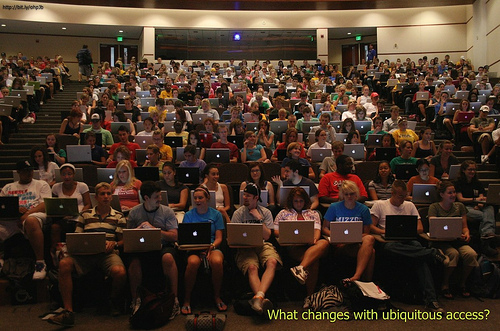
What Changes
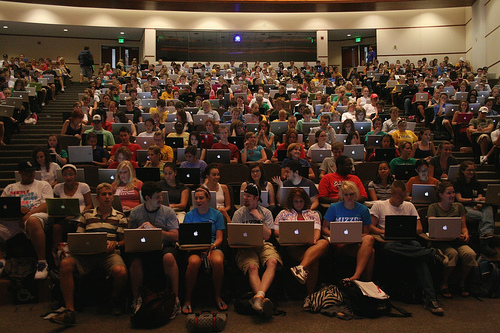
Image retrieved from http://www.flickr.com/photos/wrichard/3743686850/in/set-72157621765265022
Came across this image that really captures what ubiquity of Internet access is starting to bring about. This is image was only modified from its original state by the the addition of the caption

What Changes with Ubiquitous Access?

The original image posted on flicker was used to show just how many Mac computers there were in in a lecture at the Missouri School of Journalism.
Non-Macs

Either image conveys the fact that our learners today are coming into our classrooms prepared to use laptops and I would dare to say all other forms of technology to help them learn– what are we doing to prepare for this.

I really enjoy running across these video productions that pull together all the thoughts and ideas about active and engaging learning that most constructivist tend to agree with. David Truss offers this wonderful example or argument for 21st Century learning.

The video was originally viewed at: http://blip.tv/?file_type=flv;sort=date;date=;id=1262079;s=file