Without a doubt, the ability to connect the dots is rare, prized, and valuable. Connecting dots, solving the problem that hasn’t been solved before, seeing the pattern before it is made obvious, is more essential than ever before.
Godin also asks why then do we spend so much time collecting dots. We overwhelm our learners with so much data, ask them to regurgitate this content in tests, and simply focus on the delivery of content instead of helping our learners make meaningful connections. While Godin has coined the notion of connecting the dots rather than collecting the dots, the idea of developing connections within a conceptual framework was first introduced to me by my colleague Robert McKelvain, Ph.D. at Abilene Christian University in 2010. McKelvain suggested that the difference between an expert and a novice is that an expert has a fully developed conceptual framework.
In the diagram, the main concepts are represented by the larger blue dots and the dotted lines between the concepts represent the connections that the expert has developed as they have expanded their conceptual framework. The expert not only relies upon their full conceptual framework, but they are also able to enter into this framework from many different perspectives. They can see all the pieces and understand all the connections and when dealing with new information they have a much broader base in which to understand and encode that new information—which makes them a more adaptable, efficient, and effective learner and problem solver in their areas of expertise.
In contrast to the expert, the novice may not only have a minimally developed conceptual framework, but they may also even have some of the concepts wrong, miss the connections, and not fully understand all the connections that they do see. If we understand that learning is the making of meaningful connections then the role of the expert teacher is to:
Provide the context for learning which includes introducing the fundamental conceptual framework components.
Create an environment where the learner can start to make meaningful connections between those concepts.
Model the learning process needed to: make those connections, add new concepts, and see the patterns that lead to solving problems.
Mentor the novice in building and expanding their conceptual framework.
In a nutshell, the expert models what it takes to become an expert learner and take ownership in the development of one’s own expertise.
One of the biggest challenges in this process is the expert’s bias, which is the inability of an expert to see the challenges that a novice or beginner faces. This can have significant ramifications in areas where subject matter experts with limited teaching knowledge and experience are tasked with teaching. Subject matter experts have often forgotten more than a novice even knows and unless they are also expert teachers and have developed the conceptual framework of an expert teacher, they can have difficulty understanding the challenges that the novice is experiencing. Therefore, teacher training and professional development will be crucial if we hope to move from the notion of collecting dots to connecting dots.
The whole notion of connecting dots involves analyzing, evaluating, synthesizing, and creating that leads to deeper learning and Learner’s Mindset. Connecting dots is a foundational or fundamental idea that we need to consider when we look at creating significant learning environments. The other key foundational concepts include: Applied Learning, Assessment Of/For/As Learning, Change of Focus, CLSE, COVA,
and the Learner’s Mindset.
It is also essential to consider the role of analyzing, evaluating, synthesizing, and creating that leads to deeper learning which is expanded upon in the post How to Change the World One Learner at a Time
Back in February of 2018 I posted Reading, Watching, & Listening where I finally completed a list of what I am reading, watching, and listening to in response to the questions I get from many of my students, friends, and colleagues about where I find my ideas. I promised to update this list on a regular basis and I am finally getting around to that promise. As part of that promise I am moving the contents of the 2018 blog post to my Reading, Watching, & Listening page which, I will continue to make this a permanent part of the Learning section of my website. I will keep the 2018 blog post up to serve as an archive and to see how my selection of resources has changed over time.
Even though constructivist learning theorists for many decades promoted the benefits of self-directed learning or autodidactism it wasn’t until the COVID crisis of 2020 and the mass forced remote learning that most educators had realized that too many students were not suited or prepared to learn online. Why? Justin Reich (2020) points to research in his book, A Failure to Disrupt: Why Technology Alone Can’t Transform Education, which shows that the learners who are most successful in an online or blended environment that requires self-pacing and personal motivation are those who are already successful in school. These self-directed, self-motivated, and academically prepared learners will succeed in any learning environment because they know how to learn and assess the quality of their own work. The problem that we face is that the vast majority of students are dependent on their teachers to direct their learning and to administer standardized testing. If autodidactic learners are able to learn in any type of environment then we should be asking how do we help our learners become autodidacts and adopt a learner’s mindset. I have explored this notion further in the post, We Need More Autodidacts and the related Learner’s Mindset Discussion.
Our research in the Digital Learning and Leading (DLL) program at Lamar University, our experience in the School of Instructor Education at Vancouver Community college over the past several years, and several decades of related research and experience in a wide variety of learning environments have confirmed that if you create a significant learning environment where you give your learners choice, ownership, and voice through authentic learning opportunities (CSLE+COVA) you can incorporate assessment FOR/AS learning which can help shift a learner toward a learner’s mindset. We have also learned through our experience and research that incorporating feedforward or educative formative assessment will also help to continue that shift toward the learner’s mindset. By giving learners choice over most aspects of their learning experience and through the use of authentic learning opportunities and ePortfolios, our students over the past several years have incorporated many aspects of the assessment as learning perspective which are essential to the learner’s mindset.
Unfortunately, all too often there is a very different learning environment that our students experience in the courses and programs I have developed and instructed than the type of the learning environment that my students are able to create for their learners in their organizations. Finding the right balance between assessment of learning, assessment for learning, and assessment as learning is one more factor that plays a significant role in the learning environment. In much the same way that we have explored and differentiated the role of choice, ownership, and voice through authentic learning opportunities we have to do the same for assessment OF/FOR/AS learning.
Rather than add to the decades of literature on assessment OF/FOR/AS learning I will draw upon the key ideas and summarize the salient points that are most important to contributing to a significant learning environment.
For those who prefer a more typical written definition the New South Wales (Australia) Education Standards Authority (2017) provide a good summary of “assessment for, as, and of learning”
Assessment of learning assists teachers in using evidence of student learning to assess achievement against outcomes and standards. Sometimes referred to as ‘summative assessment’, it usually occurs at defined key points during a teaching work or at the end of a unit, term or semester, and may be used to rank or grade students. The effectiveness of assessment of learning for grading or ranking purposes depends on the validity, reliability, and weighting placed on any one task. Its effectiveness as an opportunity for learning depends on the nature and quality of the feedback.
Assessment for learning involves teachers using evidence about students’ knowledge, understanding, and skills to inform their teaching. Sometimes referred to as ‘formative assessment’, it usually occurs throughout the teaching and learning process to clarify student learning and understanding.
Assessment as learning occurs when students are their own assessors. Students monitor their own learning, ask questions and use a range of strategies to decide what they know and can do, and how to use assessment for new learning.
The following assessment OF/FOR/AS learning table is a compilation of from a wide variety of resources that goes a bit further than simple definitions (Chappuis et al., 2012; Fenwick & Parsons, 2009; McNamee & Chen, 2005; Rowe, 2012; Schraw, 2001; Sparks, 1999):
Assessment
Of Learning
For Learning
As Learning
Type
Summative
Formative
Formative
What
Teachers determine the progress or application of knowledge or skills against a standard.
Teachers and peers check progress and learning to help learners to determine how to improve.
Learner takes responsibility for their own learning and asks questions about their learning and the learning process and explores how to improve.
Who
Teacher
Teacher & Peers
Learner & Peers
How
Formal assessments used to collect evidence of student progress and may be used for achievement grading on grades.
Involves formal and informal assessment activities as part of learning and to inform the planning of future learning.
Learners use formal and informal feedback and self-assessment to help understand the next steps in learning.
When
Periodic report
Ongoing feedback
Continual reflection
Why
Ranking and reporting
Improve learning
Deeper learning and learning how to learn
Emphasis
Scoring, grades, and competition
Feedback, support, and collaboration
Collaboration, reflection, and self-evaluation
If we want to encourage our learners to become more autodidactic it would then seem reasonable to shift from assessment of learning to assessment for learning and ultimately get to assessment as learning. We see this perspective from Lorna Earl (2012) in her highly cited text Assessment as Learning: Using Classroom Assessment to Maximise Student Learning.
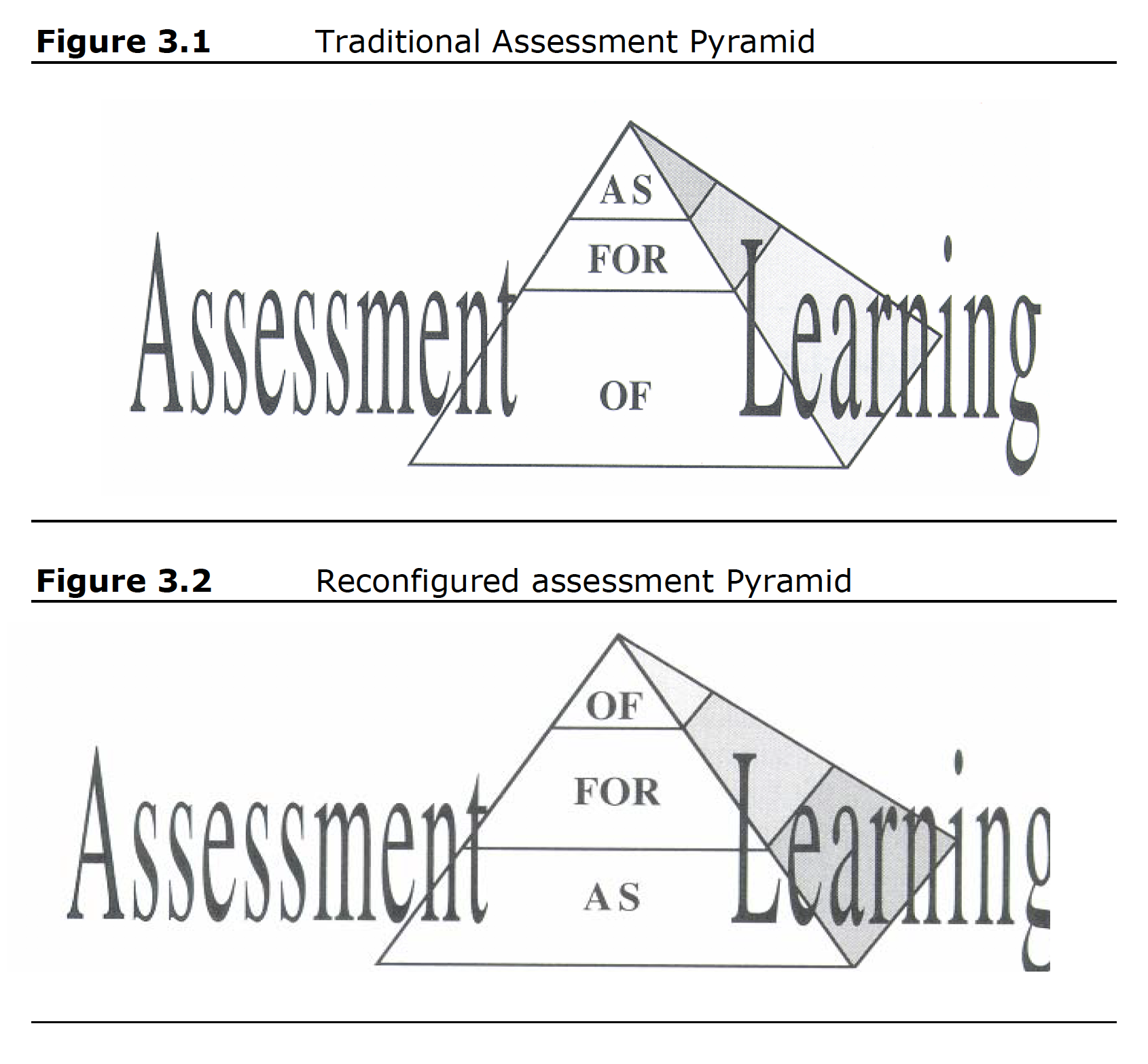
Earl’s assessment pyramids are featured in many different sources and her argument that the traditional assessment of learning is the dominant form of assessment is widely accepted. Even though she calls for a balance in the use of assessment of/for/as learning her revised assessment pyramid that replaces assessment of learning with assessment as learning as the base of the pyramid still doesn’t represent a realistic balance nor an effective way to incorporate assessment into the learning environment.
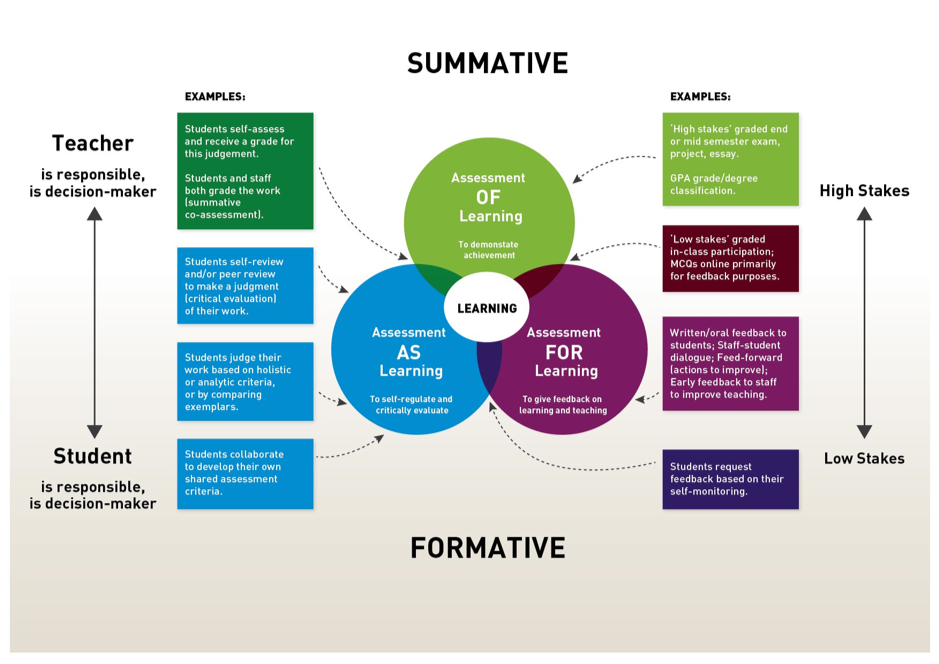
Rather than view assessment of/for/as learning as hierarchical it may be more effective to view assessment of/for/as learning more holistically as more of an interplay of assessment within the learning environment. The National Forum for the Enhancement of Teaching and Learning in Higher Education in Ireland (2017) offers a wonderful perspective on assessment of/for/as learning that emphasizes the interplay of the different types of assessment and the key roles that the assessment and the people involved play.
While some learning theorists may desire to craft a potential learning environment that uses assessment as learning, the reality we face, and that our learners face is not theoretical. We live in a world where we use credentialing exams and other forms of standardized testing and while we have seen a recent move toward implementing formative feedback most educators’ reality reveals that assessment of learning dominates. Moving toward assessment for learning and assessment as learning will only be possible if we look at the bigger picture. We need to help educators to recognize that we are not asking for a full pendulum swing away from assessment of learning to assessment as learning with assessment for learning somewhere in the middle. We are acknowledging that an interplay of all three is not only realistic it will be the most productive approach to improving the learning environment.
We must also acknowledge that our teaching and learning environment are dramatically influenced by the assessments we use. If we consider assessment of/for/as learning as an integral part of the learning environment and we look to fully integrate assessment as part of the learning process then we do our learners justice by helping them to experience a balance in the assessment of/for/as learning. If we model an integrated approach to assessment of/for/as learning then we will be equipping our learners so that they too can integrate assessment of/for/as learning into their own learning environments that they create for their learners.
While this more focused examination of assessment of/for/as learning may provide a novel perspective for some, we have been incorporating the assessment of/for/as learning inter-relationship in the creation of our significant learning environments and when we give learners choice, ownership and voice through authentic learning. This assessment as learning perspective is a practical way to move into what the researcher Mizerow would argue is transformational learning. Mizerow (2000 & 2010) argues that you do not learn things until you tell someone about what you have learned. The transformation to deeper learning happens in the reflective process and the sharing of your learning process with others.
The entire shift toward the learner’s mindset includes the shift toward assessment as learning and you and the following posts and video are a few examples of how we have been supporting and exploring how to help learners become self-directed or autodidactic.
Alberta Education. (2003). Types of classroom Assessment http://www.learnalberta.ca/content/mewa/html/assessment/types.html
Assessment OF/FOR/AS Learning. (2017, March). [National Forum]. The National Forum for the enhancement of teaching and learning in higher education. https://www.teachingandlearning.ie/our-priorities/student-success/assessment-of-for-as-learning/
Chappuis, J., Stiggins, R. J., Chappuis, S., & Arter, J. (2012). Classroom assessment for student learning: Doing it right-using it well. Pearson Upper Saddle River, NJ.
Earl, L. M. (2012). Assessment as learning: Using classroom assessment to maximize student learning. Corwin Press.
Earl, L. M., & Manitoba School Programs Division. (2006). Rethinking classroom assessment with purpose in mind: Assessment for learning, assessment as learning, assessment of learning. Manitoba
Education, Citizenship and Youth. https://www.edu.gov.mb.ca/k12/assess/wncp/index.html
Fenwick, T. J., & Parsons, J. (2009). The art of evaluation: A resource for educators and trainers. Thompson Educational Publishing.
McNamee, G. D., & Chen, J.-Q. (2005). Dissolving the Line between assessment and teaching. Educational Leadership, 63(3), 72–76.
Mezirow, J. (2000). Learning as transformation: Critical perspectives on a theory in progress. Jossey-Bass Publishers. San Francisco, CA.
National Forum for the Enhancement of Teaching and Learning in Higher Education. (2017, March 30). Expanding our Understanding of Assessment and Feedback in Irish Higher Education. Retrieved from https://www.teachingandlearning.ie/publication/expanding-our-understanding-of-assessment-and-feedback-in-irish-higher-education/.
NSW Education Standards Authority. (n.d.). Assessment For, As and of Learning. Retrieved December 7, 2020, from https://educationstandards.nsw.edu.au/wps/portal/nesa/k-10/understanding-the-curriculum/assessment/approaches
Rowe, J. (2012). Assessment as learning—ETEC 510. http://etec.ctlt.ubc.ca/510wiki/Assessment_as_Learning
Schraw, G. (2001). Promoting general metacognitive awareness. In Metacognition in learning and instruction (pp. 3–16). Springer.
Sparks, D. (1999). Assessment without victims: An interview with Rick Stiggins. Journal of Staff Development, 20, 54–56.
Over the past few months, I have been working on the updates to the Masters of Digital Learning and Leading program which in January of 2021 will become the Masters of Applied Digital Learning. I will be creating an explanation page/post to highlight the changes but in this post, I need to address the significance of applied learning. A search of the internet and related literature reveals the need to build a consolidated definition based on the following applied learning definition components:
At the most basic level the literature points to this foundational definition:
Applied learning – a process in which students apply knowledge and skills gained from traditional classroom learning to hands-on and/or real-world
settings, creative projects, or independent or directed research, and in turn apply what is gained from the applied experience to academic learning” (SUNY, 2018, para. 1).
Quite often this basic definition is supplemented with the notion that applied learning is
“is grounded in the conviction that learning is maximized when it is active, engaged, and collaborative” (Ash & Clayton, 2009, p. 25).
Perhaps one of the most overlooked aspects of applied learning is the integration of reflection or more specifically critical reflection which
“is an evidence-based examination of the sources of and gaps in knowledge and practice, with the intent to improve both” (Ash & Clayton, 2009, p. 28).
Critical reflection goes well beyond the notion of navel-gazing but is an integrative, analytical, capacity-building process that must be purposefully designed (Ash & Clayton, 2009; Whitney & Clayton, 2010; Zlotkowski & Clayton, 2005).
The consolidated definition that I will be using in the new Masters of Applied Digital Learning combines all these components:
Applied learning – is an active and collaborative process in which learners apply knowledge and skills gained from theory, hands-on experience, and authentic learning opportunities. What differentiates applied learning from experiential learning, project-based learning and other forms of active learning are the critical reflections on the evidence-based analysis of the sources of and gaps in knowledge and practice. This iterative process stimulates the continual desire for growth and improvement through the implementation of assessment as learning which also enables the learner to reinvigorate their learner’s mindset.
Applied digital learning is therefore the application of applied learning beyond the confines of the traditional classroom and moves learning into the digital environment or all the time and anywhere context that have in the digital information age.
References
Ash, S. L., & Clayton, P. (2009). Documenting learning: The power of critical reflection in applied learning. Journal of Applied Learning in Higher Education, 1(1), 25–48.
The State University of New York. (2018). Common definitions in applied learning. Retrieved from https://www.suny.edu/applied-learning/about/definitions/
Whitney, B., & Clayton, P. (2010). Research on the role of reflection in international service-learning. In R. Bringle, J. Hatcher, & S. Jones (Eds.), International service learning: Conceptual frameworks and research. Sterling, VA: Stylus Publishing.
Zlotkowski, E., & Clayton, P. (2005, April). Reclaiming reflection. Paper presented at the meeting of the Gulf South Summit on Service-Learning and Civic Engagement, Cocoa Beach, FL.
A recent question by one of my graduate students reveals that while the name or phrase may change or fall out of favor, but if the idea is good it will persist in a slightly different format.
In an online class meeting, I cautioned my graduate students on using the phrase “disruption” or “disruptive innovation” in their innovation proposals because disruption has a tendency to convey a negative connotation in an educational setting. Teachers don’t like disruptions to their classes.
The following question and response (which I do have permission to share) reveal the challenge of conveying meanings especially when some names or labels have the potential to be misunderstood.
Question
I do have a question about using the word “disruption”. As that is the name of this course, I understood it to be one of the qualifiers of our proposal. As a student, I now understand that disruption is not negative. Could it be part of my charge to change that rhetoric? Is there something more fundamentally wrong with the theory of disruption? Why did we read Clayton Christensen’s article in week one, if it is a term we should avoid? Do you agree with Christensen?
My Response
You do ask a really good question about disruptive innovation. If I recall my memory correctly Christensen coined the term disruptive technologies back in an article in 1996 and then he later referred to this as disruptive innovation in his 1997 book Innovator’s Dilemma. Many people now refer to Christensen’s ideas on how technology can disrupt the change process as the theory of disruptive innovation which I would argue is still quite well supported, but like any theory, there are supporters and detractors. I am on the supporter side, but I am also aware of the limitations. In a much earlier (2009-2010) version of this disruptive innovation course which was called a different name in a different institution, I had my students read Christensen’s book Disrupting Class: How Disruptive Innovation Will Change the Way the World. Back in late 1990, I would have my students read the Innovator’s Dilemma, so I have been a longtime supporter of Christensen’s ideas. While I may have shifted the way I talk about disruptive innovation and more importantly ask my students to talk about disruptive innovation, I still believe we need to be aware of how it works and take advantage of the opportunities it offers.
The change in language is just a matter of applying the old adage/proverb…you can catch more flies with honey than with vinegar. People don’t want to be disrupted and it can often scare people, especially those who want to be safe. Over the past 10 years, we have seen a shift in our campuses toward the use of “safe spaces” and “trigger warnings” and in 2015 when Lukianoff and Haidt argued in the Atlantic article The Coddling of the American Mind that overprotection is having a negative effect on university students I knew I needed to shift the language a bit in the course where I used the notion of disruptive innovation. I have been trying to bring about change in learning environments since the late 80’s so I have learned many valuable lessons. I learned that you have to take a very broad approach and consider many different factors and while the facts or data may be right many people are still afraid of the data and some just like things the way they are…they don’t want to be disrupted. In the post People who like this stuff…like this stuff I point to 4 key factors that you need to address to bring about change in the learning environment. I will be asking my student to apply these ideas in an upcoming course on organizational change.
To summarize, the adage you can catch more flies with honey than with vinegar is very true, especially in an educational setting. Be careful how you use the term disruptions but still use the ideas. Remember we want to improve or change the world one learner at a time.
It took me a while to realize I could speed up this process if I didn’t scare my learners first.