[ted id=2679]
Unfortunately, technology like the Citation Machine or other citation generation tools aren’t going to help you with the proper APA formatting of your citations and references unless you understand the fundamental APA rules and are able to use the official APA Publication Manual or at minimum use the Purdue OWL site to check and confirm the accuracy of what these tools generate. Yes, this is a bit of a paradox because these tools are intended to help you save time in citing your references. But if you don’t understand the basic rules or are not willing to spend some time to confirm that what these tools generate then you will run the risk of having significant errors. I also found that they can take more time to use then if you manually formatted the reference.
Lets consider the following reference example from the son of citation machine:
Livingston, J. A. (1997). Metacognition: An Overview. Retrieved from http://gse.buffalo.edu/fas/shuell/cep564/Metacog.htm
While this is very close to being correct it isn’t because the title is not formatted properly. The correct format according to APA is “Metacognition: An overview” – the letter “O” should not be capitalized. Small error but still an error.
Follow along the process of using one of these citation tools. There are a wide variety of citation tools that can help you generate this reference but I will deal with one of the more popular tools – Citation machine or Son of Citation Machine
When I go to the Citation Machine site I input the URL for this reference and this is what I get:
Metacognition: An Overview
http://gse.buffalo.edu/fas/shuell/cep564/Metacog.htm
The site prompted me to additional information like the author and dates and then it generated:
Livingston, J. A. (1997). Metacognition: An Overview. Retrieved November 30, 2016, from http://gse.buffalo.edu/fas/shuell/cep564/Metacog.htm
Unfortunately, the title format is wrong. Only the first word in the title should be capitalized. The second word “A” after the colon is also capitalized but the word “Overview” should not be capitalized.
Manually formatted based on the Purdue OWL site – https://owl.english.purdue.edu/owl/resource/560/10/
I used the Non-periodical Web Document or Report section since this is isn’t a blog post which recommended this format:
Author, A. A., & Author, B. B. (Date of publication). Title of document. Retrieved from http://Web address
Lets consider another example – a Youtube video:
Not Suited for School But Suited For Learning – https://youtu.be/clv2yr_UhDU
After setting the APA setting and selecting the Film tab the citation machine then asks me to fill in the following details:
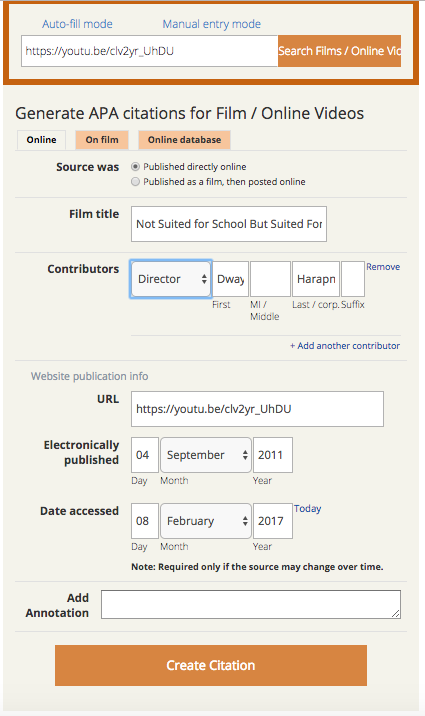
The first time I ran the citation machine I left it on Producer as the default and it generated a partial reference.
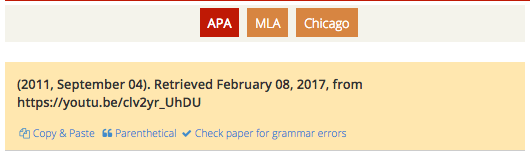
I had to go back and fill in all the details again and select Writer in order for it to generate a complete reference.
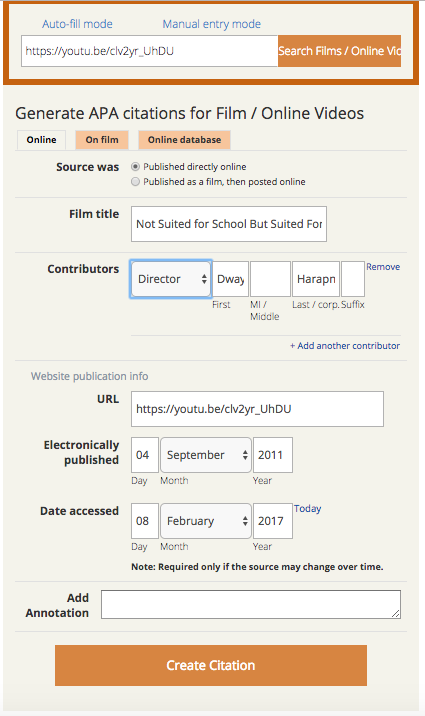
Once I had the right role selected the citation machine generated:
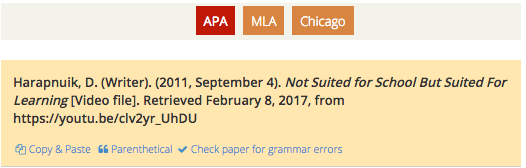
But this is still wrong. APA doesn’t require a role designation so you don’t need (Writer) in the reference and more significantly only the first letter in the title should be capitalized.
The correct reference is:
Harapnuik, D. (2011, September 4). Not suited for school but suited for learning [Video file]. Retrieved from https://youtu.be/clv2yr_UhDU
The problem with these types of tools is that they require you to fill in the blanks and if you just copy and past the title in from the Youtube page chances are the title capitalization required by APA won’t be met. Having to go back and forth as many times as I did to get a more accurate reference was also not very efficient. The formatting instructions on the Reference List: Electronic Sources (Web Publications) page of the Purdue OWL site points to an example that is easy enough to follow:
J Dean. (2008, May 7). When the self emerges: Is that me in the mirror? [Web log comment]. Retrieved from http://www.spring.org.uk/the1sttransport
Just need to remember to replace the Web log comment with Youtube and you will be good to go.
As much as I would like to hope these citation tools are useful they really aren’t and you still need to go to the APA Publication Manual, Purdue OWL site, or other style guide to check and see if the reference is actually correct – so why not just save yourself the time and start with the style guides.
If you really want to save some time on creating your Reference list for a larger literature review then I recommend that you bite the bullet and purchase the APA Style Guide and also use Zotero to house your references. The key to using Zotero effectively is to input the date into Zotero correctly and check it according to the APA style-guide. There are some quick tricks to getting content into Zotero that I will deal with in another post–but even with these tricks you still need to manually check the reference to make sure it adheres to APA formatting.
While I do recommend using the Purdue OWL site it really only covers the fundamentals and if you need to really dig down into the details of figuring out when to use the et al. or other unique APA features then you really do need to refer to the official APA Publication Manual.

In the Influencer: New Science of Leading change, Joseph Grenny (2013) and his colleagues point to the example of how the eradication of the Guinea worm was accomplished through three vital behaviors and the supporting six sources of influence. The Guinea worm is a parasite that infected 3 million people in 23,000 remote villages in 20 countries. The Guinea worm was spread through the water supply for all these villagers. Once the Guinea larva was ingested a Guinea worm would hatch out of the larva and start to work its way out of the host’s body in whatever way it chose. This caused immense pain that was temporarily lessened when the infected person immersed themselves in water. The worm would then inject thousands of eggs into the water perpetuating a cycle that had lasted for thousands of years.
The goal of Dr. Hopkins from the Carter center was to stop the spread of the Guinea worm and ultimately eradicate the this blight on humanity. For the sake of using this example in EDLD 5304 this goal would be referred to as the result.
Three vital behaviors were identified that would prove to lead to the near eradication of the disease:
- People were required to filter their water.
- An infected person must not make contact with the public water supply.
- If a villager is not filtering water or becomes infected the villagers must confront them.
The Introductory section of Part 2 of the the book (pages 67-75 in the paperback version) offers a wonderful summary of the whole Guinea worm scenario and also provides a detailed explanation on how the six sources of influence came into play in helping to change behavior that ultimately lead the eradication of the Guinea worm.
This is a very helpful example to use in assessing your Guinea worm (your situation) and identifying:
- Results you want to achieve and how you will measure them.
- Vital behavior(s) you are trying to change.
- Who are you organizational influencers.
Using this section of the book and the six sources of influence matrix from the 10x Your Influence Research Report should put you on the right path to building your own influencer strategy. So what’s your Guinea worm and what are you going to do about it?
View the status of the eradication of the Guinea Worm – https://www.cartercenter.org/health/guinea_worm/case-totals.html
Reference
Grenny, J., Patterson, K., Maxfield, D., McMillan, R., & Switzler, A. (2013). Influencer: The new science of leading change (2nd ed.). New York, NY: McGraw Hill Professional.


