Archives For COVA

I have always been a reader. In grade school I read hundreds of books on every imaginable subject. I grew up in a rural setting and as a young boy I the read through the World Book Encyclopedia and then used the school library and any other repositories of book as resources to solve many practical day to day problems I faced living on a farm in Northern Alberta. These books became a lifeline to a much bigger and brighter world that I was also inspired to explore. I didn’t know it then, but these books also started me down the path of authentic learning which I define as making meaningful connections with new ideas and using that new knowledge to shape and change my attitudes, skills, and behaviors.

So, anything that would help me to learn was extremely valuable. This was many decades before the birth of the Internet so books magazines, films, records, recordings, stories and insights from experienced people and almost anything that contained or was able to share information contributed to my learning. Unfortunately, this cognitivist focused learning I found so natural was not a priority in any of the behaviourist focused schools that I attended as a child and teen in the 1960s and 1970s. I am not alone in viewing learning as an amazing and natural part of the human experience and have always been frustrated with the fact that learning happens so naturally everywhere but in schools (Thomas & Brown, 2011). Fortunately, I didn’t listen to all those teachers and administrators who said I wasn’t “suited” for school. I had always known that there was much more to learning than just being able to repeat meaningless facts and figures on quizzes and tests.

While I wasn’t “suited” for school, I was suited for learning, and as a result, I focused on learning how to learn more effectively (Harapnuik, 2011). Furthermore, my use of technology to create things, to solve problems, and to enhance my learning was something that I also was prevented from using in school. Therefore, most of my experiences in a wide assortment of educational systems and at all levels confirmed that for the most part the 20th century model of information delivery followed by confirmation via some form of summative assessment was really the priority of school.

As an adult in higher education, I also had to deal with the troubling reality that my passion for learning, which I now refer to as the making of meaningful connections, or connecting the dots, was not as important to my teachers as the processes of schooling, which I also refer to as collecting and regurgitating the dots (Harapnuik, 2015a).

While collecting and regurgitating the dots, or the information delivery model of instruction, is well suited to the industrial age, it is not so well suited for the information age. Unfortunately, throughout my entire childhood educational career and up to the present time, I have been forced to deal with teachers, educators, and many colleagues who still operate in the industrial age of information delivery. Because these people are so trapped by the existing systems of schooling and the behaviourist methods that still dominate our assessment strategies, they mistakenly believe that they can simply take technology and strap it onto existing modes of delivery. As we have learned from Papert (1993), this is no more effective than strapping a jet engine onto a horse cart.

This response by traditional educators is unfortunate because technology has profoundly changed the world in which we live. That change has the potential to improve education in the way in which our students use digital resources to acquire and apply knowledge and more importantly, create new knowledge, skills, attitudes, and behaviors. Despite the availability of these digital tools and resources, most educators continue to struggle to effectively implement them. There are small number of teachers who are early adopters of technology who are making a difference and who are using technology to enhance the learning environment. They are willing to give the learner choice, ownership and voice through authentic learning opportunities. These people are using technology to help create the significant learning environments that promotes growth and enable learners to address what is one of the most important fundamental questions we need to continually ask – what are you learning today? This question leads to the next most important question – What do you want to learn next? And this is the topic for future posts….

References

Harapnuik, D. (2011, September 4). Not suited for school but suited for learning
[Youtube]. Retrieved from https://youtu.be/clv2yr_UhDU

Harapnuik, D. (2015, August 15). Connecting the dots vs collecting the dots. [Video file]. Retrieved from https://youtu.be/85XpexQy68g

Papert, S. (1993). The children’s machine: Rethinking school in the age of the computer. New York, NY: Basic books.

Thomas, D., & Brown, J. S. (2011). A new culture of learning: Cultivating the
imagination for a world of constant change. Lexington, KY: CreateSpace.

My boys are competitive Down Hill Mountain bike racers and they recently raced in several events at Whistler Crankworx. This meant that they had several practices, qualifiers, and final races that ran very close together and had to incorporate protein and energy bars into their nutritional plans to get them through their hectic schedule over the week of racing. High quality protein and complex carbohydrates packed into a portable bar are not just a convenience for my sons, they are a necessity if they wish to stay fully fuelled and competitive. Slipping a couple of these small energy packed bars into a jersey or shorts pocket means my boys can quickly and easily maintain their nutritional needs for the hectic training and/or racing session.

A quality protein and energy bar has little or no sugar, uses natural ingredients, and has a balance of protein and complex carbohydrate to help an athlete maintain their energy when they are unable to access whole foods. Bars that are nutritionally high quality often don’t taste the greatest because the manufacturers stay true to the purpose of helping to fuel a competitive athlete. Unfortunately, as protein and energy bars get more and more popular quality bars are getting harder and harder to find because too many manufacturers are willing to move away from the fundamental purpose of the bars and focus primarily on the taste of the bars at the expense of the nutritional quality.

When you focus on the taste and not the nutritional needs of an athlete you end up with something that sounds like it would be a good thing, but when you look at the details you find it’s not the case. The list of ingredients on the following popular protein and energy bar reveals that taste and not nutrition is their priority:
Power Bar Ingredients

Evaporated cane juice syrup and corn maltodextrin are the first and third listed ingredients which also indicates their quantities. While neither of these ingredients are listed as sugar they are essentially the same as sugar hiding behind a more natural name. The more diligent athlete who is aware of the sugar synonyms won’t be tricked by the manufacturer and will look for a better bar, but for the average person who isn’t as informed this fake protein and energy bar is really not much better then a typical candy bar. At least in the candy bar the manufacturers don’t try to hide the actual ingredients behind more natural sounding names:
chocolate bar ingrediants

What makes this really serious is that the majority of protein and energy bars are really not much better or different then candy bars when you look at the first three ingredients:

Protein bar – Evaporated cane juice syrup oat bran, corn maltodextrin and soy protein isolate
Candy bar – Sugar, peanuts, and corn syrup

Yes the protein bar does have a few better ingredients, it does have soy isolate protein powder, but for the most part it is just a candy bar with added protein. This is very alarming and in the display pictured below there are a couple of dozen different types of bars and there were only two that were actually healthy enough to be used by a competitive athlete:
Protein Bars on Shelf

How does such a good idea, a portable highly nutritious bar that a competitive athlete can use to stay energized, go from good to bad. Simply shift the primary purpose from a portable highly nutritious bar used by competitive athletes for fuel to a good tasting convenience snack used by anyone. Most competitive athletes are willing to deal with the lack of flavour and even a chalky texture in their bars because they know that it isn’t about the taste it is about the fuel that they need to stay competitive.

This shift in purpose from fuel to taste has as a dramatic effect on an individuals results as a shift from a focus on learning to technology has on the learner.

We can run into a similar problem in education when we shift our focus from the learning to the technology. In his post How to Fake a 21st Century Classroom Terry Heick satirically posits how to:

“fake 21st century thinking and learning environment to make the right kind of impression with the right people, and give the appearance of forward-thinking.”

Useful ideas like Project-Based learning, 1 to 1, and blended learning can all too easily loose their benefit when we shift the focus from learning and just do projects, just focus on the devices, and just focus on the content delivery part of the blended learning. Heick points to ten good learning ideas that can easily go bad for the learner if we shift our focus from the learning to the technology or to what appears to be a trendy 21st Century activity. His post How to Fake a 21st Century Classroom Terry Heick is worth the read but I must caution you that you may be bothered or convicted by a few convenient or fake activities that you may have fallen into. I know I am taking a hard look at several of my activities as a result of reading his post.

As educators, our responsibility is to know better, to know that you can’t fake Project-Based learning by doing make work or fake projects. You have to give the learner the control, ownership and voice over an authentic project that will make some sort of difference in the learner’s personal life or community. You can’t just fake 1 to 1 by making students do digital worksheets on their iPads. You have to give the learner the opportunity to use their devices for creation, collaboration and communication and enable them to learn all the time and everywhere with everyone. You can’t just fake blended learning by focusing on the content. The emphasis on creation, collaboration and communication in your blended learning environment will also enable your learners to go much deeper then they would if you were to focus on the delivery of content.

As educators we should know better but just like the average person who is swayed by the appearance, convenience and taste of the fake protein bars we too often can be swayed by wanting to give the right kind of impression and the appearance of forward-thinking.

We can also be swayed by the fact that we may be faking it until we make it; meaning that we may move toward our learning goals by implementing changes incrementally and may use that worksheet on the iPad as a transition activity until we can focus on more genuine activities. This is understandable and as long as the transition happens this will be fine. But just like the fake protein bars that will work when you don’t have anything else available, temporary or transition use of technology can also work, but also like the fake protein bars long term use would not be heathy for the athlete or the learner.

It is widely accepted that eportfolios can help learners “deepen the inquiry process” by enabling them to integrate metacognition or reflection into their learning experience (Catalyst for Learning, n.d.). Eportfolios have the potential to be inviting, reflective, and engaging learning tools that stimulate deeper learning and offer many other benefits and as a result many higher education institutions promote their creation and use. Unfortunately, many educators who have been exploring the use of eportfolios over the past several decades have noticed that despite their wonderful potential as life long learning tools many students stop using their eportfolio after the completion of their program of study.

Researchers, Cynthia Cummings, Thilisa Thibodeaux and Dwayne Harapnuik recognized the need to find out which factors contribute to the continued use, or lack thereof, of the eportfolio. More specifically, these researchers have started a study to identify the factors that contribute to the continued or dis-continued use of eportfolios beyond the student’s program of study. The literature review revealed that choice, ownership, voice and authenticity (COVA) are key factors in encouraging students to go much deeper into learning so Cummings, Thibodeaux and Harapnuik sought to confirm if these factors would also influence the continued or dis-contined use of the eportfolio (Buchem, et el., 2014; Campbell, 2009; Lindgren & McDaniel, 2012; Pink, 2011; Qauglia, (n.d.); Rikard, 2015; Waters, 2015).

The initial results of the study were presented at the AAEEBL Western Regional Conference at Texas Christian University (TCU) in Fort Worth, TX in February, 2016. The study utilized a convergent mixed methods research design and the participants of this study included students from the Educational Technology Leadership master’s program at Lamar University who developed eportfolios as part of their program requirement. The 526 survey participants where first asked if they continued or dis-continued using their eportfolio beyond their program of study and then were asked to a likert scale to rate a list of twenty factors to identify to what extent those factor contributed to their continued or dis-continued use of the eportfolio.

Participants were given three opportunities to complete the online survey over a period of three weeks and 141 participants responded giving the survey just over a 26% response rate.
Using or not using eportfolio numbers

The survey revealed that only 18% of the participants continued to use their eportfolios while 82% stopped using their eportfolios after the completion of their program of study. These results confirmed earlier anecdotal evidence that many students stop using their eportfolios when not required to do so for a course.

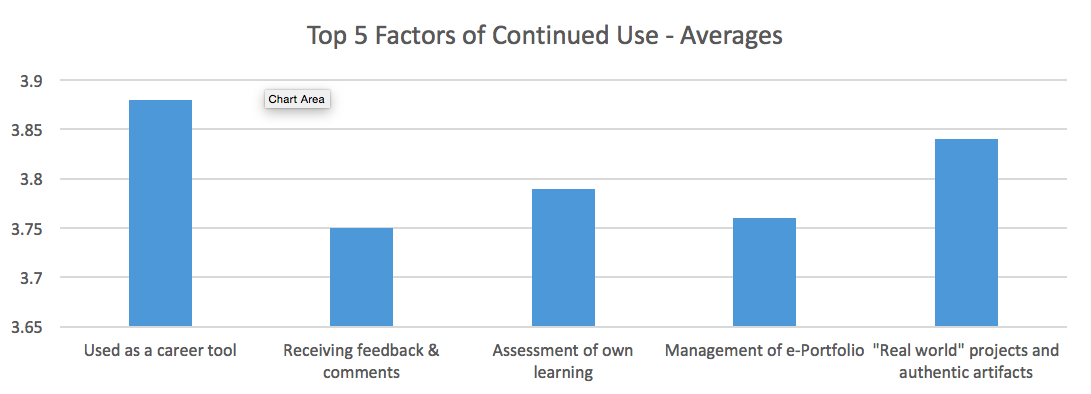
The survey also revealed that use of the eportfolio as a career tool, the use of authentic projects, control over assessment of their learning and the management of the eportfolio were the most significant factors that contributed to the continued use of the eportfolio.
Continued use of eportfolio

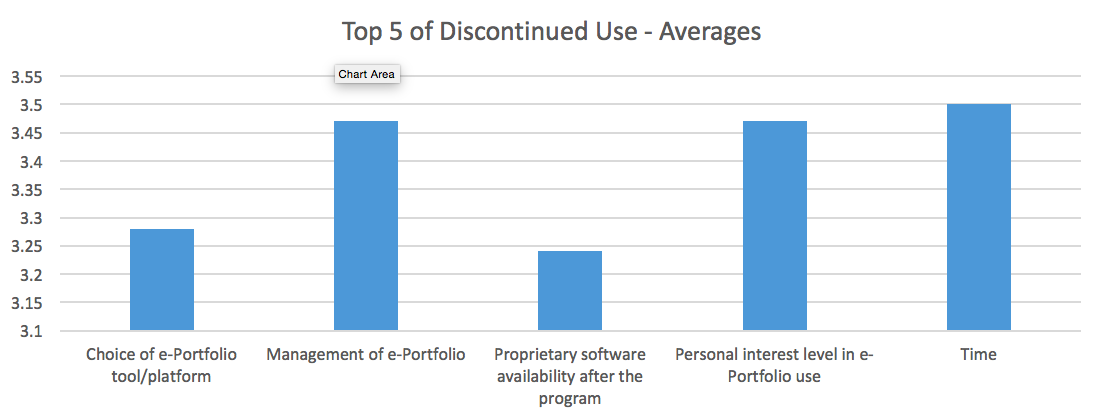
The primary factors for why students stopped using an eportfolio was the lack of time followed very closely by a lack of interest in eportfolios and lack of management over the eportfolio process.
Discontinued use of eportfolio

Several follow up focus groups were conducted to gain additional insight into the continued or dis-continued use of the eportfolio and see if any additional factors not listed in the survey had impact the students continued or dis-continued use. One focus group participant in the research project confirmed why time is such a significant factor by stating:
“All your time is spent just keeping your head above water; there is no time to think about the benefits of an eportfolio or how to build and structure your eportfolio for use for anything more than document storage”.

For many of the students in the new Masters of Digital Learning and Leading program (DLL) at Lamar University coming out of the first course in the program EDLD 5302 Concepts of Educational Technology this frustration with a lack of time is also a reality. We have often seen students struggle with just learning how to learn to use new technology and concepts so getting the weekly assignments completed and simply dropping an evidence of learning into their eportfolio container is often the most students have been able to accomplish with limited time.

Our initial research findings and original assumptions suggest that if we gave our DLL students enough time and the appropriate environment to experiment with their eportfolio then we should see continued use of the eportfolio. Since the DLL program is new we won’t have our first graduates for the next 18 months, we have some time to wait to officially confirm our assumptions.

The eportfolio is a fundamental component of the DLL program and each course has been designed to utilize authentic projects and the eportfolio to showcase student’s work. EDLD 5303 Applying Educational Technology: Eportfolio is the second course in the DLL which is structured specifically to give students the time to focus completely on and experiment with the eportfolio. The evidence of learning accumulated in EDLD 5302 or through Microsoft Teaching with Technology, Google Educator, or the Apple Distinguished Educator programs can now be shaped and moulded into a well organized and cohesive format to genuinely convey a message beyond basic technology skills competence. In EDLD 5303 students are given the opportunity to move beyond dropping assignments into a digital container and are encouraged to start to consider and show how they plan to use technology to enhance their own learning and their learning environments.

To help shape student’s thinking on eportfolios and to start them on the journey of continuous reflection and revision of their work in EDLD 5303 we ask students to explore the following:

Though this process of working through these ideas in their own eportfolios students will gain an appreciation for the value of the eportfolio as a deeper learning tool.

Next to a lack of time the lack of an appreciation of the value of the eportfolio was another major contributing factor for students who stopped using eportfolios beyond the course of study. Through the use of authentic assessment in all DLL courses and the ability to work on projects that will have a direct impact in the students own learning environment the DLL program gives students choice, ownership, voice and authenticity (COVA) that our research findings have initially confirmed are the key factors in encouraging students to continue using their eportfolios beyond their programs of study.

We are confident that this eportfolio experience started in EDLD 5303 and continued throughout all other DLL courses will provide a solid learning foundation for the DLL M.Ed and for the continued use of the eportfolio beyond this program. If you really want to students to learn deeply and build a foundation for learning how to learn then you need to give students:

  • The freedom to choose how they wish to organize, structure and present their experiences and evidences of learning
  • Ownership over the entire eportfolio process – including selection of projects and their portfolio tools
  • The opportunity to use their own voice to revise and restructure their work and ideas.
  • The opportunity to prepare their eportfolio platform for all the authentic learning assignments that they will experience in the remainder of the DLL program.

We are also confident that the DLL program will prepare students for the challenges of the future and shape them into the digital leaders that we need to move our educational systems forward.

Our research into this area is really just beginning while we are continuing to examine the data and will be publishing the full results shortly, we are also exploring relationships with other institutions who have used eportfolios in their programs to replicate our research in different settings to further confirm our findings.

References

Buchem, I., Tur, G., Hoelterhof, T., Rahimi, E., van den Berg, J., Veen, W., … & Aresta, M. (2014). Learner control in Personal Learning Environments: A cross-cultural study. Learning and Diversity in the Cities of the Future, 13.

Campbell, G. (2009). A Personal Cyberinfrastructure. EDUCAUSE Review, 44(5), 58–59.

Catalyst for Learning Eportfolio Resources and Research (n.d.). Pedagogy. Retrieved from http://c2l.mcnrc.org/pedagogy/

Lindgren, R., & McDaniel, R. (2012). Transforming Online Learning through Narrative and Student Agency. Educational Technology & Society, 15 (4), 344–355.

Pink, D. H. (2011). Drive: The surprising truth about what motivates us. Penguin.
Chicago

Qauglia, R. (n.d.). Quaglia Institute Framework. Retrieved September 8, 2015, from http://www.qisa.org/framework/

Rikard, A. (2015). Do I Own My Domain If You Grade It? (EdSurge News). Retrieved September 8, 2015, from https://www.edsurge.com/news/2015-08-10-do-i-own-my-domain-if-you-grade-it

Watters, A. (2015, July 15). The Web We Need to Give Students. Retrieved September 10, 2015, from https://medium.com/bright/the-web-we-need-to-give-students-311d97713713

These past several weeks my two boys, Levi and Caleb, have spent most of their days riding Silver Star and Whistler Bike Park, Whistler Aerodome and other DownHill and DirtJump locations in British Columbia. This type of riding is not only extremely hard on the human body (i.e. Levi’s concussion and recent shoulder injury and Caleb’s ongoing aching hands, too many bruises, scrapes and scratches to mentions) it may even be harder on the bikes. As result there is extensive daily maintenance and the all too often broken component that needs to be replaced as a result of bad hit, wipe out our simply the harsh terrain.

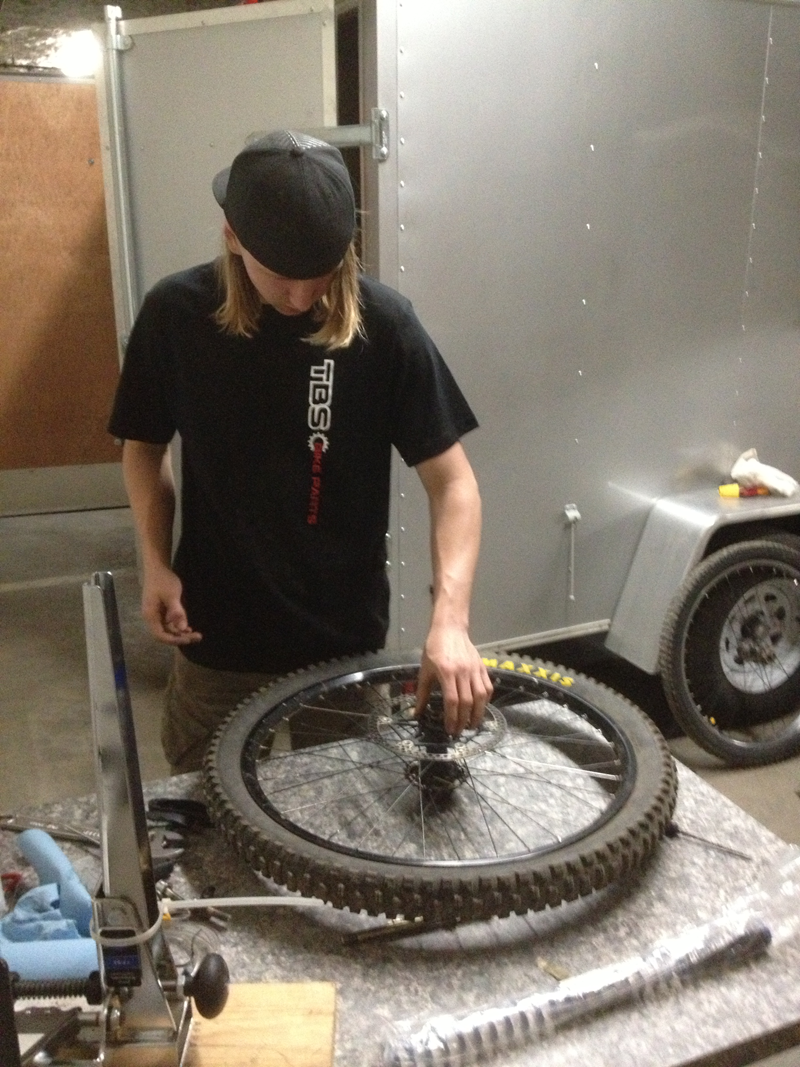
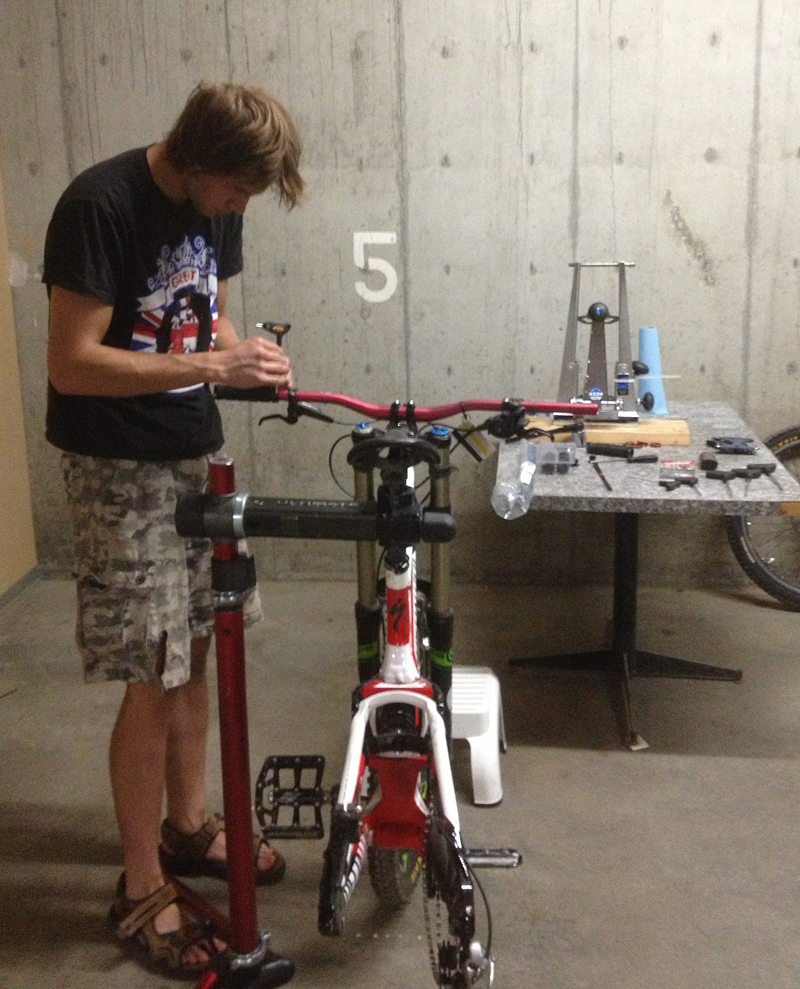
Up until this summer I had been supervising and directing this daily maintenance. Taking on a new position at BCIT means that I am not going to be able to ride with my boys on a daily basis and help them with their bike maintenance and repairs. That is why a recent Saturday morning at Silver Star confirmed that the gift of intrinsic motivation that I have been giving my boys for several years has not only finally been fully received, it has blossomed into the wonderful sight displayed in these pictures.

caleb wheelrepair

Cluster Removal

levi bikerepair

Lockon Grip Fastening

Two typical teenage boys (17 and 15) are not only cleaning, lubing and adjusting their high end DH bikes, they are spending sometimes up to 2-3 hours a day doing full repairs and preventative maintenance which ranges from replacing spokes, truing and tensioning wheels to changing fork oil, brake bleeds, replacing suspension bearings and every other aspect of maintaining and repairing their very expensive bikes. Most importantly they are doing it on their own without having to be told or directed. The gift of intrinsic motivation has finally been received.

While the title and initial focus of this blog post suggests that you can give someone intrinsic motivation I must concede the fact that you cannot give anyone intrinsic motivation. This type of motivation comes from within. You can however create the environment and influence the circumstances in which intrinsic motivation will not only emerge but will grow into a driving force.

I believe that we can help foster the growth and establishment of intrinsic motivation if we consider and foster the following five key contributing factors.

Modelling
James Dobson has repeatedly stated that “Values are not taught to our children; they are caught by them.” I suggest that intrinsic motivation is similar to values in that is not taught to our children but has to be caught by them. Ever since my boys first started riding their bikes they have also learned how to repair and maintain them–it is just something that I/we have always done. In addition to maintaining bikes I maintain our vehicles, our home and just about anything that we own. The years of rotating tires, changing oil, fixing the dishwasher, renovating and updating our homes and everything else that the boys were involved in helping their mom and dad do on a daily basis contributed to showing the boys how they could “catch” the intrinsic motivation required to work through the mundane tasks that are part of everyday life.

Expectations
Effective modelling will also convey or demonstrate what expectations, standards and criteria need to be met. Knowing what is expected and fulfilling those expectations is extremely important for children and teenagers because it will help them to develop responsibility and accountability. As adults our work is judged and often connected to our income so developing the ability to meet or exceed expectations for our children is not only very important, their future careers may also depend on this ability.

One of the biggest challenges with expectations is being realistic. The performance standard for an 10-12 year old child will not be the same as a 15-17 year old teenager or an adult. The desired end quality should not be compromised but the path to getting to that quality will depend on the age and skill level of your children so be patient. Unrealistic expectations are the source of too many disappointed fathers and children so remember when your 12 year old son or daughter is striving to meet their father’s expectations remember that they are just a 12 year old boy or girl. Similarly there is a point when challenging your 17 year old son or daughter to step up and perform as adult is crucial to their development.

Trust
The key to trust is letting go and letting your children do the task, make their own mistakes and learn from the situation. All too often we want to swoop in and direct and correct and interfere with the learning process. Or worse we think that it would be more time effective and less stressful to do the task ourselves or worse still outsource the job. When we trust our children to make breakfast, repair the doorknob, fix the flat tire or, in the case of my boys, build their own bikes from scratch we are telling them that we believe in them and that we value their effort and contribution. A father’s and mother’s trust is a major contributor to your child’s identity and to their intrinsic motivation. Knowing that someone else trusts and believes in them helps them to trust and believe in themselves. This instills confidence which is a fundamental contributor to personal motivation.

Ownership
Little boys and girls want to be like their mom and dad and have their own tool belts, hammers, appliances, bikes, cars and so many other things. This is one principle that I wish I would have fully grasped and understood sooner. When Caleb and Levi searched out and selected all the necessary components and built their own DH bikes up from a raw frame it really changed the way they approached maintaining their equipment. They now have a vested interest. They understand the work involved in putting the bike together and what it would take to replace or repair those components. More importantly, my boys now not only want to maintain their bikes they do so on their own and even appreciate preventative maintenance because they know the work that went into building up their bikes.

Consequences
Broken spokes are like deer; if you see one you inevitably will see another. A bad landing, a rock or root can cause a broken spoke and cut into prime riding time. Unfortunately, a poorly tensioned wheel will be more susceptible to damage than a well maintained wheel. There is often nothing better than natural consequences to motivate a young man to take the extra time necessary to properly tension his wheels to limit the downtime that can ruin an otherwise wonderful riding day. The idiom “an ounce of prevention is worth a pound of cure” is never fully appreciated until one is personally responsible for implementing that pound of cure. Letting your children suffer the consequences (as long as they aren’t life threatening) will be much more valuable to them in the long run than your intervening.

The lesson learned in the garage and on the mountain slopes, bike parks and dirt jump parks of BC have played a significant role in my sons’ acceptance of the gift of intrinsic motivation. As an intentional father it is my responsibility to create an environment at home, on the road and anywhere we are at where the above listed contributing factors will help my boys to grow into responsible men. Helping them with the gift of intrinsic motivation is just one part of this ongoing process.

Related Intentional Father Posts:

Becoming an Intentional Father
Catching the Openness to Change