Bryan Alexander interviews Educational thought leader Will Richardson who suggests that not much has changed in our classrooms over the decade and he doesn’t see much change on the horizon. Furthermore, Will suggest that learning happens when our students leave the building. This is a criticism of our teachers but an indictment of our educational system.
The next time you complain about how difficult things are consider the following:

Source: kopywritingkourse.com/writers-block/

It is widely accepted that eportfolios can help learners “deepen the inquiry process” by enabling them to integrate metacognition or reflection into their learning experience (Catalyst for Learning, n.d.). Eportfolios have the potential to be inviting, reflective, and engaging learning tools that stimulate deeper learning and offer many other benefits and as a result many higher education institutions promote their creation and use. Unfortunately, many educators who have been exploring the use of eportfolios over the past several decades have noticed that despite their wonderful potential as life long learning tools many students stop using their eportfolio after the completion of their program of study.
Researchers, Cynthia Cummings, Thilisa Thibodeaux and Dwayne Harapnuik recognized the need to find out which factors contribute to the continued use, or lack thereof, of the eportfolio. More specifically, these researchers have started a study to identify the factors that contribute to the continued or dis-continued use of eportfolios beyond the student’s program of study. The literature review revealed that choice, ownership, voice and authenticity (COVA) are key factors in encouraging students to go much deeper into learning so Cummings, Thibodeaux and Harapnuik sought to confirm if these factors would also influence the continued or dis-contined use of the eportfolio (Buchem, et el., 2014; Campbell, 2009; Lindgren & McDaniel, 2012; Pink, 2011; Qauglia, (n.d.); Rikard, 2015; Waters, 2015).
The initial results of the study were presented at the AAEEBL Western Regional Conference at Texas Christian University (TCU) in Fort Worth, TX in February, 2016. The study utilized a convergent mixed methods research design and the participants of this study included students from the Educational Technology Leadership master’s program at Lamar University who developed eportfolios as part of their program requirement. The 526 survey participants where first asked if they continued or dis-continued using their eportfolio beyond their program of study and then were asked to a likert scale to rate a list of twenty factors to identify to what extent those factor contributed to their continued or dis-continued use of the eportfolio.
Participants were given three opportunities to complete the online survey over a period of three weeks and 141 participants responded giving the survey just over a 26% response rate.
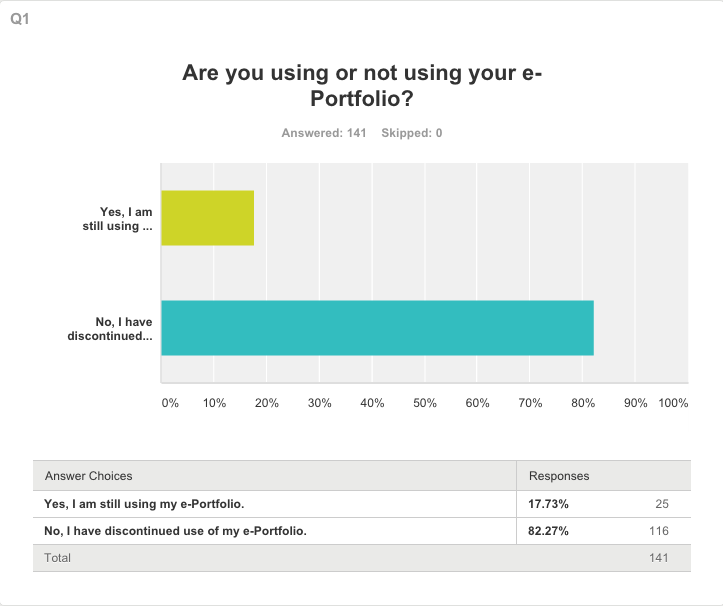
The survey revealed that only 18% of the participants continued to use their eportfolios while 82% stopped using their eportfolios after the completion of their program of study. These results confirmed earlier anecdotal evidence that many students stop using their eportfolios when not required to do so for a course.
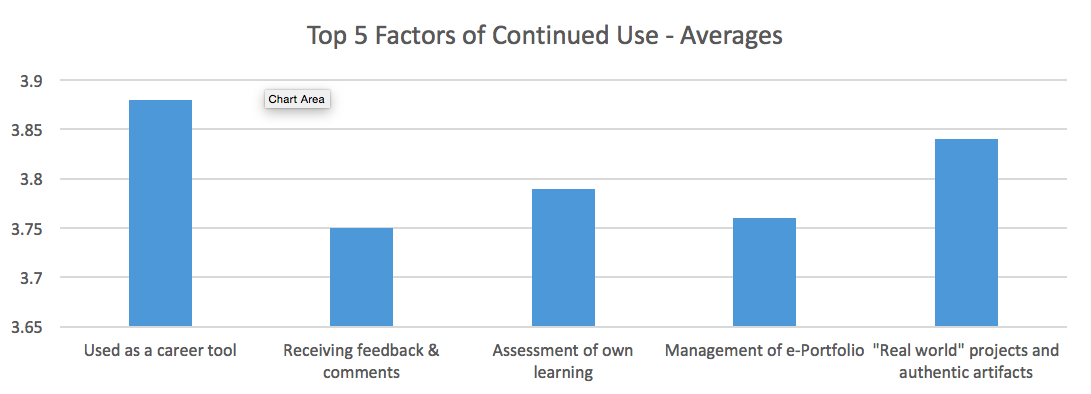
The survey also revealed that use of the eportfolio as a career tool, the use of authentic projects, control over assessment of their learning and the management of the eportfolio were the most significant factors that contributed to the continued use of the eportfolio.
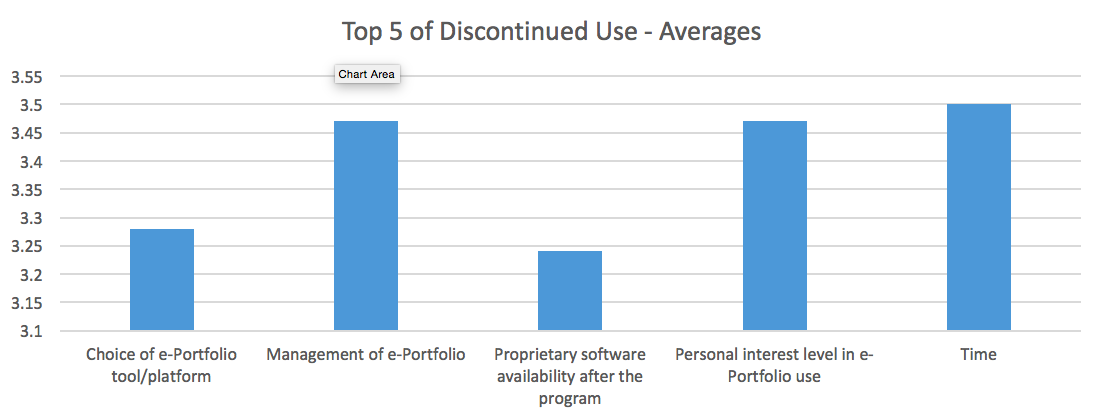
The primary factors for why students stopped using an eportfolio was the lack of time followed very closely by a lack of interest in eportfolios and lack of management over the eportfolio process.
Several follow up focus groups were conducted to gain additional insight into the continued or dis-continued use of the eportfolio and see if any additional factors not listed in the survey had impact the students continued or dis-continued use. One focus group participant in the research project confirmed why time is such a significant factor by stating:
“All your time is spent just keeping your head above water; there is no time to think about the benefits of an eportfolio or how to build and structure your eportfolio for use for anything more than document storage”.
For many of the students in the new Masters of Digital Learning and Leading program (DLL) at Lamar University coming out of the first course in the program EDLD 5302 Concepts of Educational Technology this frustration with a lack of time is also a reality. We have often seen students struggle with just learning how to learn to use new technology and concepts so getting the weekly assignments completed and simply dropping an evidence of learning into their eportfolio container is often the most students have been able to accomplish with limited time.
Our initial research findings and original assumptions suggest that if we gave our DLL students enough time and the appropriate environment to experiment with their eportfolio then we should see continued use of the eportfolio. Since the DLL program is new we won’t have our first graduates for the next 18 months, we have some time to wait to officially confirm our assumptions.
The eportfolio is a fundamental component of the DLL program and each course has been designed to utilize authentic projects and the eportfolio to showcase student’s work. EDLD 5303 Applying Educational Technology: Eportfolio is the second course in the DLL which is structured specifically to give students the time to focus completely on and experiment with the eportfolio. The evidence of learning accumulated in EDLD 5302 or through Microsoft Teaching with Technology, Google Educator, or the Apple Distinguished Educator programs can now be shaped and moulded into a well organized and cohesive format to genuinely convey a message beyond basic technology skills competence. In EDLD 5303 students are given the opportunity to move beyond dropping assignments into a digital container and are encouraged to start to consider and show how they plan to use technology to enhance their own learning and their learning environments.
To help shape student’s thinking on eportfolios and to start them on the journey of continuous reflection and revision of their work in EDLD 5303 we ask students to explore the following:
- Getting Started Tips
- The Minimalist Fundamentals of Eportfolios
- What is an Eportfolio
- Who Owns the Eportfolio
- Why Use an Eportfolio
- Example of Eportfolios
- How to Create an Eportfolio
Though this process of working through these ideas in their own eportfolios students will gain an appreciation for the value of the eportfolio as a deeper learning tool.
Next to a lack of time the lack of an appreciation of the value of the eportfolio was another major contributing factor for students who stopped using eportfolios beyond the course of study. Through the use of authentic assessment in all DLL courses and the ability to work on projects that will have a direct impact in the students own learning environment the DLL program gives students choice, ownership, voice and authenticity (COVA) that our research findings have initially confirmed are the key factors in encouraging students to continue using their eportfolios beyond their programs of study.
We are confident that this eportfolio experience started in EDLD 5303 and continued throughout all other DLL courses will provide a solid learning foundation for the DLL M.Ed and for the continued use of the eportfolio beyond this program. If you really want to students to learn deeply and build a foundation for learning how to learn then you need to give students:
- The freedom to choose how they wish to organize, structure and present their experiences and evidences of learning
- Ownership over the entire eportfolio process – including selection of projects and their portfolio tools
- The opportunity to use their own voice to revise and restructure their work and ideas.
- The opportunity to prepare their eportfolio platform for all the authentic learning assignments that they will experience in the remainder of the DLL program.
We are also confident that the DLL program will prepare students for the challenges of the future and shape them into the digital leaders that we need to move our educational systems forward.
Our research into this area is really just beginning while we are continuing to examine the data and will be publishing the full results shortly, we are also exploring relationships with other institutions who have used eportfolios in their programs to replicate our research in different settings to further confirm our findings.
References
Buchem, I., Tur, G., Hoelterhof, T., Rahimi, E., van den Berg, J., Veen, W., … & Aresta, M. (2014). Learner control in Personal Learning Environments: A cross-cultural study. Learning and Diversity in the Cities of the Future, 13.
Campbell, G. (2009). A Personal Cyberinfrastructure. EDUCAUSE Review, 44(5), 58–59.
Catalyst for Learning Eportfolio Resources and Research (n.d.). Pedagogy. Retrieved from http://c2l.mcnrc.org/pedagogy/
Lindgren, R., & McDaniel, R. (2012). Transforming Online Learning through Narrative and Student Agency. Educational Technology & Society, 15 (4), 344–355.
Pink, D. H. (2011). Drive: The surprising truth about what motivates us. Penguin.
Chicago
Qauglia, R. (n.d.). Quaglia Institute Framework. Retrieved September 8, 2015, from http://www.qisa.org/framework/
Rikard, A. (2015). Do I Own My Domain If You Grade It? (EdSurge News). Retrieved September 8, 2015, from https://www.edsurge.com/news/2015-08-10-do-i-own-my-domain-if-you-grade-it
Watters, A. (2015, July 15). The Web We Need to Give Students. Retrieved September 10, 2015, from https://medium.com/bright/the-web-we-need-to-give-students-311d97713713
If you just finished EDLD 5302 and are wondering what is the best way to approach EDLD 5303 then you will appreciate this post.
In our research into why students either continue to use or stop using an eportfolio after a program of study the number one factor for why students stopped using an eportfolio was the lack of time.

In addition to the survey results one of our focus group participants stated:
“All your time is spent just keeping your head above water there is no time to think about the benefits of an eportfolio or how to build and structure your eportfolio for use for anything more than document storage”
For many of the students in Masters of Digital Learning and Leading program at Lamar University coming out of the first course in the program EDLD 5302 Concepts of Educational Technology this sentiment is true. We have often seen students struggle with getting the weekly assignments completed and simply dropping an evidence of learning into their eportfolio container is what most students have been able to accomplish.
EDLD 5303 is structured to give students the time to focus completely on the eportfolio, to experiment with blogging tools and methods, and to work on their eportfolio without having to do additional course work?
The evidence of learning accumulated in EDLD 5302 can now be shaped and moulded into a well organized and cohesive format to genuinely convey a message beyond basic technology skills competence. In EDLD 5303 students are given the opportunity to move beyond dropping assignments into a digital container and are encouraged to start to consider and show how they plan to use technology to enhance their own learning and their learning environments.
This theory and background is all great but what is the best way to proceed through EDLD 5303?
We recommend that students:
- Explore and incorporate the ideas from the following and related links:
- Take the time to revise and better organize and preset your EDLD 5302 coursework. Chances are you received significant feedback that you would like to act on and also wished you had more time to do a better job on your assignments. You now have the time to do this.
- Review your eportfolio platform and consider if it is robust enough to support you through the remaining 10 courses in the DLL program and for many years to come. For example, in EDLD 5305 you will be required to have students comment on your work. Getting comments working in Google Sites can be challenging so if you were to switch to a different platform this would be a wonderful time. Consider the recommendations in How to Create an Eportfolio. If you are not using WordPress or a similarly robust blogging platform you should consider the switch before you have so much content that the switch becomes much more difficult.
- Review and improve your navigation and organizational structure. Even though we all rely heavily on search engines a well organized and comprehensive navigation structure can go a long way to making it easy for your user to access information on your site. Have other people use your site and share how easy or difficult it is to navigate. If you are using WordPress you should start to build a good “Categories” structure which will help you to organize your site was you continue to add more content.
- As the bare minimum you should include the following sections on your site:
- About/Bio
- Main Interest (on my blog you will see Learning, Courses, CSLE, Eportfolio, Book list etc.)
- Projects
- Categories
- Archives
- Links
- Social Media connections
- Contact
- Start using your eportfolio for more than just your course work and start posting about your learning experiences.
- Enjoy the learning experience!


