Archives For Learning
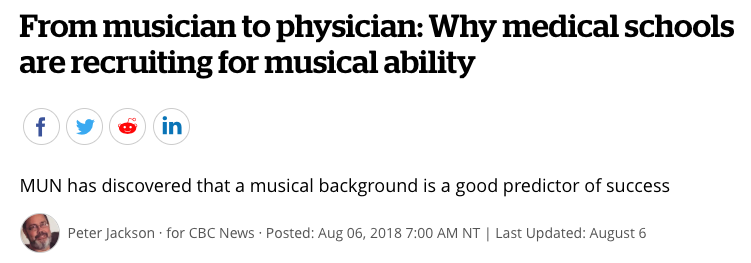
A recent CBC news post reveals that Memorial University of Newfoundland (MUN), as well as other Canadian universities, have discovered that a musical background is a good predictor of success for medical students. Why? Constant, continual improvement is central to being a musician and this skill is crucial and transferable for future physicians. The study of music helps the learner to:
- Avoid complacency
- Constantly reassess what you are doing
- Reflect on how to continually get better
Doctors have to continually reflect on how they can improve and continually get better especially if they are surgeons.
This post also confirms the research on deliberate practice by Anders Ericsson. According to Ericsson (2016), deliberate practice is much different than traditional practice because instead of just doing the same thing over and over again the learner focuses on the continual pursuit of personal improvement that is directed by well-defined, specific goals and continuous feedback that drives incremental gains. A skill or ability that a person is working towards is broken down into small enough components where feedback on the performance is used to help the learner make small adjustments that will lead to incremental improvements. The feedback can come from a teacher, mentor, or coach who observes where the adjustments need to be made. The continuous feedback can also come from peers, video, timing devices and other technologies that can provide the learner data that helps map their progress. As the learner gains experience and expertise they can also are able to see where they need to make the adjustments themselves—this is one of the key differences between amateurs and experts.
Another key aspect of deliberate pracitices is that the learner must constantly practices outside their comfort zone. Just far enough to push the boundries but not so far to cause fear and immeidate failure. This is where a few percentage points of pushing the boundry can cointribute the continous incremental gains that are so important to improvement. These incrimetnal gains can add up over time to enable one become an expert. Ericsson’s research into how long it takes one to become an expert was miscontrued and popularized by Malcom Gladwell in his 2008 book Outliers: The Story of Success where he posited the10,000-Hour Rule. Gladwell suggested that the key to achieving world-class expertise in any skill simply practicing the correct way, for a total of around 10,000 hours. Ericsson refuted Gladwell’s claims and pointed out that in some disciplines expertise can be achieved in as short as 5,000 hours and in other,s true expertise is achieved in over 20,000 hours. Furthermore, attaining the level of expertise is only the beginning because the world’s best continue their discipline of deliterate practice throughout their tenure of being at the top of their field. Regardless of how much time is conmitted, the key is deliberate practices with continual feedback that leads toward incremental gains.
Getting back to the story about musicians becoming good physicians because of their ability continually improve it is important for us to understand as educators are that there has to be a purpose for one to commit years of deliberate practice. Whether it is to become a Chessmaster, a world-class musician, a world-class athlete or to be the leader in a particular field the drive toward this end goal only happens if the goal is real world or authentic.
It takes real world or authentic learning opportunities to provide the context for learning and to drive the intrinsic motivation for the learner to persist in making those continuous incremental improvements over time. This is why it is so important as educators to recognize we must not only prepare our learners for the test but we need to prepare them for life. We can do so by creating a significant learning environment in which we give our learners choice ownership, and voice through authentic learning opportunities – the CLSE+COVA framework.
We need to continually ask – are we preparing them for the test or are we preparing them for life.
Additional posts exploring deliberate practice:
References
Ericsson, A., & Pool, R. (2016). Peak: Secrets from the new science of expertise. New York, NY: Eamon Dolan/Houghton Mifflin Harcourt.
Gladwell, M. (2008). Outliers: The story of success. New York: Little, Brown and Co.

Which is better taking notes by handwriting or by typing? Like all research, the answer is in the details and the interpretation, not just the initial results.
The Mueller/Oppenhiemer study The Pen Is Mightier Than the Keyboard Advantages of Longhand Over Laptop Note Taking revealed that since students can type much faster than they can write there is a tendency for students to mindlessly transcribe large volumes of notes. In contrast, with handwritten notes, a student must focus more on the concepts than on the transcription. The authors pointed to additional research in their literature review suggested summarization and conceptualization resulting from handwriting notes added in retention and deeper understanding.
The authors also speculated as did many other bloggers who reposted the summary results that if one could combine the efficiency of typing with the conceptualization of handwriting that taking notes with a laptop or tablet could contribute equally to memory retention. This is a key point of this debate–Rather then just mindlessly type and record the information being transferred if the typist were to apply the same method of summarization and conceptualization that happens with handwriting notes then typing notes would be even more effective and efficient.
While being more efficient with the passive information transfer required from your typical lecture is helpful in dealing with those situations where one has no choice but to take in a lecture, if we are really concerned with deeper learning then we would provide an alternative to the typical lecture. Since the lecture is still the primary mode of information transfer in secondary and post-secondary education this will continue to be an ongoing issue.
While I have no reason to doubt the Mueller/Oppenhiemer study that is currently popular in the traditional media and blogosphere I am always hesitant to trust the “most popular” opinion and I explored further to see if there were any additional studies that provided an alternative perspective. A recent undergraduate research project by Ian Schoen of Pitzer College that directly compared typing notes and handwriting notes in both the lecture and textbook study. In his senior thesis Effects of Method and Context of Note-taking on Memory: Handwriting versus Typing in Lecture and Textbook-Reading Contexts Schoen found that although the survey participants preferred taking notes by hand, his research revealed that typing notes in a lecture produced slightly higher retention scores.
Article Abstract:
Both electronic note-taking (typing) and traditional note-taking (handwriting) are being utilized by college students to retain information. The effects of the method of note-taking and note-taking context were examined to determine if handwriting or typing notes and whether a lecture context or a textbook-reading context influenced retention. Pitzer College and Scripps College students were assigned to either handwrite or type notes on a piece of academic material presented in either a lecture or textbook context and were given a test to assess their retention. The results demonstrated that there was a significant main effect for typing notes such that typing notes produced higher retention scores than handwriting notes. The results also indicated that there was an interaction between the method of note-taking and context such that the lowest scores were achieved in the condition in which participants hand0-wrote notes during a lecture. In total, these findings suggest that typing as a method of note-taking may be an influential factor in memory retention, particularly in a lecture context.
If the goal is to retain information from a lecture or other form of information transfer, then taking notes is better than not taking notes is the one fact consistent in all the research on this topic. It is also clear that much more research will need to be conducted to provide a more definitive answer on this issue. Until all the research is in, one’s personal preference should also play a significant role in deciding just how to take notes.
The other key factor in this debate is that you can’t just blindly trust NPR, Scientific America, popular educational websites or other traditional news sources you have to go back to the primary sources to really see what the research points to and how it has been interpreted. Upon closer reading of the research, one could argue if used properly the typing notes on your laptop could be more effective then handwriting–assuming the note take applies the same summarization and conceptualization skills that are required due to the lesser speed of handwriting.
Reference
Mueller, P. A., & Oppenheimer, D. M. (2014). The Pen Is Mightier Than the Keyboard Advantages of Longhand Over Laptop Note Taking. Psychological Science, 25(6), 1159–1168. https://doi.org/10.1177/0956797614524581
Schoen, I. (2012). Effects of method and context of note-taking on memory: Handwriting versus typing in lecture and textbook-reading contexts (Pitzer Senior Theses). Pitzer College. Retrieved from http://scholarship.claremont.edu/pitzer_theses/20/
Outside the field of behaviorism, Chomsky’s paper is considered to be a classic, and is cited as final evidence of the inadequacy of behaviorism as a general framework for animal behavior and human affairs (Virués-Ortega, 2006 p. 243).
As you will see in the Noam Chomsky Behaviorism video and read in the articles linked below even though behaviorism has been shown to be inadequate it not only persists to this day it still dominates educational practice. Most recently we have seen a resurgence of behaviorism in the form of personalized learning, or “competency-based education,” which Diane Ravitch (2018) argues are are both euphemisms for computer adaptive instruction.
Norm Freiesn (2018) argues that educations primary purpose has always been to help children to gradually become free and responsible adults who will contribute to everyday life in our civil society. The reliance on computer algorithms to control the education process moves it away from its essence as a human activity. Ironically the label of “personalized learning” is used even though computer-aided instruction depersonalizes and reduces the process of learning to that of matching curricular competency with workforce placement. Personalized learning is really about the meaningful connections that are made with teachers, peers, and the significant learning experiences that are made possible by giving learners choice, ownership, and voice through authentic learning opportunities.
The following warning from Paul Emerich (2018) a former Silicon Valley personalized learning expert emphasizes the human dimension of genuine personalized learning:
We must walk away from this hyper-individualized brand of personalized learning. We must walk away from its reductionism, assuming that education is simply an arrangement of individualized playlist cards or isolated experiences. We must run from the idea that technology is necessary to make the classroom a more personal and humanized place, because what personalizes the classroom is not fancy technology and big data: truly knowing children is what personalizes and humanizes a modern classroom.
References
Chomsky N. Review of B. F. Skinner, Verbal Behavior. Language. 1959;35:26–58. Retrieved from https://chomsky.info/1967____/
Chomsky N. Review of B.F. Skinner’s Beyond Freedom and Dignity. The New York Review of Books. 1971 Dec 30;17:18–24. Retrieved from http://www.nybooks.com/articles/1971/12/30/the-case-against-bf-skinner/
Emerich, P. (2018, January 16). Why I left Silicon Valley, edTech, and “personalized” learning [Blog]. Retrieved June 22, 2018, from https://paulemerich.com/2018/01/15/why-i-left-silicon-valley-edtech-and-personalized-learning/
Friesen, N. (2018). Personalized learning technology and the new behaviorism: Beyond freedom and dignity. Retrieved from https://www.academia.edu/36112036/Personalized_Learning_Technology_and_the_New_Behaviorism_Beyond_Freedom_and_Dignity.docx
Ravitch, D. (2017, December 29). 5 risks posed by the increasing misuse of technology in schools [Blog]. Retrieved June 22, 2018, from https://www.edsurge.com/news/2017-12-29-5-risks-posed-by-the-increasing-misuse-of-technology-in-schools
Skinner, F.B. (1965).Science and Human Behavior. New York: The Free Press.
Skinner, B.F. (1971). Beyond Freedom and Dignity. New York: Bantam/Vintage
Virués-Ortega, J. (2006). The Case Against B. F. Skinner 45 years Later: An Encounter with N. Chomsky. The Behavior Analyst, 29(2), 243–251. Retrieved from https://www.researchgate.net/publication/223960274_The_Case_Against_B_F_Skinner_45_years_Later_An_Encounter_with_N_Chomsky
Watters, A. (2017, December 23). Education technology and the new behaviorism. Retrieved June 22, 2018, from http://hackeducation.com/2017/12/23/top-ed-tech-trends-social-emotional-learning


