
Original Source: The Ambassador Blog
Creating Significant Learning Environments
The following two video outline how the World’s Number One Beverage retailer plans to remain in the position and to grow. The key is content.
Coca-Cola Content 2020 Part One
Coca-Cola Content 2020 Part Two
Understandably Coke has the funds and focus to pay people like Jonathan Mildenhall but any organization with any sort of marketing budget can learn from the focus of Midlenhall and get clear on the content that is fundamental to that organization. Ironically the historical purveyors of content, Education aren’t nearly as clear on why they do what they do as a soft drink company. I wonder Why not?

Sir Ken Robinson confirms that the learning revolution has already begun and if we have any involvement with students we can make a difference:
The education system for any given student is the school or classroom they go to… If you are a teacher you are the education system for those kids. So you can change the world of education for those kids immediately if you choose to. If enough of us do that, that adds up to social movement and that is what revolutions is.
Are you doing your part?
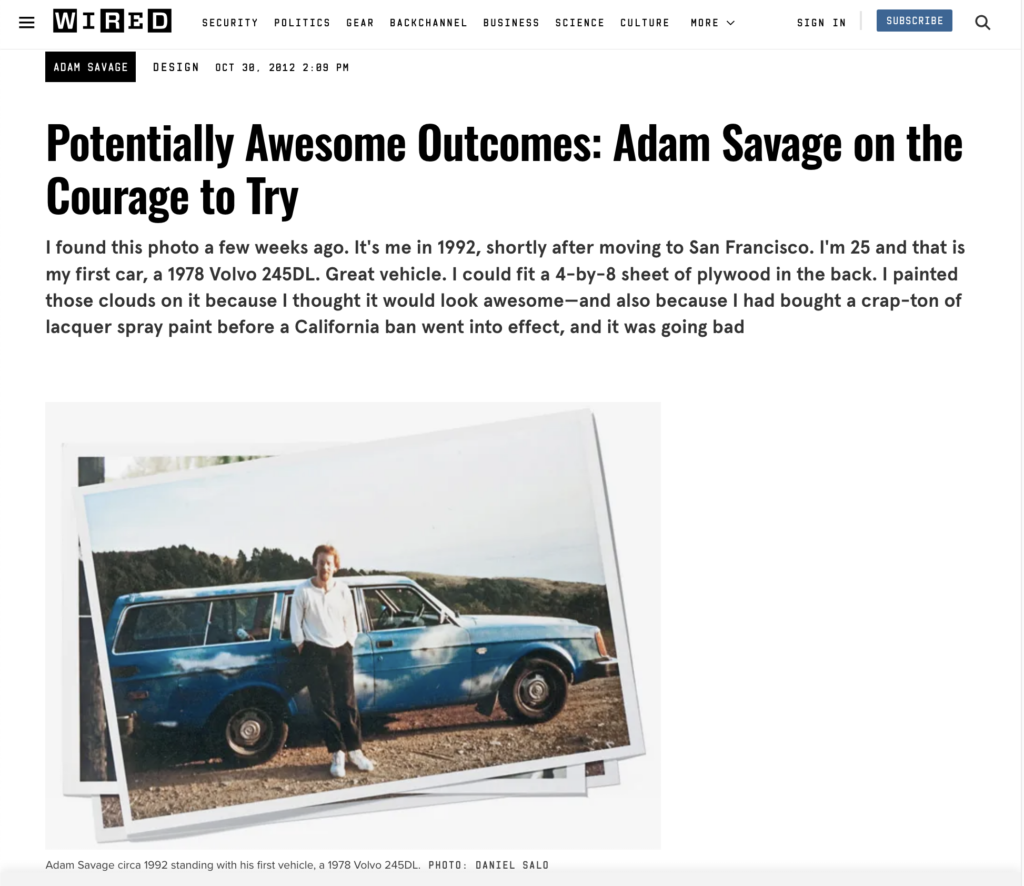
Source: https://www.wired.com/2012/10/ft-savage-first-car/
Adam Savage of Mythbusters fame relays his experience in learning how to parse complex systems which is a skill that he has used professionally ever since. Savage explains:
Every repair followed the same progression: (1) I don’t know how, (2) I can’t afford to pay someone else to do it, (3) I have to do it, (4) hey, that wasn’t so hard!
One of my teenage sons’ favorite shows is Mythbusters and while they may not yet appreciate the similarities they too have been learning how to deal with complex challenges. In the post I relayed the my son’s experience in diagnosing, disassembling and repairing a broken van door. Savage reminds us of the power that comes from solving these sorts of complex problems:
there’s a huge difference between not understanding something and not understanding it yet
Unfortunately, not enough people have the courage to try even the simplest of tasks. The following anecdotal story reveals just how pervasive this may be. My wife broke a windshield wiper the other day and went to local Canadian Tire for a replacement. At the check out the clerk asked if my wife would like a bag and my wife responded that a bag would not be necessary because our youngest son, Caleb, was going to immediately install the wiper–which he left to do. The clerks response was surprise and then turned to encouragement. She told my wife that most people had the shop install wipers even though they often had to wait a long time. The clerk went onto praise my wife that we had given our son a wonderful gift in teaching him how to do these sorts of things.
While I appreciate the kind words, I am also saddened and concerned by this experience. Replacing a windshield wiper is not even a task that my boys, or I, would consider complex–it is just something we all have to do. Teaching my children how to deal with complex systems and to solve problems shouldn’t be considered a gift–it is my responsibility as a parent. If I want my boys to grow into men of character who can positively contribute to society, they must not only learn how to solve ever day complex problems, they also need the courage and confidence to be able to tackle future problems that currently do not exist.
Are we as parents, schools and society doing enough to prepare our children to solve the complex problems that face society and the world?

Mary Meeker Gives Mid-Year Internet Trends Report: Android Adoption Ramping Up 6X Faster Than iPhone | TechCrunch via kwout
Mary Meeker of KPCB who is best known for her Internet Trends Report provided a mid year update to a select group of industry leaders and confirmed that mobile adoption is growing even more rapidly than she or anyone else has predicted. Meeker points to the following increased growth:
… iPad adoption is now ramping up five times faster than iPhone adoption, up from 3X in her May report…Android adoption is increasing six times faster than iPhone adoption, up from 4X.
Perhaps the most significant number and Meeker points to is:
…by the end of Q2 2013, Meeker believes the global smartphone plus tablet install base will surpass the install base of the PC.
In less than 5 years smartphones and tablets have surpassed the installed base of PCs. The notion of accessing the world’s information all the time and from everywhere is no longer a futuristic prediction. We are living this. We have been living this for several years and industries like Education are being disrupted in the same way that music, newspapers and video/dvd distribution have been disrupted.
Is Higher Education doing enough to respond to this disruption? Are faculty and administrator and schools at all levels preparing our students for a world that is changing so rapidly?


